MCQ
If the sun and the planets carried huge amounts of opposite charges,
  • A
    All three of Kepler’s laws would still be valid.
  • B
    The first law will still be valid.
  • C
    The second law will not change.
  • All of the above

Answer

Correct option: D.
All of the above
Due to opposite charges the attractive electrostatic forces of attraction produced will be large, along with the gravitational forces. Both the forces will be added and would be radial in nature. Since both the forces are central forces and obey the inverse square law, all the three kepler's laws will be valid.

Need a full question paper?

Generate a complete, print-ready paper with questions like this in minutes — across 16+ boards, with answer keys.
Start Generating Free

Similar questions

A particle has an initial velocity of ($3\hat i + 4\hat j)\;ms^{-1}$ and an acceleration of $(0.4\hat i + 0.3\hat j)\;ms^{-1}$ Its speed after $10\;s$ is:
Gravitational acceleration on the surface of a planet is $\frac{\sqrt{6}}{11} \mathrm{~g}$, where $\mathrm{g}$ is the gravitational acceleration on the surface of the earth. The average mass density of the planet is $\frac{2}{3}$ times that of the earth. If the escape speed on the surface of the earth is taken to be $11 \ \mathrm{kms}^{-1}$, the escape speed on the surface of the planet in $\mathrm{kms}^{-1}$ will be
A projectile is fired from the surface of the earth with a velocity of $5\, ms^{-1}$ and angle $\theta$ with the horizontal. Another projectile fired from another planet with a velocity of $3\, ms^{-1}$ at the same angle follows a trajectory which is identical with the trajectory of the projectile fired from the earth. The value of the acceleration due to gravity on the planet is (in $ms^{-2}$) is (given $g = 9.8\, m/s^2$)
A cricketer can throw a ball to maximum horizontal distance of $100\,m$ . With the same speed how much high above the ground can the cricketer throw the same ball   ......... $m$
The area of a square is $5.29\, cm^2$. The area of $7$ such squares taking into account the significant figures is  ........... $cm^2$
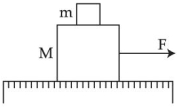
A system of two blocks of masses $m =2 \; kg$ and $M=8 \; kg$ is placed on a smooth table as shown in figure. The coefficient of static friction between two blocks is $0.5$. The maximum horizontal force $F$ that can be applied to the block of mass $M$ so that the blocks move together will be $\dots \; N$
A flywheel rotates about an axis. Due to friction at the axis, it experiences an angular retardation proportional to its angular velocity. If its angular velocity falls to half while it makes $n$ rotations, how many more rotations will it make before coming to rest?
A simple pendulum, suspended from the ceiling of a stationary van, has time period $T$. If the van starts moving with a uniform velocity the period of the pendulum will be
The gravitational force between two stones of mass $1\, kg $ each separated by a distance of $1 \,metre$ in vacuum is
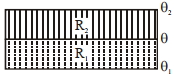
The temperature $\theta$ at the junction of two insulating sheets, having thermal resistances $R _{1}$ and $R _{2}$ as well as top and bottom temperatures $\theta_{1}$ and $\theta_{2}$ (as shown in figure) is given by