Question
If the telescope is reversed i.e. seen from the objective side

Answer

(a) Because magnification in this case becomes reciprocal of initial magnification.

Need a full question paper?

Generate a complete, print-ready paper with questions like this in minutes — across 16+ boards, with answer keys.
Start Generating Free

Similar questions

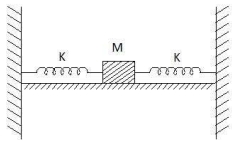
In the figure given below. a block of mass $M =490\,g$ placed on a frictionless table is connected with two springs having same spring constant $\left( K =2 N m ^{-1}\right)$. If the block is horizontally displaced through ' $X$ 'm then the number of complete oscillations it will make in $14 \pi$ seconds will be $.........$
The electron emitted in beta radiation originates from
A cell of e.m.f. $E$ is connected with an external resistance $R$, then p.d. across cell is $V$. The internal resistance of cell will be
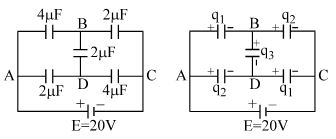
The value of charge $q_1, q_2$ and $q_3$ as shown in the figure are
A projectile is fired from horizontal ground with speed $v$ and projection angle $\theta$. When the acceleration due to gravity is $g$, the range of the projectile is $d$. If at the highest point in its trajectory, the projectile enters a different region where the effective acceleration due to gravity is $g^{\prime}=\frac{g}{0.81}$, then the new range is $d^{\prime}=n d$. The value of $n$ is. . . . .
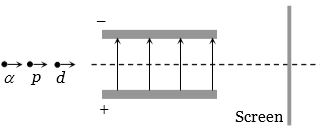
A proton, a deutron and an $\alpha$-particle having the same momentum, enters a region of uniform electric field between the parallel plates of a capacitor. The electric field is perpendicular to the initial path of the particles. Then the ratio of deflections suffered by them is
A $2\,kg$ block slides on a horizontal floor with a speed of $4\, m/s$. It strikes a  uncompressed spring, and compresses it till the block is motionless. The kinetic friction  force is $110\,N$ and spring constant is $1000\, N/m$. The spring compresses by ........ $cm$
If the angular momentum of a rotating body is increased by $200\ \%$, then its kinetic energy of rotation will be increased by .......... $\%$
Unit mass of a liquid with volume ${V_1}$ is completely changed into a gas of volume ${V_2}$ at a constant external pressure $P$ and temperature $T.$ If the latent heat of evaporation for the given mass is $L,$ then the increase in the internal energy of the system is
A particle moves in a circular path of radius $r$ with speed $v.$ It then increases its speed to $2\,v$ while travelling along the same circular path. The centripetal acceleration of the particle has changed by a factor of