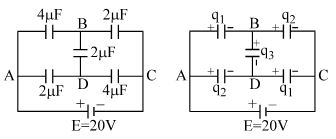
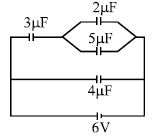
The value of charge $q_1, q_2$ and $q_3$ as shown in the figure are
Diffcult


Download our appand get started for free
Experience the future of education. Simply download our apps or reach out to us for more information. Let's shape the future of learning together!No signup needed.*
Similar Questions
- 1A charged particle $q$ is shot towards another charged particle $Q$ which is fixed, with a speed $v$. It approaches $Q$ upto a closest distance $r$ and then returns. If $q$ were given a speed $2v$, the closest distances of approach would beView Solution

- 2A parallel plate condenser has a capacitance $50\,\mu F$ in air and $110\,\mu F$ when immersed in an oil. The dielectric constant $'k'$ of the oil isView Solution
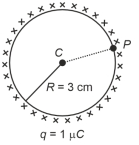
- 3A thin spherical shell is charged by some source. The potential difference between the two points $C$ and $P$ (in $V$) shown in the figure is:View Solution
(Take $\frac{1}{4 \pi \varepsilon_0}=9 \times 10^9$ $SI$ units)
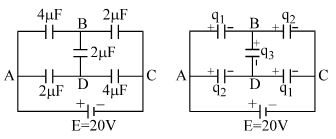
- 4The value of charge $q_1, q_2$ and $q_3$ as shown in the figure areView Solution
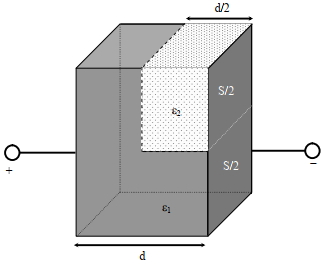
- 5A parallel plate capacitor having plates of area $S$ and plate separation $d$, has capacitance $C _1$ in air. When two dielectrics of different relative permittivities $\left(\varepsilon_1=2\right.$ and $\left.\varepsilon_2=4\right)$ are introduced between the two plates as shown in the figure, the capacitance becomes $C _2$. The ratio $\frac{ C _2}{ C _1}$ isView Solution
- 6Four identical charges $ + \,50\,\mu C$ each are placed, one at each corner of a square of side $2\,m$. How much external energy is required to bring another charge of $ + \,50\,\mu C$ from infinity to the centre of the square......$J$ $\left( {{\rm{Given}}\frac{{\rm{1}}}{{{\rm{4}}\pi {\varepsilon _{\rm{0}}}}} = 9 \times {{10}^9}\,\frac{{N{m^2}}}{{{C^2}}}} \right)$View Solution
- 7In the circuit shown in figure, the ratio of charges on $5\ \mu F$ and $4\ \mu F$ capacitor is :View Solution
- 8An alpha particle is accelerated through a potential difference of ${10^6}\,volt$. Its kinetic energy will be......$MeV$View Solution
- 9A point charge of magnitude $+ 1\,\mu C$ is fixed at $(0, 0, 0) $. An isolated uncharged spherical conductor, is fixed with its center at $(4, 0, 0).$ The potential and the induced electric field at the centre of the sphere isView Solution
- 10A capacitor with capacitance $5\,\mu F$ is charged to $5\,\mu C.$ If the plates are pulled apart to reduce the capacitance to $2\,\mu F,$ how much work is done?View Solution