If the temperature of the body is increased by $10\% $ , the percentage increase in the emitted radiation will be ....... $\%$
Medium


Download our appand get started for free
Experience the future of education. Simply download our apps or reach out to us for more information. Let's shape the future of learning together!No signup needed.*
Similar Questions
- 1A slab consists of two parallel layers of copper and brass of the same thickness and having thermal conductivities in the ratio $1 : 4$ . If the free face of brass is at ${100^o}C$ and that of copper at $0^\circ C $, the temperature of interface is ........ $^oC$View Solution
- 2Suppose the sun expands so that its radius becomes $100$ times its present radius and its surface temperature becomes half of its present value. The total energy emitted by it then will increase by a factor ofView Solution
- 3A planet of radius $R_{p}$ is revolving around a star of radius $R^{*}$, which is at temperature $T^{*}$. The distance between the star and the planet is $d$. If the planet's temperature is $f T^{*}$, then $f$ is proportional toView Solution
- 4Two rods of same material have same length and area. The heat $\Delta Q$ flows through them for $12\,minutes$ when they are jointed in series. If now both the rods are joined in parallel, then the same amount of heat $\Delta Q$ will flow in ........ $\min$View Solution
- 5Heat is flowing through two cylindrical rods of the same material. The diameters of the rods are in the ratio $1 : 2$ and their lengths are in the ratio $2 : 1$. If the temperature difference between their ends is the same, then the ratio of the amounts of heat conducted through per unit time will beView Solution
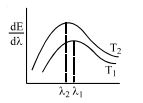
- 6The spectral emissive power $E_\lambda $ for a body at temperature $T_1$ is plotted against the wavelength and area under the curve is found to be $A$. At a different temperature $T_2$ the area is found to be $9A$. Then $\lambda _1/\lambda _2 =$View Solution
- 7View SolutionA solid cube and a solid sphere of identical material and equal masses are heated to the same temperature and left to cool in the same surroundings. Then,
- 8A body cools from a temperature $3T$ to $2T$ in $10$ minutes. The room temperature is $T.$ Assume that Newton's law of cooling is applicable. The temperature of the body at the end of next $10$ minutes will beView Solution
- 9View SolutionThe velocity of heat radiation in vacuum is
- 10Two metal rods $1$ and $2$ of same lengths have same temperature difference between their ends. Their thermal conductivities are $K_1$ and $K_2$ and cross sectional areas $A_1$ and $A_2$ , respectively. If the rate of heat conduction in $1$ is four times that in $2$, thenView Solution