- A$\left[h^{\frac{1}{2}} c^{-\frac{1}{2}} G^1\right]$
- B$\left[ h ^1 c ^1 G ^{-1}\right]$
- C$\left[ h ^{-\frac{1}{2}} c ^{\frac{1}{2}} G ^{\frac{1}{2}}\right]$
- ✓$\left[h^{\frac{1}{2}} c^{\frac{1}{2}} G ^{-\frac{1}{2}}\right]$
$M ^1=\left( ML ^2 T ^{-1}\right)^{ x }\left( LT ^{-1}\right)\left( M ^{-1} L ^3 T ^{-2}\right)^Z$
$M ^1 L ^0 T ^0= M ^{ x - z } L ^{2 x + y +3 z} T ^{- x - y -2 z}$
on comparing both side
$x-z=1$
$2 x+y+3 z=0$
$-x-y-2 z=0$
On solving above equations we get
$x=\frac{1}{2} \quad y=\frac{1}{2} \quad z=\frac{-1}{2}$
Generate a complete, print-ready paper with questions like this in minutes — across 16+ boards, with answer keys.
| $A (mm \,\,s^{-2}$) |
$16$ |
$8$ |
$0$ |
$- 8$ |
$- 16$ |
|
$x\;(mm)$ |
$- 4$ |
$- 2$ |
$0$ |
$2$ |
$4$ |

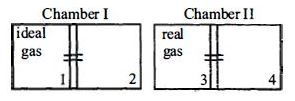
Statement $-1$ : No change in the temperature of the gas takes place when ideal gas expands in vacuum. However, the temperature of real gas goes down (cooling) when it expands in vacuum
Statement $-2$ : The internal energy of an ideal gas is only kinetic. The internal energy of a real gas is kinetic as well as potential