Question
If there is a statement involving the natural number n such that:
  1. The statement is true for $n = 1$
  2. When the statement is true for $n = k ($where $k$ is some positive integer$),$ then the statement is also true for $n = k + 1.$
Then, the statement is true for all natural numbers n.
Also, if $A$ is a square matrix of order n, then $A^2$ is defined as $AA$. In general, $A^m = AA .... A (m$ times$)$. where m is any positive integer.
Based on the above information, answer the following questions.
  1. If $\text{A}=\begin{bmatrix}3&-4\\1&-1\end{bmatrix},$ then for any positive integer n,
  1. $\text{A}^\text{n}=\begin{bmatrix}3\text{n}&-4\text{n}\\\text{n}&-\text{n}\end{bmatrix}$
  2. $\text{A}^\text{n}=\begin{bmatrix}1+2\text{n}&-4\text{n}\\\text{n}&1-2\text{n}\end{bmatrix}$
  3. $\text{A}^\text{n}=\begin{bmatrix}3\text{n}&-8\text{n}\\1&-\text{n}\end{bmatrix}$
  4. $\text{A}^\text{n}=\begin{bmatrix}1+3\text{n}&-4\text{n}\\\text{n}&1-3\text{n}\end{bmatrix}$
  1. If $\text{A}=\begin{bmatrix}1&2\\0&1\end{bmatrix},$ then $|A^n|$, where $\text{n}\in\text{ N},$ is equal to:
  1. $2^n$
  2. $3^n$
  3. $n$
  4. $1$
  1. If $\text{A}=\begin{bmatrix}1&0\\1&1\end{bmatrix}$ and $\text{I}=\begin{bmatrix}1&0\\0&1\end{bmatrix}$ then which of the following holds for all natural numbers $\text{n}\geq1?$
  1. $A^n= nA - (n - 1)I$
  2. $A^n = 2^{n-1} A - (n - 1)I$
  3. $A^n= nA + (n - 1)I$
  4. $A^n = 2^{n-1} A + (n - 1)I$
  1. Let $\text{A}=\begin{bmatrix}\text{a}&0&0\\0&\text{a}&0\\0&0&\text{a}\end{bmatrix}$ and $\text{A}^\text{n}=[\text{a}_{\text{ij}}]_{3\times3}$ for some positive integer n, then the cofactor of $a_{13}$ is:
  1. $a^n$
  2. $-a^n$
  3. $2a^n$
  4. $0$
  1. If $A$ is a square matrix such that $|A| = 2,$ then for any positive integer n, $|A^n|$ is equal to:
  1. $0$
  2. $2n$
  3. $2^n$
  4. $n^2$

Answer

  1. (b) $\text{A}^\text{n}=\begin{bmatrix}1+2\text{n}&-4\text{n}\\\text{n}&1-2\text{n}\end{bmatrix}$
Solution:
We have, $\text{A}=\begin{bmatrix}3&-4\\1&-1\end{bmatrix}$
$\therefore\text{A}^2=\begin{bmatrix}3&-4\\1&-1\end{bmatrix}\begin{bmatrix}3&-4\\1&-1\end{bmatrix}=\begin{bmatrix}5&-8\\2&-3\end{bmatrix},$ which can be obtained from $\text{A}^\text{n}=\begin{bmatrix}1+2\text{n}&-4\text{n}\\\text{n}&1-2\text{n}\end{bmatrix}$ for $n = 2.$
  1. (d) $1$
Solution:
We have, $\text{A}=\begin{bmatrix}1&2\\0&1\end{bmatrix}$
$\therefore|\text{A}|=\begin{vmatrix}1&2\\0&1\end{vmatrix}=1-0=1$
Also, $|A^n| = |A· A ...... A(n$ times$)| = |A|^n = 1^n = 1$
  1. (a) $A^n= nA - (n - 1)I$
Solution:
For $n = 1,$ all options are true.
$\text{A}^2=\text{A}\cdot\text{A}=\begin{bmatrix}1&0\\1&1\end{bmatrix}\begin{bmatrix}1&0\\1&1\end{bmatrix}=\begin{bmatrix}1&0\\2&1\end{bmatrix}$
and $\text{A}^3=\text{A}^2\cdot\text{A}=\begin{bmatrix}1&0\\2&1\end{bmatrix}\begin{bmatrix}1&0\\1&1\end{bmatrix}=\begin{bmatrix}1&0\\3&1\end{bmatrix}$
Putting $n = 3$, in $(a),$ we get $A^3 = 3A - 2I$
$=3\begin{bmatrix}1&0\\1&1\end{bmatrix}-\begin{bmatrix}2&0\\0&2\end{bmatrix}$
$=\begin{bmatrix}3&0\\3&3\end{bmatrix}-\begin{bmatrix}2&0\\0&2\end{bmatrix}=\begin{bmatrix}1&0\\3&1\end{bmatrix},$ which is true.
All other options are different from $A^3 = 3A -2I$ for $n = 3.$
  1. (d) $0$
Solution:
We have, $\text{A}=\begin{bmatrix}\text{a}&0&0\\0&\text{a}&0\\0&0&\text{a}\end{bmatrix}$
$\therefore\text{A}^2=\text{A}\cdot\text{A}=\begin{bmatrix}\text{a}&0&0\\0&\text{a}&0\\0&0&\text{a}\end{bmatrix}\begin{bmatrix}\text{a}&0&0\\0&\text{a}&0\\0&0&\text{a}\end{bmatrix}$
$=\begin{bmatrix}\text{a}^2&0&0\\0&\text{a}^2&0\\0&0&\text{a}^2\end{bmatrix}$
Similarly, $\text{A}^\text{n}=\begin{bmatrix}\text{a}^\text{n}&0&0\\0&\text{a}^\text{n}&0\\0&0&\text{a}^\text{n}\end{bmatrix}$
Now, cofactor of $\text{a}_{13}=(-1)^{1+3}\begin{vmatrix}0&\text{a}^\text{n}\\0&0\end{vmatrix}=0$
  1. (c) $2^n$​​​​​​​
Solution:
We have, $|A| = 2$ and $|A^n| = |A·A ...... A(n- $ times$)|$
$= |A| |A| ...... |A|(n -$ times$) = |A|^n = 2^n$​​​​​​​

Need a full question paper?

Generate a complete, print-ready paper with questions like this in minutes — across 16+ boards, with answer keys.

Start Generating Free

Similar questions

Derivative of y = f(x) w.r.t. x (if exists) is denoted by $\frac{\text{dy}}{\text{dx}}$ or f'(x) and is called the first order derivative of y. If we take derivative of $\frac{\text{dy}}{\text{dx}}$ again, then we get $\frac{\text{d}}{\text{dx}}\Big(\frac{\text{dy}}{\text{dx}}\Big)=\frac{\text{d}^2\text{y}}{\text{dx}^2}$ or f''(x) and is called the second order derivative of y. Similarly, $\frac{\text{d}}{\text{dx}}\Big(\frac{\text{d}^2\text{y}}{\text{dx}^2}\Big)$ is denoted and defined as $\frac{\text{d}^3\text{y}}{\text{dx}^3}$ or f'''(x) and is known as third order derivative of y and so on.
Based on the above information, answer the following questions.
  1. If $\text{y}=\tan^{-1}\Big(\frac{\log(\frac{\text{e}}{\text{x}^2})}{\log(\text{ex}^2)}\Big)+\tan^{-1}\Big(\frac{3+2\log\text{x}}{1-6\log\text{x}}\Big),$ then $\frac{\text{d}^2\text{y}}{\text{dx}^2}$ is equal to:
  1. 2
  2. 1
  3. 0
  4. -1
  1. If $u = x^2 + y^2$ and $x = s + 3t, y = 2s - t$, then $\frac{\text{d}^2\text{u}}{\text{ds}^2}$ is equal to:
  1. 12
  2. 32
  3. 36
  4. 10
  1. If $\text{f}(\text{x})=2\log\sin\text{x},$ then f''(x) is equal to:
  1. $2\text{cosec}^3\text{x}$
  2. $2\cot^2\text{x}-4\text{x}^2\text{cosec}^2\text{x}^2$
  3. $2\text{x}\cot\text{x}^2$
  4. $-2\text{cosec}^2\text{x}$
  1. If $\text{f}(\text{x})=\text{e}^\text{x}\sin\text{x},$ then f'''(x) =
  1. $2\text{e}^\text{x}(\sin\text{x}+\cos\text{x})$
  2. $2\text{e}^\text{x}(\cos\text{x}-\sin\text{x})$
  3. $2\text{e}^\text{x}(\sin\text{x}-\cos\text{x})$
  4. $2\text{e}^\text{x}\cos\text{x}$
  1. If $\text{y}^2=\text{ax}^2+\text{bx}+\text{c},$ then $\frac{\text{d}}{\text{dx}}(\text{y}^3\text{y}_2)=$
  1. 1
  2. -1
  3. $\frac{4\text{ac}-\text{b}^2}{\text{a}^2}$
  4. 0
Read the following passage and answer the questions given below: In an Office three employees James, Sophia and Oliver process incoming copies of a certain form. James processes $50\%$ of the forms, Sophia processes $20\%$ and Oliver the remaining $30\%$ of the forms. James has an error rate of $0.06,$ Sophia has an error rate of $0.04$ and Oliver has an error rate of $0.03.$ Based on the above
Image
information, answer the following questions.
(i) Find the probability that Sophia processed the form and committed an error.
(ii) Find the total probability of committing an error in processing the form.
(iii) The manager of the Company wants to do a quality check. During inspection, he selects a form at random from the days output of processed form. If the form selected at random has an error, find the probability that the form is not processed by James.
OR
(iii) Let E be the event of committing an error in processing the form and let 12 ,EEand 3 Ebe the events that James, Sophia and Oliver processed the form. Find the value of$\sum_{i=1}^3 P\left(E_i \mid E\right)$
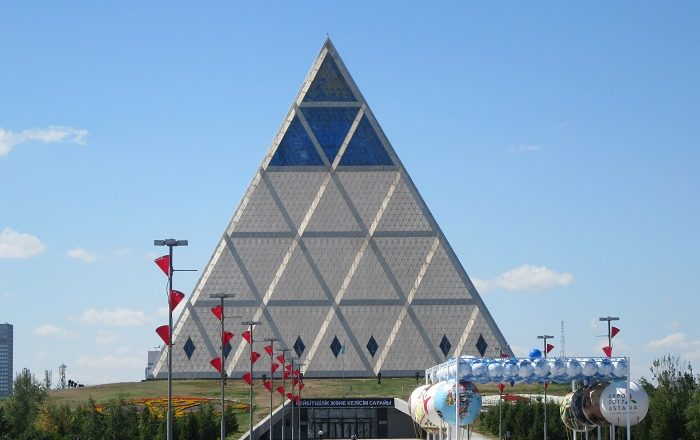
Each triangular face of the Pyramid of Peace in Kazakhstan is made up of $25$ smaller equilateral triangles as shown in the figure.

Using the above information and concept of determinants, answer the following questions.
  1. If the vertices ofoneof the smaller equilateral triangle are (0, 0), $(3,\sqrt{3})$ and $(3,-\sqrt{3}),$ then the area of such triangle is:
  1. $\sqrt{3}\text{ sq}.\text{units}$
  2. $2\sqrt{3}\text{ sq}.\text{units}$
  3. $3\sqrt{3}\text{ sq}.\text{units}$
  4. None of these.
  1. The area of a face of the Pyramid is:
  1. $25\sqrt{3}\text{ sq}.\text{units}$
  2. $50\sqrt{3}\text{ sq}.\text{units}$
  3. $75\sqrt{3}\text{ sq}.\text{units}$
  4. $35\sqrt{3}\text{ sq}.\text{units}$
  1. The length of a altitude of a smaller equilateral triangle is:
  1. $2$ units
  2. $3$ units
  3. $\sqrt{3}\text{ units}$
  4. $4$ units
  1. If $(2, 4), (2, 6)$ are two vertices of a smaller equilateral triangle, then the third vertex will lie on the line represented by:
  1. $\text{x}+\text{y}=5$
  2. $\text{x}=1+\sqrt3$
  3. $\text{x}=2+\sqrt3$
  4. $2\text{x}+\text{y}=5$
  1. Let $A(a, 0), B(0, b)$ and $C(1, 1)$ be three points. If $\frac{1}{\text{a}}+\frac{1}{\text{b}}=1,$ then the three points are:
  1. Vertices of an equilateral triangle.
  2. Vertices of a right angled triangle.
  3. Collinear.
  4. Vertices of an isosceles triangle.
Read the following passage and answer the questions given below.

Image

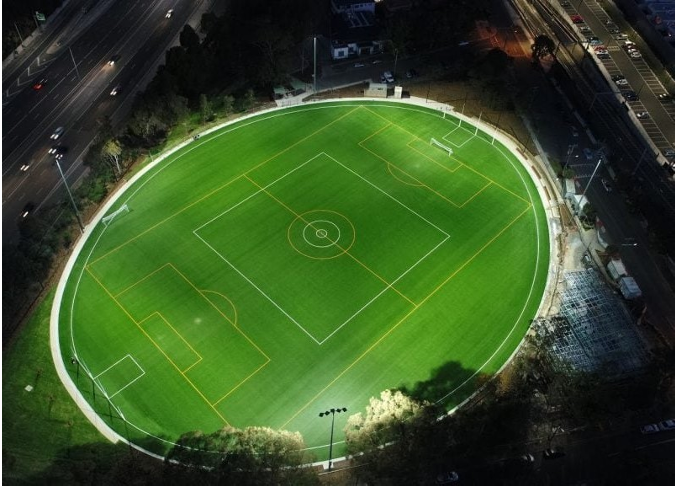
In an elliptical sport field the authority wants to design a rectangular soccer field with the maximum possible area. The sport field is given by the graph of $\frac{x^2}{a^2}+\frac{y^2}{b^2}=1$

(i) If the length and the breadth of the rectangular field be $2 x$ and $2 y$ respectively, then find the area function in terms of $x$.

(ii) Find the critical point of the function.

(iii) Use First derivative Test to find the length $2 x$ and width $2 y$ of the soccer field (in terms of $a$ and b) that maximize its area.

OR

(iii) Use Second Derivative Test to find the length $2 x$ and width $2 y$ of the soccer field (in terms of $a$ and $b$ ) that maximize its area.

Read the following text carefully and answer the questions that follow:
A building contractor undertakes a job to construct 4 flats on a plot along with parking area. Due to strike the probability of many construction workers not being present for the job is 0.65 . The probability that many are not present and still the work gets completed on time is 0.35 . The probability that work will be completed on time when all workers are present is 0.80 .
Let: $E _1$ : represent the event when many workers were not present for the job;
$E _2$ : represent the event when all workers were present; and
E: represent completing the construction work on time.
i. What is the probability that all the workers are present for the job? (1)
ii. What is the probability that construction will be completed on time? (1)
iii. What is the probability that many workers are not present given that the construction work is completed on time? (2)
OR
What is the probability that all workers were present given that the construction job was completed on time?(2)
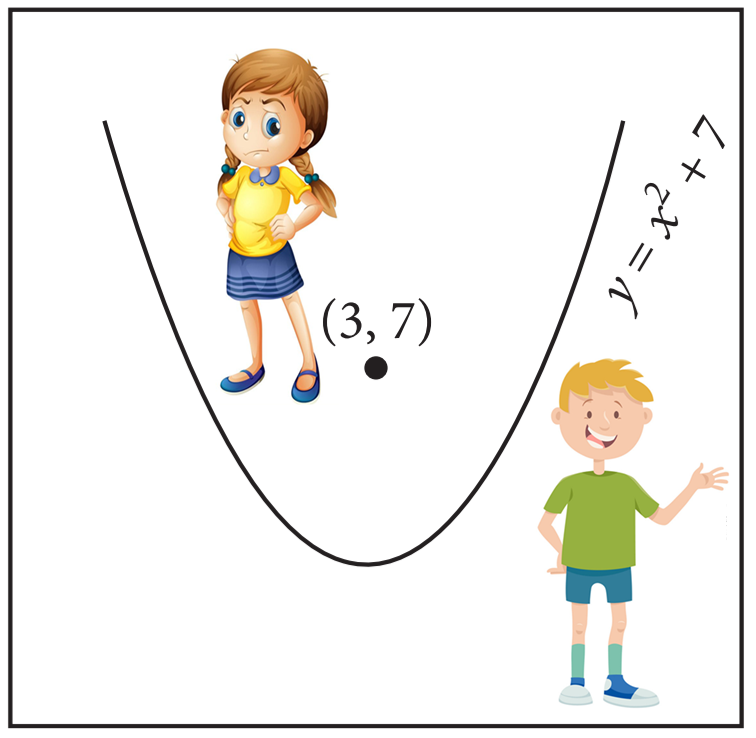
A student Arun is running on a playground along the curve given by $y = x^2 + 7.$ Another student Manila standing at point $(3, 7)$ on playground wants to hit Arun by paper ball when Arun is nearest to Manila.

Based on above information, answer the following questions.
  1. Arun's position at any value of x will be.
  1. $(x^2, y - 7)$
  2. $(x^2, y + 7)$
  3. $(x, x^2 + 7)$
  4. $(x^2, x - 7)$
  1. Distance (say D) between Arun and Manila will be.
  1. $(\text{x}-1)(2\text{x}^2+2\text{x}+3)$
  2. $(\text{x}-3)^2+\text{x}^4$
  3. $\sqrt{(\text{x}-3)+\text{x}^4}$
  4. $\sqrt{(\text{x}-1)(2\text{x}^2+2\text{x}+3)}$
  1. For which real value$(s)$ of $x$, first derivative of $D^2$ w.r.t, x will Vanish?
  1. $1$
  2. $2$
  3. $3$
  4. $4$
  1. Find the position of Arun when Manila will hit the paper hall.
  1. $(5, 32)$
  2. $(1, 8)$
  3. $(3, 7)$
  4. $(3, 16)$
  1. The minimum value of $D$ is.
  1. $3$
  2. $\sqrt{3}$
  3. $5$
  4. $\sqrt{5}$
Three slogans on chart papers are to be placed on a school bulletin board at the points A, Band C displaying A (Hub of Learning), B (Creating a better world for tomorrow) and C (Education comes first). The coordinates of these points are (1, 4, 2), (3, -3, -2) and (-2, 2, 6) respectively.

Based on the above information, answer the following questions.
  1. Let $\vec{\text{a}},\vec{\text{b}}$ and $\vec{\text{c}}$ be the position vectors of points A, B and C respectively, then $\vec{\text{a}}+\vec{\text{b}}+\vec{\text{c}}$ is equal to:
  1. $2\hat{\text{i}}+3\hat{\text{j}}+6\hat{\text{k}}$
  2. $2\hat{\text{i}}-3\hat{\text{j}}-6\hat{\text{k}}$
  3. $2\hat{\text{i}}+8\hat{\text{j}}+3\hat{\text{k}}$
  4. $2(7\hat{\text{i}}+8\hat{\text{j}}+3\hat{\text{k}})$
  1. Which of the following is not true?
  1. $\overline{\text{AB}}+\overline{\text{BC}}+\overline{\text{CA}}=\vec{0}$
  2. $\overline{\text{AB}}+\overline{\text{BC}}-\overline{\text{AC}}=\vec{0}$
  3. $\overline{\text{AB}}+\overline{\text{BC}}-\overline{\text{CA}}=\vec{0}$
  4. $\overline{\text{AB}}-\overline{\text{CB}}+\overline{\text{CA}}=\vec{0}$
  1. Area of $\triangle\text{ABC}$ is:
  1. 19 sq. units
  2. $\sqrt{1937}\text{sq}.\text{units}$
  3. $\frac{1}{2}\sqrt{1937}\text{sq}.\text{units}$
  4. $\sqrt{1837}\text{sq}.\text{units}$
  1. Suppose, if the given slogans are to be placed on a straight line, then the value of $|\vec{\text{a}}\times\vec{\text{b}}+\vec{\text{b}}\times\vec{\text{c}}+\vec{\text{c}}\times\vec{\text{a}}|$ will be equal to:
  1. -1
  2. -2
  3. 2
  4. 0
  1. If $\vec{\text{a}}=2\hat{\text{i}}+3\hat{\text{j}}+6\hat{\text{k}},$ then unit vector in the direction of vector $\vec{\text{a}}$ is:
  1. $\frac{2}{7}\hat{\text{i}}-\frac{3}{7}\hat{\text{j}}-\frac{6}{7}\hat{\text{k}}$
  2. $\frac{2}{7}\hat{\text{i}}+\frac{3}{7}\hat{\text{j}}+\frac{6}{7}\hat{\text{k}}$
  3. $\frac{3}{7}\hat{\text{i}}+\frac{2}{7}\hat{\text{j}}+\frac{6}{7}\hat{\text{k}}$
  4. None of these
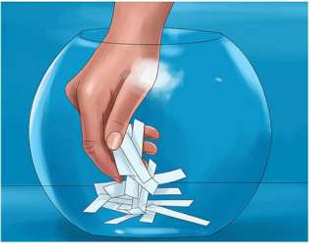
To teach the application of probability a maths teacher arranged a surprise game for 5 of his students namely Govind, Girish, Vinod, Abhishek and Ankit. He took a bowl containing tickets numbered 1 to 50 and told the students go one by one and draw two tickets simultaneously from the bowl and replace it after noting the numbers.

Image

(i) Teacher ask Govind, what is the probability that tickets are drawn by Abhishek, shows a prime number on one ticket and a multiple of 4 on other ticket?

(ii) Teacher ask Girish, what is the probability that tickets drawn by Ankit, shows an even number on first ticket and an odd number on second ticket?

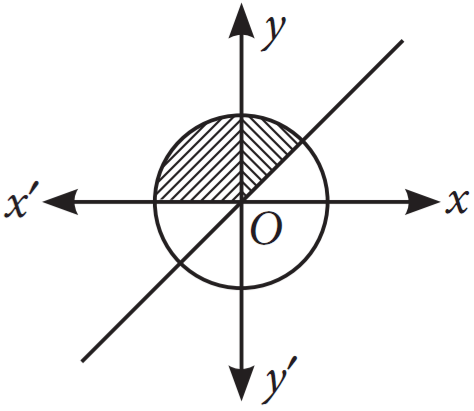
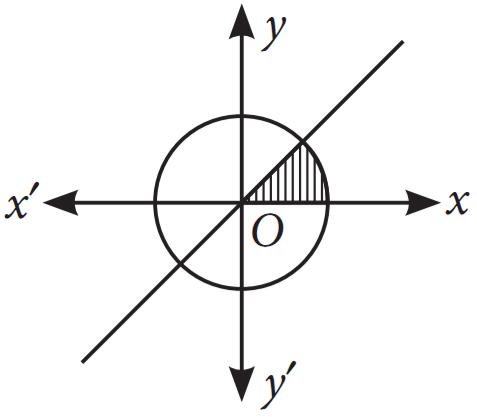
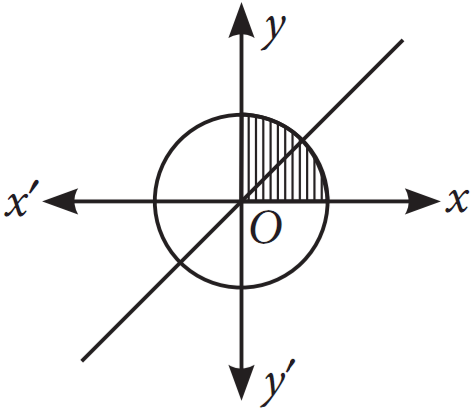
Consider the curve $x^2+y^2=16$ and line $y = x$ in the first quadrant. Based on the above information, answer the following questions.
  1. Point of intersection of both the given curves is.
  1. $(0, 4)$
  2. $(0, 2\sqrt{2})$
  3. $(2\sqrt{ 2},2\sqrt{2})$
  4. $(2,\sqrt{2},4)$
  1. Which of the following shaded portion represent the area bounded by given two curves?
  1. None of these
  1. The value of the integral $\int\limits_{0}^{2\sqrt{2}}\text{x}\text{dx}$ is.
  1. $0$
  2. $1$
  3. $2$
  4. $4$
  1. The value of the integral $\int\limits_{2\sqrt{2}}^{0}\sqrt{16-\text{x}^2}\text{ dx}$ is.
  1. $2(\pi-2)$
  2. $2(\pi-8)$
  3. $4(\pi-2)$
  4. $4(\pi+2)$
  1. Area bounded by the two given curves is.
  1. $3\pi\text{ sq.units}$
  2. $\frac{\pi}{2}\text{ sq.units}$
  3. $\pi\text{ sq.units}$
  4. $2\pi\text{ sq.units}$