Question
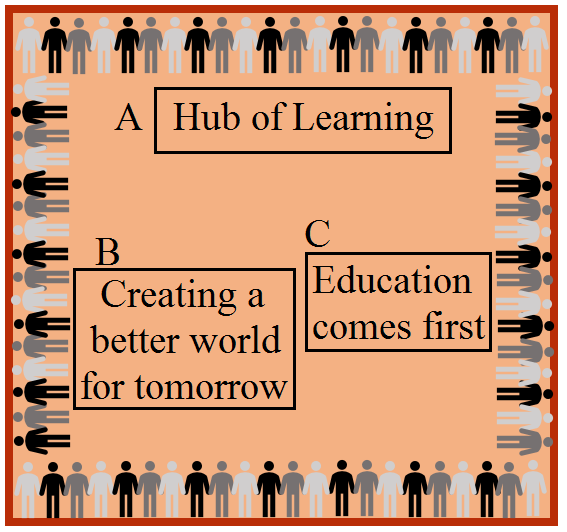
Three slogans on chart papers are to be placed on a school bulletin board at the points A, Band C displaying A (Hub of Learning), B (Creating a better world for tomorrow) and C (Education comes first). The coordinates of these points are (1, 4, 2), (3, -3, -2) and (-2, 2, 6) respectively.
Based on the above information, answer the following questions.
  1. Let $\vec{\text{a}},\vec{\text{b}}$ and $\vec{\text{c}}$ be the position vectors of points A, B and C respectively, then $\vec{\text{a}}+\vec{\text{b}}+\vec{\text{c}}$ is equal to:
  1. $2\hat{\text{i}}+3\hat{\text{j}}+6\hat{\text{k}}$
  2. $2\hat{\text{i}}-3\hat{\text{j}}-6\hat{\text{k}}$
  3. $2\hat{\text{i}}+8\hat{\text{j}}+3\hat{\text{k}}$
  4. $2(7\hat{\text{i}}+8\hat{\text{j}}+3\hat{\text{k}})$
  1. Which of the following is not true?
  1. $\overline{\text{AB}}+\overline{\text{BC}}+\overline{\text{CA}}=\vec{0}$
  2. $\overline{\text{AB}}+\overline{\text{BC}}-\overline{\text{AC}}=\vec{0}$
  3. $\overline{\text{AB}}+\overline{\text{BC}}-\overline{\text{CA}}=\vec{0}$
  4. $\overline{\text{AB}}-\overline{\text{CB}}+\overline{\text{CA}}=\vec{0}$
  1. Area of $\triangle\text{ABC}$ is:
  1. 19 sq. units
  2. $\sqrt{1937}\text{sq}.\text{units}$
  3. $\frac{1}{2}\sqrt{1937}\text{sq}.\text{units}$
  4. $\sqrt{1837}\text{sq}.\text{units}$
  1. Suppose, if the given slogans are to be placed on a straight line, then the value of $|\vec{\text{a}}\times\vec{\text{b}}+\vec{\text{b}}\times\vec{\text{c}}+\vec{\text{c}}\times\vec{\text{a}}|$ will be equal to:
  1. -1
  2. -2
  3. 2
  4. 0
  1. If $\vec{\text{a}}=2\hat{\text{i}}+3\hat{\text{j}}+6\hat{\text{k}},$ then unit vector in the direction of vector $\vec{\text{a}}$ is:
  1. $\frac{2}{7}\hat{\text{i}}-\frac{3}{7}\hat{\text{j}}-\frac{6}{7}\hat{\text{k}}$
  2. $\frac{2}{7}\hat{\text{i}}+\frac{3}{7}\hat{\text{j}}+\frac{6}{7}\hat{\text{k}}$
  3. $\frac{3}{7}\hat{\text{i}}+\frac{2}{7}\hat{\text{j}}+\frac{6}{7}\hat{\text{k}}$
  4. None of these

Answer

  1. (a) $2\hat{\text{i}}+3\hat{\text{j}}+6\hat{\text{k}}$
Solution:

$\vec{\text{a}}=\hat{\text{i}}+4\hat{\text{j}}+2\hat{\text{k}},\vec{\text{ b}}=3\hat{\text{i}}-3\hat{\text{j}}-2\hat{\text{k}}$

And $\vec{\text{c}}=2\hat{\text{i}}+2\hat{\text{j}}+6\hat{\text{k}}$

$\therefore\vec{\text{a}}+\vec{\text{b}}+\vec{\text{c}}=2\hat{\text{i}}+3\hat{\text{j}}+6\hat{\text{k}}$
  1. (c) $\overline{\text{AB}}+\overline{\text{BC}}-\overline{\text{CA}}=\vec{0}$
Solution:

Using triangle law of addition in $\triangle\text{ABC},$ we get $\overline{\text{AB}}+\overline{\text{BC}}-\overline{\text{CA}}=\vec{0}$ which can be rewritten as,

$\overline{\text{AB}}+\overline{\text{BC}}-\overline{\text{CA}}=\vec{0}$ or $\overline{\text{AB}}-\overline{\text{CB}}+\overline{\text{CA}}=\vec{0}$
  1. (c) $\frac{1}{2}\sqrt{1937}\text{sq}.\text{units}$
Solution:

We have, A(1 ,4, 2), B(3, -3, -2) and C(-2, 2, 6)

Now, $\overline{\text{AB}}=\vec{\text{b}}-\vec{\text{a}}=2\hat{\text{i}}-7\hat{\text{j}}-4\hat{\text{k}}$

And $\overline{\text{AC}}=\vec{\text{c}}-\vec{\text{a}}=-3\hat{\text{i}}-2\hat{\text{j}}+4\hat{\text{k}}$

$\therefore\overline{\text{AB}}\times\overline{\text{AC}}=\begin{vmatrix}\hat{\text{i}}&\hat{\text{j}}&\hat{\text{k}}\\2&-7&-4\\-3&-2&4\end{vmatrix}$

$=\hat{\text{i}}(-28-8)-\hat{\text{j}}(8-12)+\hat{\text{k}}(-4-21)$

$=-36\hat{\text{i}}+4\hat{\text{j}}-25\hat{\text{k}}$

Now, $|\overline{\text{AB}}\times\overline{\text{AC}}|=\sqrt{(-36)^2+4^2+(-25)^2}$

$=\sqrt{1296+16+625}=\sqrt{1937}$

$\therefore$ Area of $\triangle\text{ABC}=\frac{1}{2}|\overline{\text{AB}}\times\overline{\text{AC}}|$

$=\frac{1}{2}\sqrt{1937}\text{sq}.\text{units}.$
  1. (d) 0
Solution:

If the given points lie on the straight line, then the points will be collinear and so area of $\triangle\text{ABC}=0.$

$\Rightarrow|\vec{\text{a}}\times\vec{\text{b}}+\vec{\text{b}}\times\vec{\text{c}}+\vec{\text{c}}\times\vec{\text{a}}|=0$

[$\because$ If $\vec{\text{a}},\vec{\text{b}},\vec{\text{c}}$ are the position vectors of the three vertices A, B and C of $\triangle\text{ABC},$ then area of triangle

$=\frac{1}{2}|\vec{\text{a}}\times\vec{\text{b}}+\vec{\text{b}}\times\vec{\text{c}}+\vec{\text{c}}\times\vec{\text{a}}|]$
  1. (b) $\frac{2}{7}\hat{\text{i}}+\frac{3}{7}\hat{\text{j}}+\frac{6}{7}\hat{\text{k}}$
Solution:

Here, $|\vec{\text{a}}|=\sqrt{2^2+3^2+6^2}=\sqrt{4+6+36}$

$=\sqrt{49}=7$

$\therefore$ Unit vector in the direction of vector $\vec{\text{a}}$ is

$\hat{\text{a}}=\frac{2\hat{\text{i}}+3\hat{\text{j}}+6\hat{\text{k}}}{7}$

$=\frac{2}{7}\hat{\text{i}}+\frac{3}{7}\hat{\text{j}}+\frac{6}{7}\hat{\text{k}}$

Need a full question paper?

Generate a complete, print-ready paper with questions like this in minutes — across 16+ boards, with answer keys.

Start Generating Free

Similar questions

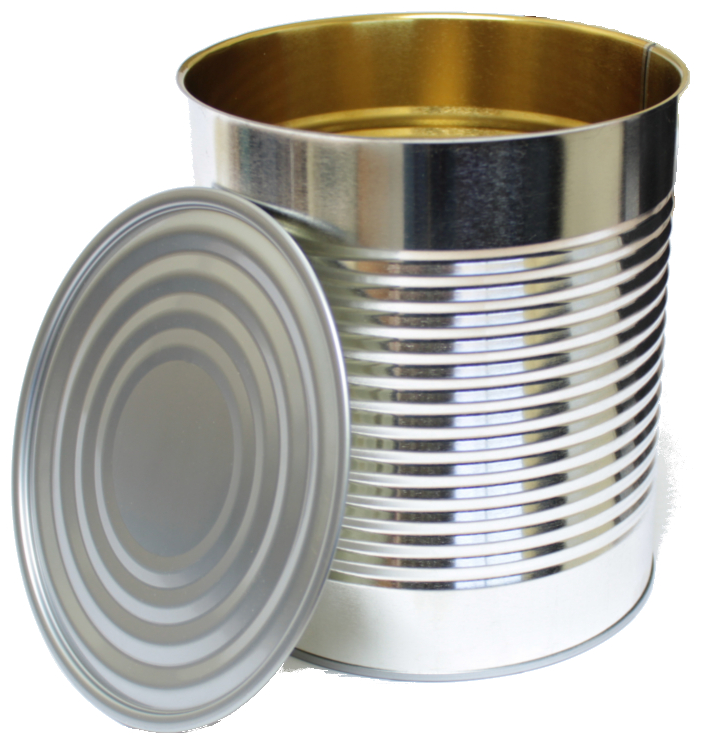
A tin can manufacturer designs a cylindrical tin can for a company making sanitizer and disinfector. The tin can is made to hold 3 litres of sanitizer or disinfector.

Based on the above in formation, answer the following questions.
  1. If r cm be the radius and h cm be the height of the cylindrical tin can, then the surface area expressed as a function of r as.
  1. $2\pi\text{r}^2$
  2. $2\pi\text{r}^2+6000$
  3. $2\pi\text{r}^2+\frac{5000}{\text{r}}$
  4. $2\pi\text{r}^2+\frac{6000}{\text{r}}$
  1. The radius that will minimize the cost of the material to manufacture the tin can is.
  1. $\sqrt[3]{\frac{600}{\pi}}\text{cm}$
  2. $\sqrt{\frac{500}{\pi}}\text{cm}$
  3. $\sqrt[3]{\frac{1500}{\pi}}\text{cm}$
  4. $\sqrt{\frac{1500}{\pi}}\text{cm}$
  1. The height that will minimize the cost of the material to manufacture the tin can is.
  1. $\sqrt[3]{\frac{600}{\pi}}\text{cm}$
  2. $2\sqrt[3]{\frac{1500}{\pi}}\text{cm}$
  3. $\sqrt{\frac{1500}{\pi}}$
  4. $2\sqrt{\frac{1500}{\pi}}$
  1. If the cost of material used to manufacture the tin can is $₹\frac{100}{\text{m}^2}$ and $\sqrt[3]{\frac{1500}{\pi}}\approx7.8,$ then minimum cost is approximately.
  1. ₹ 11.538
  2. ₹ 12
  3. ₹ 13
  4. ₹ 14
  1. To minimize the cost of the material used to manufacture the tin can, we need to minimize the.
  1. Volume.
  2. Curved surface area.
  3. Total surface area.
  4. Surface area of the base.
DETERMINANTS: A determinant is a square array of numbers (written within a pair of vertical lines) which represents a certain sum of We can solve a system of equations using determinants, but it becomes very tedious for large systems. We will only do 2 × 2 and 3 × 3 systems using determinants. Using the properties of determinants solve the problem given below and answer the questions that follow:
Three shopkeepers Ram Lal, Shyam Lal, and Ghansham are using polythene bags, handmade bags (prepared by prisoners), and newspaper's envelope as carry bags. It is found that the shopkeepers Ram Lal, Shyam Lal, and Ghansham are using (20, 30, 40), (30, 40, 20), and (40, 20, 30) polythene bags, handmade bags, and newspapers envelopes respectively. The shopkeepers Ram Lal, Shyam Lal, and Ghansham spent ₹250, ₹270, and ₹200 on these carry bags respectively.
  1. What is the cost of one polythene bag?
  1. ₹ 1
  2. ₹ 2
  3. ₹ 3
  4. ₹ 5
  1. What is the cost of one handmade bag?
  1. ₹1
  2. ₹2
  3. ₹3
  4. ₹5
  1. What is the cost of one newspaper bag?
  1. ₹1
  2. ₹2
  3. ₹3
  4. ₹5
  1. Keeping in mind the social conditions, which shopkeeper is better?
  1. Ram Lal
  2. Shyam Lal
  3. Ghansham
  4. None of these
  1. Keeping in mind the environmental conditions, which shopkeeper is better?
  1. Ram Lal
  2. Shyam Lal
  3. Ghansham
  4. None of these
Two farmers Shyam and Balwan Singh cultivate only three varieties of pulses namely Urad, Masoor and Mung. The sale (in ₹) of these varieties of pulses by both the farmers in the month of September and October are given by the following matrices A and B.

September sales (in ₹)
$\begin{matrix}\ \ \ \ \ \ \ \ \ \ \text{Urad}&\text{Masoor}&\text{Mung}\end{matrix}\\\text{A}=\begin{bmatrix}10000&20000&30000\\50000&30000&10000\end{bmatrix}\begin{matrix}\text{Shayam}\\\text{Balwan singh}\end{matrix}$
October sales (in ₹)
$\begin{matrix}\ \ \ \ \ \ \ \ \ \ \text{Urad}&\text{Masoor}&\text{Mung}\end{matrix}\\\text{B}=\begin{bmatrix}10000&20000&30000\\50000&30000&10000\end{bmatrix}\begin{matrix}\text{Shayam}\\\text{Balwan singh}\end{matrix}$
Using algebra of matrices, answer the following questions.
  1. The combined sales of Masoor in September and October, for farmer Balwan Singh, is:
  1. ₹ 80000
  2. ₹ 90000
  3. ₹ 40000
  4. ₹ 135000
  1. The combined sales of Urad in September and October, for farmer Shyam is:
  1. ₹ 20000
  2. ₹ 30000
  3. ₹ 36000
  4. ₹ 15000
  1. Find the decrease in sales of Mung from September to October, for the farmer Shyam.
  1. ₹ 24000
  2. ₹ 10000
  3. ₹ 30000
  4. No change
  1. If both farmers receive 2% profit on gross sales, compute the profit for each farmer and for each variety sold in October.
  1. $\begin{matrix} \ \text{Urad}&\text{Masoor}&\text{Mung}\end{matrix}\\\begin{bmatrix}100&\ \ \ \ \ \ 200&\ \ \ \ \ 220\\400&\ \ \ \ \ \ 300&\ \ \ \ \ 200\end{bmatrix}\begin{matrix}\text{Shayam}\\\text{Balwan singh}\end{matrix}$
  2. $\begin{matrix} \ \text{Urad}&\text{Masoor}&\text{Mung}\end{matrix}\\\begin{bmatrix}100&\ \ \ \ \ \ 200&\ \ \ \ \ 120\\400&\ \ \ \ \ \ 200&\ \ \ \ \ 200\end{bmatrix}\begin{matrix}\text{Shayam}\\\text{Balwan singh}\end{matrix}$
  3. $\begin{matrix} \ \text{Urad}&\text{Masoor}&\text{Mung}\end{matrix}\\\begin{bmatrix}150&\ \ \ \ \ \ 200&\ \ \ \ \ 220\\400&\ \ \ \ \ \ 200&\ \ \ \ \ 280\end{bmatrix}\begin{matrix}\text{Shayam}\\\text{Balwan singh}\end{matrix}$
  4. $\begin{matrix} \ \text{Urad}&\text{Masoor}&\text{Mung}\end{matrix}\\\begin{bmatrix}100&\ \ \ \ \ \ 200&\ \ \ \ \ 120\\250&\ \ \ \ \ \ 200&\ \ \ \ \ 220\end{bmatrix}\begin{matrix}\text{Shayam}\\\text{Balwan singh}\end{matrix}$
  1. Which variety of pulse has the highest selling value in the month of September for the farmer Balwan Singh?
  1. Urad
  2. Masoor
  3. Mung
  4. All of these have the same price
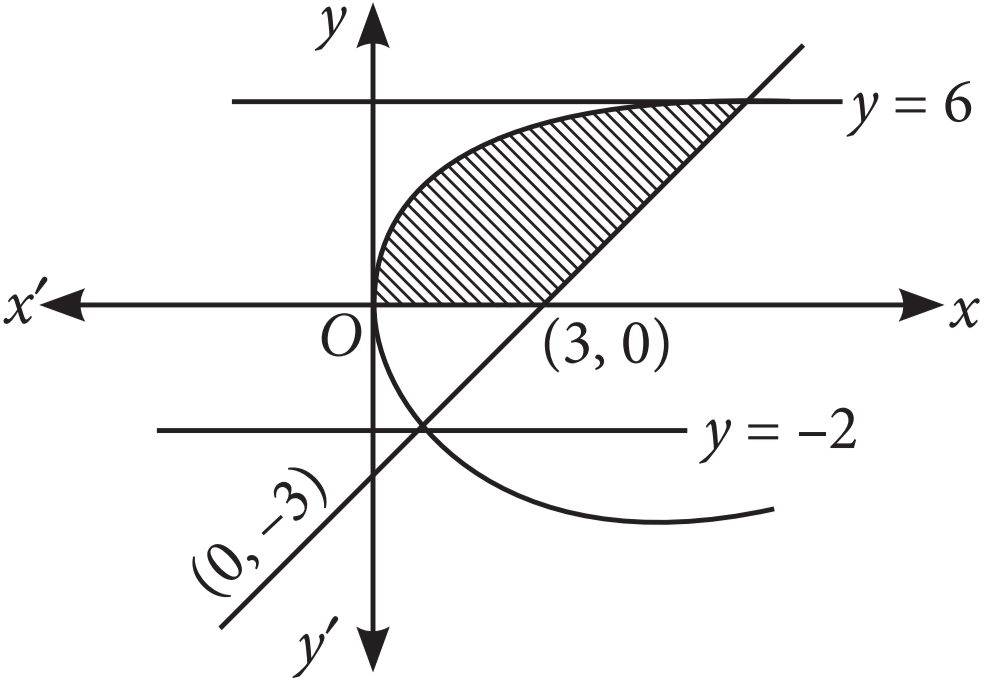
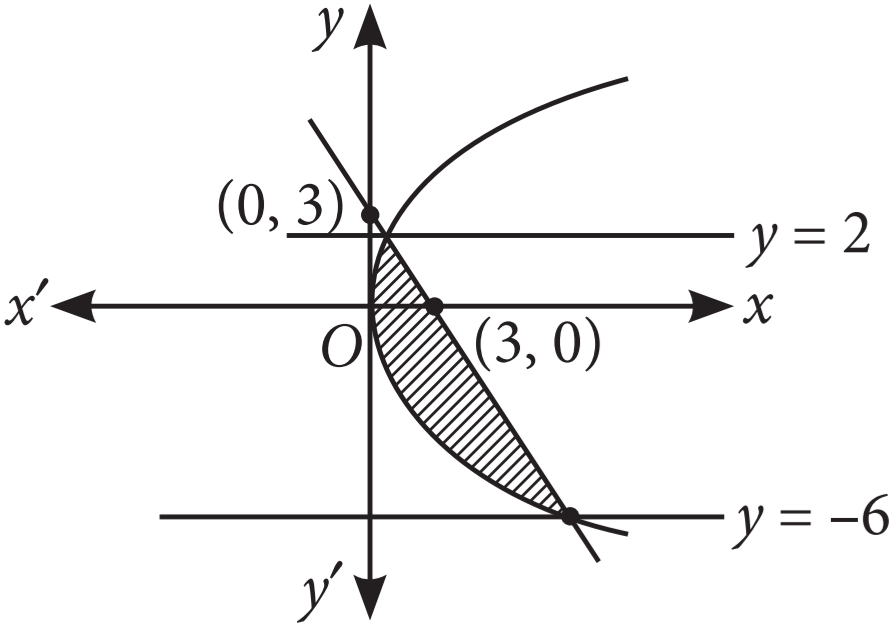
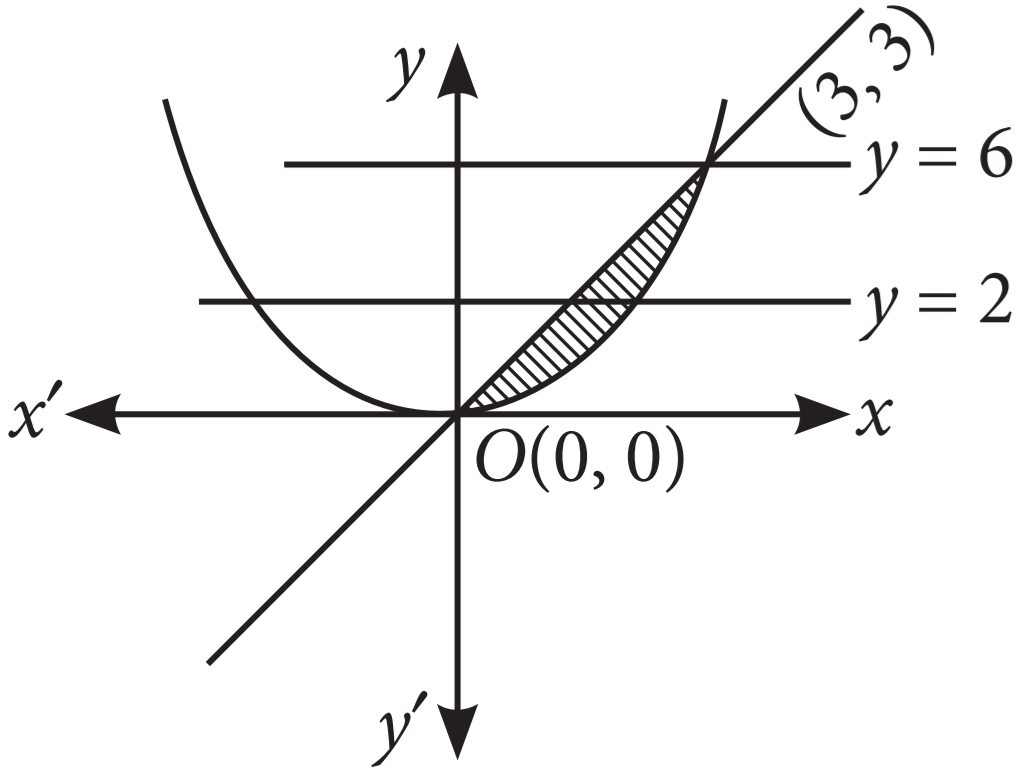
Consider the following equation of curve $y^2 = 4x$ and straight line $x + y = 3.$
Based on the above information, answer the following questions.
  1. The line $x + y = 3$ cuts the $x-$axis and $y-$axis respectively at.
  1. $(0, 2), (2, 0)$
  2. $(3, 3), (0, 0)$
  3. $(0, 3), (3, 0)$
  4. $(3, 0), (0, 3)$
  1. Point(s) of intersection of two given curves is (are).
  1. $(1, -2), (-9, 6)$
  2. $(2, 1), (-6, 9)$
  3. $(1, 2), (9, -6)$
  4. None of these.
  1. Which of the following shaded portion re present the area bounded by given curves?
    1. None of these
  1. Value of the integral $\int\limits_{-6}^{2}(3-\text{y})\text{ dy}$ is
  1. $10$
  2. $20$
  3. $30$
  4. $40$
  1. Value of area bounded by given curves is.
  1. $56\text{ sq.units}$
  2. $\frac{63}{5}\text{ sq. units}$
  3. $\frac{64}{3}\text{ sq. units}$
  4. $31\text{ sq.units}$
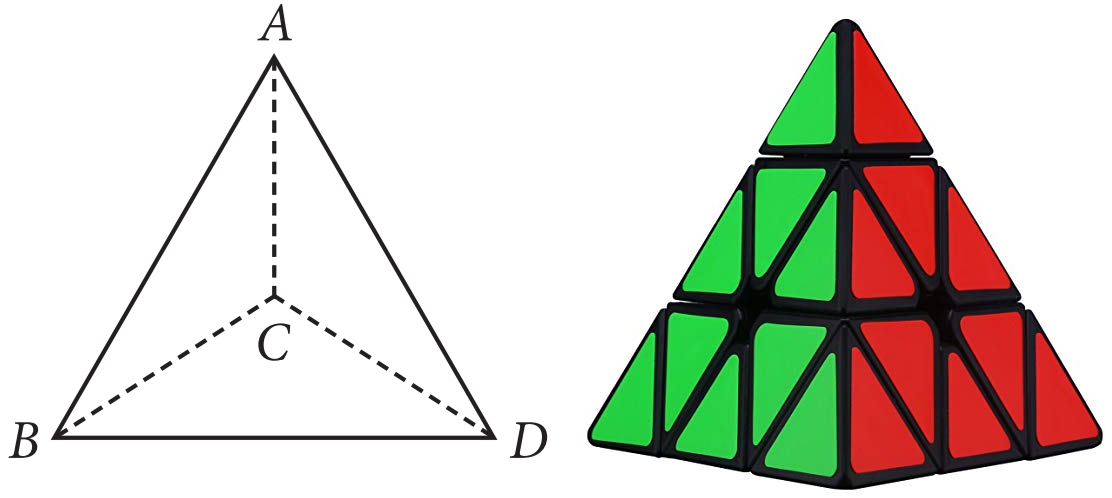
A building is to be constructed in the form of a triangular pyramid, ABCD as shown in the figure.

Let its angular points are A(0, 1, 2), B(3, 0, 1), C(4, 3, 6), and D(2, 3, 2), and G be the point of intersection of the medians of $\triangle\text{BCD}.$
Based on the above information, answer the following questions.
  1. The coordinates of point Gare:
  1. (2, 3, 3)
  2. (3, 3, 2)
  3. (3, 2, 3)
  4. (0, 2, 3)
  1. The length of vector $\overline{\text{AG}}$ is:
  1. $\sqrt{17}\text{ units}$
  2. $\sqrt{11}\text{ units}$
  3. $\sqrt{13}\text{ units}$
  4. $\sqrt{19}\text{ units}$
  1. Area of $\triangle\text{ABC}$ (in sq. units) is:
  1. $\sqrt{10}$
  2. $2\sqrt{10}$
  3. $3\sqrt{10}$
  4. $5\sqrt{10}$
  1. The sum of lengths of $\overline{\text{AB}}$ and $\overline{\text{AC}}$ is:
  1. 5 units
  2. 9.32 units
  3. 10 units
  4. 11 units
  1. The length of the perpendicular from the vertex D on the opposite face is:
  1. $\frac{6}{\sqrt{10}}\text{ units}$
  2. $\frac{2}{\sqrt{10}}\text{ units}$
  3. $\frac{3}{\sqrt{10}}\text{ units}$
  4. $8\sqrt{10}\text{ units}$
In a city there are two factories A and B. Each factory produces sports clothes for boys and girls. There are three types of clothes produced in both the factories, type I, II and III. For boys the number of units of types I, II and III respectively are 80, 70 and 65 in factory A and 85, 65 and 72 are in factory B. For girls the number of units of types I, II and III respectively are 80, 75, 90 in factory A and 50, 55, 80 are in factory B.

Based on the above information, answer the following questions:
  1. If P represents the matrix of number of units of each type produced by factory A for both boys and girls, then P is given by:
  1. $\begin{matrix}&\text{Boys}&\text{Girls}\end{matrix}\\\begin{matrix}\text{I}\\\text{II}\\\text{III}\end{matrix}\begin{bmatrix}85&50\\65&55\\72&80\end{bmatrix}$
  2. $\begin{matrix}&&&\text{I}\ \ \ &\text{II}&\text{III}\end{matrix}\\\begin{matrix}\text{Boys}\\\text{Girls}\end{matrix}\begin{bmatrix}50&55&80\\85&65&72\end{bmatrix}$
  3. $\begin{matrix}&&&\text{I}\ \ \ &\text{II}&\text{III}\end{matrix}\\\begin{matrix}\text{Boys}\\\text{Girls}\end{matrix}\begin{bmatrix}80&75&90\\80&70&65\end{bmatrix}$
  4. $\begin{matrix}&\text{Boys}&\text{Girls}\end{matrix}\\\begin{matrix}\text{I}\\\text{II}\\\text{III}\end{matrix}\begin{bmatrix}80&80\\70&75\\65&90\end{bmatrix}$
  1. If Q represents the matrix of number of units of each type produced by factory B for both boys and girls, then Q is given by:
  1. $\begin{matrix}&\text{Boys}&\text{Girls}\end{matrix}\\\begin{matrix}\text{I}\\\text{II}\\\text{III}\end{matrix}\begin{bmatrix}85&50\\65&55\\72&80\end{bmatrix}$
  2. $\begin{matrix}&&&\text{I}\ \ \ &\text{II}&\text{III}\end{matrix}\\\begin{matrix}\text{Boys}\\\text{Girls}\end{matrix}\begin{bmatrix}80&75&90\\80&70&65\end{bmatrix}$
  3. $\begin{matrix}&&&\text{I}\ \ \ &\text{II}&\text{III}\end{matrix}\\\begin{matrix}\text{Boys}\\\text{Girls}\end{matrix}\begin{bmatrix}80&75&90\\80&70&65\end{bmatrix}$
  4. $\begin{matrix}&\text{Boys}&\text{Girls}\end{matrix}\\\begin{matrix}\text{I}\\\text{II}\\\text{III}\end{matrix}\begin{bmatrix}80&80\\70&75\\65&90\end{bmatrix}$
  1. The total production of sports clothes of each type for boys is given by the matrix.
  1. $\begin{matrix}\ \ \text{I}&\ \ \ \ \text{II}&\ \ \ \text{III}\end{matrix}\\\begin{matrix}[165&130&137]\end{matrix}\\$
  2. $\begin{matrix}\ \ \text{I}&\ \ \ \ \text{II}&\ \ \ \text{III}\end{matrix}\\\begin{matrix}[130&165&137]\end{matrix}\\$
  3. $\begin{matrix}\ \ \text{I}&\ \ \ \ \text{II}&\ \ \ \text{III}\end{matrix}\\\begin{matrix}[165&135&137]\end{matrix}\\$
  4. $\begin{matrix}\ \ \text{I}&\ \ \ \ \text{II}&\ \ \ \text{III}\end{matrix}\\\begin{matrix}[137&135&165]\end{matrix}\\$
  1. The total production of sports clothes of each type for girls is given by the matrix.
  1. $\begin{matrix}\ \ \text{I}&\ \ \ \ \text{II}&\ \ \ \text{III}\end{matrix}\\\begin{matrix}[130&130&170]\end{matrix}\\$
  2. $\begin{matrix}\ \ \text{I}&\ \ \ \ \text{II}&\ \ \ \text{III}\end{matrix}\\\begin{matrix}[170&130&130]\end{matrix}\\$
  3. $\begin{matrix}\ \ \text{I}&\ \ \ \ \text{II}&\ \ \ \text{III}\end{matrix}\\\begin{matrix}[130&170&130]\end{matrix}\\$
  4. None of these
  1. Let R be a 3 × 2 matrix that represent the total production of sports dothes of each type for boys and girls, then transpose of R is:
  1. $\begin{bmatrix}165 & 135 & 137\\130 & 130 & 170 \end{bmatrix}$
  2. $\begin{bmatrix}130 & 130 & 170\\165 & 135 & 138 \end{bmatrix}$
  3. $\begin{bmatrix}165 & 132 \\135 & 130 \\137 & 170 \end{bmatrix}$
  4. $\begin{bmatrix}130 & 168 \\130 & 135 \\170 & 137 \end{bmatrix}$
Let x = f(t) and y = g(t) be parametric forms with t as a parameter, then
$\frac{\text{dy}}{\text{dx}}=\frac{\text{dy}}{\text{dt}}\times\frac{\text{dt}}{\text{dx}}=\frac{\text{g}'(\text{t})}{\text{f}'(\text{t})},$ where $\text{f}'(\text{t})\neq0.$
On the basis of above information, answer the following questions.
  1. The derivative of $\text{f}(\tan\text{x})\text{w.r.t.}\text{ g}(\sec\text{x})\text{ at}\text{ x}=\frac{\pi}{4},$ where f'(1) = 2 and $\text{g}'(\sqrt{2})=4,$ is:
  1. $\frac{1}{\sqrt{2}}$
  2. ${\sqrt{2}}$
  3. 1
  4. 0
  1. The derivative of $\sin^{-1}\Big(\frac{2\text{x}}{1+\text{x}^2}\Big)$ with respect to $\cos^{-1}\Big(\frac{1-\text{x}^2}{1+\text{x}^2}\Big)$ is:
  1. -1
  2. 1
  3. 2
  4. 4
  1. The derivative of $\text{e}^{\text{x}^3}$ with respect to log x is:
  1. $\text{e}^{\text{x}^3}$
  2. $3\text{x}^22\text{e}^{\text{x}^3}$
  3. $3\text{x}^3\text{e}^{\text{x}^3}$
  4. $3\text{x}^2\text{e}^{\text{x}^3}+3\text{x}$
  1. The derivative of $\cos^{-1}(2\text{x}^2-1)\text{w.r.t.}\cos^{-1}\text{x}$ is:
  1. $2$
  2. $\frac{-1}{2\sqrt{1-\text{x}^2}}$
  3. $\frac{2}{\text{x}}$
  4. $1-\text{x}^2$
  1. If $\text{y}=\frac{1}{4}\mu^4$ and $\mu=\frac{2}{3}\text{x}^3+5,$ then $\frac{\text{dy}}{\text{dx}}=$
  1. $\frac{2}{27}\text{x}^2(2\text{x}^3+15)^3$
  2. $\frac{2}{7}\text{x}^2(2\text{x}^3+15)^3$
  3. $\frac{2}{27}\text{x}(2\text{x}^3+5)^3$
  4. $\frac{2}{7}(2\text{x}^3+15)^3$
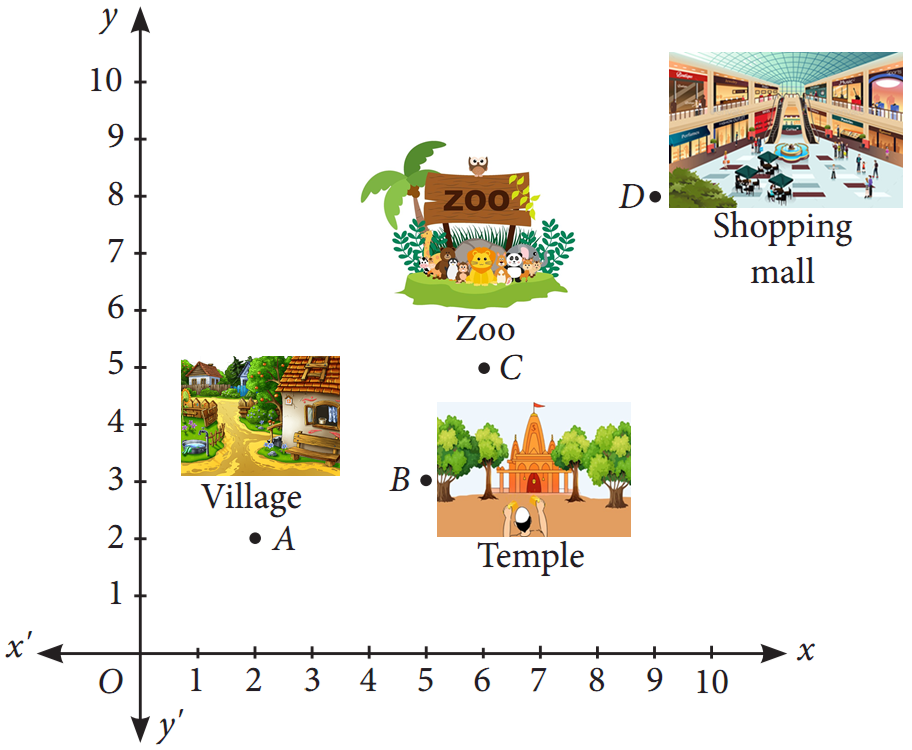
Ishaan left from his village on weekend. First, he travelled up to temple. After this, he left for the zoo. After this, he left for shopping in a mall. The positions of Jshaan at different places is given in the following graph.

Based on the above information, answer the following questions.
  1. Position vector of B is:
  1. $3\hat{\text{i}}+5\hat{\text{j}}$
  2. $5\hat{\text{i}}+3\hat{\text{j}}$
  3. $-5\hat{\text{i}}-3\hat{\text{j}}$
  4. $-5\hat{\text{i}}+3\hat{\text{j}}$
  1. Position vector of D is:
  1. $5\hat{\text{i}}+3\hat{\text{j}}$
  2. $3\hat{\text{i}}+5\hat{\text{j}}$
  3. $8\hat{\text{i}}+9\hat{\text{j}}$
  4. $9\hat{\text{i}}+8\hat{\text{j}}$
  1. Find the vector $\overline{\text{BC}}$ in terms of $\hat{\text{i}},\hat{\text{j}}.$
  1. $\hat{\text{i}}-2\hat{\text{j}}$
  2. $\hat{\text{i}}+2\hat{\text{j}}$
  3. $2\hat{\text{i}}+\hat{\text{j}}$
  4. $2\hat{\text{i}}-\hat{\text{j}}$
  1. Length of vector $\overline{\text{AB}}$ is:
  1. $\sqrt{67}\text{ units}$
  2. $\sqrt{85}\text{ units}$
  3. 90 units
  4. 100 units
  1. If $\vec{\text{M}}=4\hat{\text{j}}+3\hat{\text{k}},$ then its unit vector is:
  1. $\frac{4}{5}\hat{\text{j}}+\frac{3}{5}\hat{\text{k}}$
  2. $\frac{4}{5}\hat{\text{j}}-\frac{3}{5}\hat{\text{k}}$
  3. $-\frac{4}{5}\hat{\text{j}}+\frac{3}{5}\hat{\text{k}}$
  4. $-\frac{4}{5}\hat{\text{j}}-\frac{3}{5}\hat{\text{k}}$
A function f(x) is said to be continuous in an open interval (a, b), if it is continuous at every point in this interval.
A function f(x) is said to be continuous in the closed interval [a, b), if f(x) is continuous in (a, b) and $\lim\limits_{\text{x}\rightarrow0}\text{f}(\text{a}+\text{h})=\text{f}(\text{a})$ and $\lim\limits_{\text{x}\rightarrow0}\text{f}(\text{b}-\text{h})=\text{f}(\text{b})$
If function $\text{f}(\text{x})=\begin{cases}\frac{\sin(\text{a}+1)\text{x}+\sin\text{x}}{\text{x}}&,\text{x}<0\\\text{c}&,\text{x}=0\\\frac{\sqrt{\text{x}+\text{bx}^2}-\sqrt{\text{x}}}{\text{bx}^{\frac{3}{2}}}&,\text{x}>0\end{cases}$ is continuous at x = 0, then answer the following questions.
  1. The value of a is:
  1. $-\frac{3}{2}$
  2. $0$
  3. $\frac{1}{2}$
  4. $-\frac{1}{2}$
  1. The value of b is:
  1. 1
  2. -1
  3. 0
  4. Any real number.
  1. The value of c is:
  1. $1$
  2. $\frac{1}{2}$
  3. $-1$
  4. $-\frac{1}{2}$
  1. The value of a + c is:
  1. 1
  2. 0
  3. -1
  4. -2
  1. The value of c - a is:
  1. 1
  2. 0
  3. -1
  4. 2
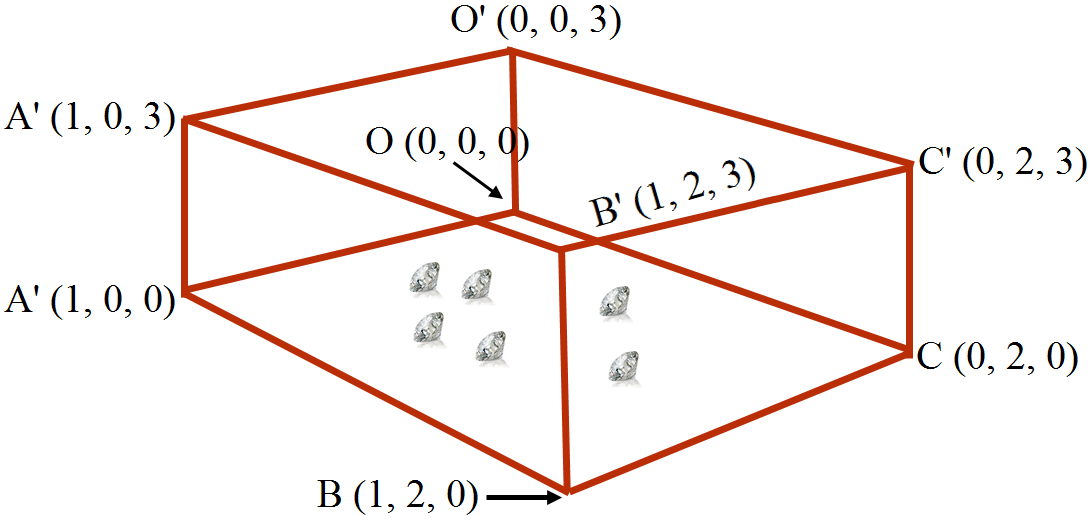
In a diamond exhibition, a diamond is covered in cubical glass box having coordinates O(0, 0, 0), A(1, 0, 0), B(1, 2, 0), C(0, 2, 0), O'(0, 0, 3), A'(1, 0, 3), B'(1, 2, 3) and C'(0, 2, 3). Based on the above information, answer the following questions.
  1. Direction ratios of OA are:
  1. < 0, 1, 0 >
  2. < 1, 0, 0 >
  3. < 0, 0, 1 >
  4. None of these
  1. Equation of diagonal OB' is:
  1. $\frac{\text{x}}{1}=\frac{\text{y}}{2}=\frac{\text{z}}{3}$
  2. $\frac{\text{x}}{0}=\frac{\text{y}}{1}=\frac{\text{z}}{2}$
  3. $\frac{\text{x}}{1}=\frac{\text{y}}{0}=\frac{\text{z}}{2}$
  4. None of these
  1. Equation of plane OABC is:
  1. x = 0
  2. y = 0
  3. z = 0
  4. None of these
  1. Equation of plane O' A' B' C' is:
  1. x = 3
  2. y = 3
  3. z = 3
  4. z = 2
  1. Equation of plane ABB' A' is:
  1. x = 1
  2. y = 1
  3. z = 2
  4. x = 3