Question
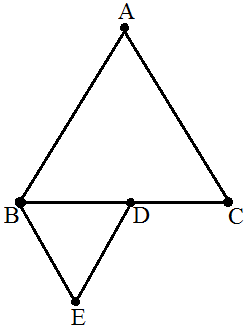
If $\triangle\text{ABC}$ and $\triangle\text{BDE}$ are equilateral triangles, where D is the midpoint of BC, find the ratio of areas of $\triangle\text{ABC}$ and $\triangle\text{BDE}.$
Answer


We have,
$\triangle\text{ABC}$ and $\triangle\text{BDE}$ are equilateral triangles then both triangles are equiangular
$\therefore\triangle\text{ABC}\sim\triangle\text{BDE}$ [By AAA similarity]
By area of similar triangle theorem
$\frac{\text{ar}(\triangle\text{ABC)}}{\text{ar}(\triangle\text{BDE})}=\frac{\text{BC}^2}{\text{BD}^2}$
$=\frac{(2\text{BD})^2}{\text{BD}^2}$ [D is the mid-point of BC]
$=\frac{4(\text{BD})^2}{\text{BD}^2}$
$=\frac{4}{1}$

Need a full question paper?

Generate a complete, print-ready paper with questions like this in minutes — across 16+ boards, with answer keys.
Start Generating Free

Similar questions

There is a circular path around a sports field. Sonia takes 18 minutes to drive one round of the field, while Ravi takes 12 minutes for the same. Suppose they both start at the same point and the same time and go in the same direction. After how many minutes will they meet again at the starting point?
Using division algorithm find quotient and remainder dividing $x^3+13 x^2+x-2$ by $2 x+1$
Prove that : $(\sin \theta+1+\cos \theta)(\sin \theta-1+\cos \theta)$. $\sec \theta \operatorname{cosec} \theta=2$
Which of the following sequences are arithmetic progressions. For those which are arithmetic progressions, find out the common difference.
$a + b, (a + 1) + b, (a + 1) + (b + 1), (a + 2) + (b + 1), (a + 2) + (b + 2), .....$
An archery target has three regions formed by the concentric circles as shown in the figure. If the diameters of the concentric circles are in the ratio 1:2:3, then find the ratio of the areas of three regions.
Find the sum of all the natural numbers less than $100$ which are divisible by $6.$
Two right circular cylinders of equal volumes have their heights in the ratio 1 : 2. What is the ratio of their radii?
Solve the following quadratic equations by factorization:
$\text{x}^2-\Big(\sqrt{3}+1\Big)\text{x}+\sqrt{3}=0$
In an AP: $a = 5, d = 3, a_n = 50$, find n and $S_n.$
The dimensions of a solid iron cuboid are $4.4\ m \times 2.6 \ m \times 1.0\ m$. It is melted and recast into a hollow cylindrical pipe of $30 \ cm$ inner radius and thickness $5 \ cm$ . Find the length of the pipe.