Question 13 Marks
If the sides of a triangle are $3\ cm, 4\ cm$ and $6\ cm$ long, determine whether the triangle is a right-angled triangle.
AnswerWe have,
$a = 3cm$
$b = 4cm$
$c = 6cm$
In order to prove that the triangle is a right angled triangle we have to prove that square of the larger side is equal to the sum of the squares of the other two sides.
Here, the larger side is c = 6cm
Hence, we have to prove that $a^2 + b^2 = c^2$
Let solve the left hand side of the above equation.
$a^2 + b^2 = 3^2 + 4^2$
$= 9 + 16$
$= 25$
Now we will solve the right hand side of the equation,
$c^2 = 6^2$
$= 36$
Here we can observe that left hand side is not equal to the right hand side.
Therefore, the given triangle is not a right angled triangle.
View full question & answer→Question 23 Marks
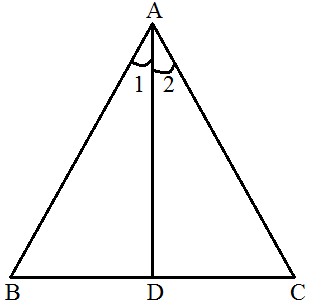
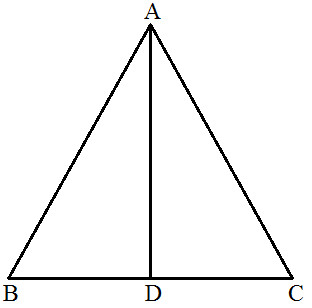
In fig. $\triangle\text{ABC}$ is a triangle such that $\frac{\text{AB}}{\text{AC}}=\frac{\text{BD}}{\text{DC}},\angle\text{B}=70^\circ,\angle\text{C}=50^\circ.$ Find the $\angle\text{BAD}.$
Answer
 In $\triangle\text{ABC},$
$\frac{\text{AB}}{\text{AC}}=\frac{\text{BD}}{\text{DC}},\angle\text{B}=70^\circ,\angle\text{C}=50^\circ$
We know that,
$\angle\text{A}+\angle\text{B}+\angle\text{C}=180^\circ$
$\Rightarrow\angle\text{A}+70^\circ+50^\circ=180^\circ$
$\Rightarrow\angle\text{A}+120^\circ=180^\circ$
$\Rightarrow\angle\text{A}=180^\circ-120^\circ$
$\Rightarrow\angle\text{A}=60^\circ$
$\because\frac{\text{AB}}{\text{AC}}=\frac{\text{BD}}{\text{DC}}$
$\therefore$ AD is bisector of $\angle\text{A}$ so,
$\angle1=\angle2$
$\Rightarrow\angle\text{A}=\angle1+\angle2$
$\Rightarrow60^\circ=2\angle1$
$\Rightarrow\angle1=\frac{60^\circ}{2}$
$\Rightarrow\angle1=30^\circ$
$\Rightarrow\angle\text{BAD}=30^\circ$ View full question & answer→Question 33 Marks
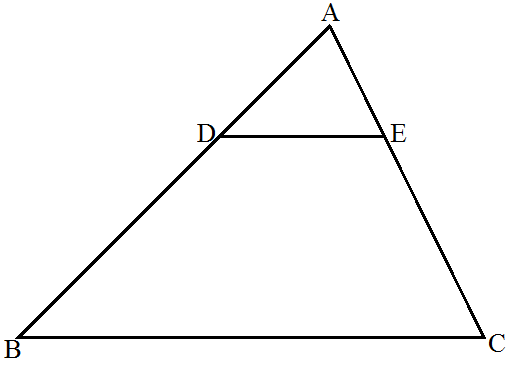
In the given figure, DE || BC such that $\text{AE}=\Big(\frac{1}{4}\Big)$ AC. If AB = 6cm, find AD.
AnswerWe have,
DE || BC and $\text{AE}=\frac{1}{4}\text{ AC},$ AB = 6cm
In $\triangle\text{ADE}$ and $\triangle\text{ABC},$
$\angle\text{A}=\angle\text{A}$ (Common)
$\triangle\text{ADE}\sim\triangle\text{ABC}$
$\Rightarrow\frac{\text{AD}}{\text{AB}}=\frac{\text{AE}}{\text{AC}}$
$\Rightarrow\frac{\text{AD}}{6}=\frac{1}{4}$
$\Rightarrow\text{AD}=\frac{6}{4}=\frac{3}{2}$
$\Rightarrow\text{AD}=1.5\text{cm}$
View full question & answer→Question 43 Marks
In $\triangle\text{ABC and }\triangle\text{DEF},$ it is being given that: AB = 5cm, BC = 4cm and CA = 4.2cm; DE = 10cm, EF = 8cm and FD = 8.4cm. If $\text{AL}\perp\text{BC}$ and $\text{DM} \perp \text{EF,}$ find AL : DM.
Answer
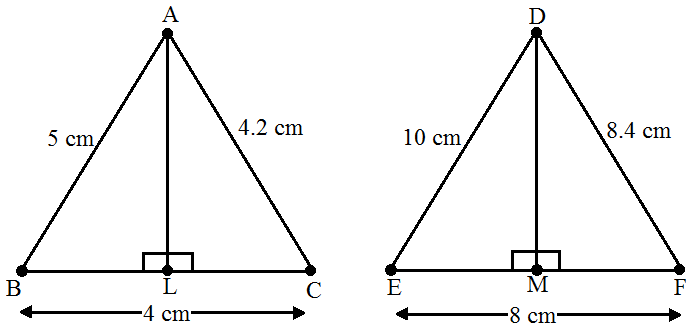 Since, $\frac{\text{AB}}{\text{DE}}=\frac{\text{BC}}{\text{EF}}=\frac{\text{AC}}{\text{DE}}=\frac{1}{2}$
Then, $\triangle\text{ABC}\sim\triangle\text{DEF}$ [By SSS similarity]
Now, In $\triangle\text{ABL}\sim\triangle\text{DEF}$
$\angle\text{B}=\angle\text{E}$ $\big[\triangle\text{ABC}\sim\triangle\text{DEF}\big]$
$\angle\text{ALB}=\angle\text{DME}$ [Each 90°]
Then, $\triangle\text{ABL}\sim\triangle\text{DEM}$ [By AA similarity]
$\therefore\frac{\text{AB}}{\text{DE}}=\frac{\text{AL}}{\text{DM}}$ [Corresponding parts of similar $\triangle$ are proportional]
$\Rightarrow\frac{5}{10}=\frac{\text{AL}}{\text{DM}}$
$\Rightarrow\frac{1}{2}=\frac{\text{AL}}{\text{DM}}$ View full question & answer→Question 53 Marks
In the given figure, $\angle\text{ABC}=90^\circ$ and $\text{BD}\perp\text{AC}.$ If BD = 8cm and AD = 4cm, find CD.
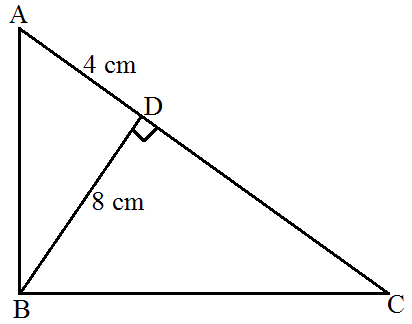
Answer
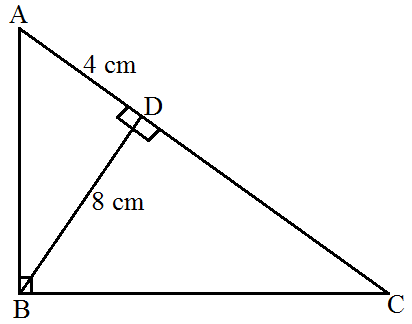 In right $\triangle\text{ABC},$
$\text{BD}\perp\text{AC}$
$\therefore\triangle\text{ABD}\sim\triangle\text{CBD}$
$\therefore\frac{\text{AD}}{\text{BD}}=\frac{\text{BD}}{\text{CD}}$
$\Rightarrow\frac{4}{8}=\frac{8}{\text{CD}}\Rightarrow\text{CD}=\frac{8\times8}{4}=16$
$\therefore\text{CD}=16\text{cm}$ View full question & answer→Question 63 Marks
A vertical stick of length 6m casts a shadow 4m long on the ground and at the same time a tower casts a shadow 28m long. Find the height of the tower.
Answer
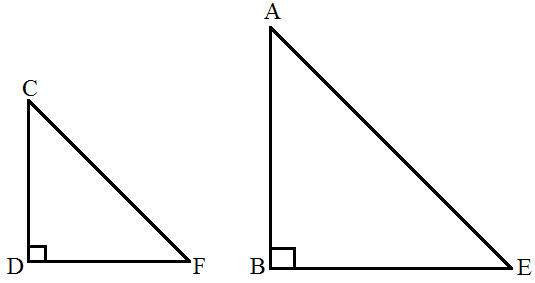 Let AB be a tower
CD be a stick, CD = 6m
Shadow of AB is BE = 28m
Shadow of CD is DF = 4m
At same time light rays from sun will fall on tower and stick same angle.
So, $\angle\text{DCF}=\angle\text{BAE}$
And $\angle\text{DFC}=\angle\text{BEA}$
$\angle\text{CDF}=\angle\text{ABE}$ [tower and stick are vertical to ground)
Therefore $\triangle\text{ABE}\sim\triangle\text{CDF}$ (By AA Similarity)
So, $\frac{\text{AB}}{\text{CD}}=\frac{\text{BE}}{\text{DF}}$
$\frac{\text{AB}}{6}=\frac{28}{4}$
$\text{AB}=28\times\frac{6}{4}=42\text{m}$
So, height of tower will be 42 metres. View full question & answer→Question 73 Marks
In an equilateral $\triangle\text{ABC},\ \text{AD}\perp\text{BC}$ prove that $AD^2 = 3BD^2.$
AnswerGiven: $\triangle\text{ABC}$ is an equilateral in which $AB = BC = CA.$
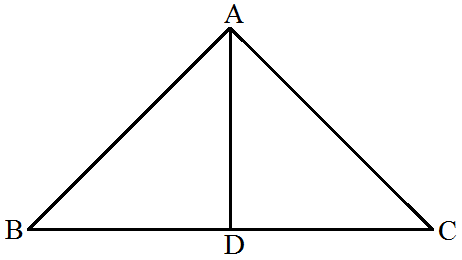
$\text{AD}\perp\text{BC}$
To prove: $AD^2 = 3BD^2$^
Proof: In equilateral $\triangle\text{ABC}.$
$\because\text{AD}\perp\text{BC}$
$\therefore$ AD bisects BC at D
$\therefore\text{BD}=\frac{1}{2}\text{BC}$
Now in right $\triangle\text{ABD}$
$AB^2 = AD^2 + BD^2$ (pythagoras theorem)
$\therefore AD^2 = AB^2 - BD^2$
$AD^2 = BC^2 - BD^2 {AB = AC = BC given}$
$AD^2 = (2BD)^2 - BD^2 {BC = 2BD}$
$AD^2 = 4BD^2 - BD^2$
$AD^2 = 3BD^2$^
Hence proved. View full question & answer→Question 83 Marks
In a $\triangle\text{ABC, D}$ and E are points on the sides AB and AC respectively. For the following cases show that DE || BC:
AB = 10.8cm, BD = 4.5cm, AC = 4.8cm and AE = 2.8cm.
AnswerIt is given that D and E are point on sides AB and AC.
We have to prove that DE || BC.
According to thales theorem we have
$\frac{\text{AD}}{\text{DB}}=\frac{\text{AE}}{\text{CE}}$
AD = AB - DB = 10.8 - 4.5 = 6.3
And EC = AC - AE = 4.8 - 2.8 = 2
Now
$\frac{6.3}{4.5}=\frac{2.8}{2.0}$
Hence, DE || BC.
View full question & answer→Question 93 Marks
In $\triangle\text{ABC},\ \angle\text{A}$ is obtuse, $\text{PB}\perp\text{AC}$ and $\text{QC}\perp\text{AB}$ Prove that:
AB × AQ = AC × AP
Answer
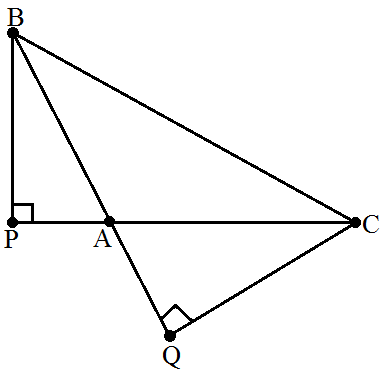 Then, $\triangle\text{APB}\sim\triangle\text{AQC}$ [By AA similarity]
$\therefore\frac{\text{AP}}{\text{AQ}}=\frac{\text{AB}}{\text{AC}}$ [Corresponding parts of similar $\triangle$ are proportional]
⇒ AP × AC = AQ × AB .....(i) View full question & answer→Question 103 Marks
Two poles of heights 6m and $11\ m$ stand on a plane ground. If the distance between their feet is $12\ m$, find the distance between their tops.
AnswerLet us draw a perpendicular from $B$ on $C D$ which meets $C D$ at $P$.
It is clear that $B P=12 m$ because it is given that distance between feet of the two poles is 12 m . After drawing the perpendicular we get a rectangle $B A C P$ such that $A B=P C$ and $B P=A C$.
Because of this construction we also obtained a right angled triangle BPD.
Now we will use Pythagoras theorem,
$B D^2=B P^2+P D^2$
Let us substitute the values of BP and PD we get,
$B D^2=12^2+5^2$
$\therefore B D^2=144+25$
$B D^2=169$
Taking the square root we get, $BD =13$
Therefore, distance between the top of the two poles is 13 m .
View full question & answer→Question 113 Marks
In a $\triangle ABC , D$ and E are points on the sides AB and $A C$ respectively such that $D E \| B C$.If $A D=x, D B=x-2, A E=x$ +2 and $E C=x-1$, find the value of $x$.
AnswerIn the figure, $AD = x, DB = x - 2, AE = x + 2$ and $EC = x - 1$
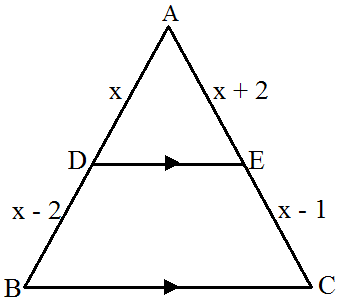
$\because$ DE || BC
$\therefore\frac{\text{AD}}{\text{DB}}=\frac{\text{AE}}{\text{EC}}$
$\Rightarrow\frac{\text{x}}{\text{x}-2}=\frac{\text{x}+2}{\text{x}-1}$
$\Rightarrow x(x - 1) = (x + 2)(x - 2)$
$\Rightarrow x^2 - x = x^2 - 4$
$\Rightarrow x^2 - x - x^2 = -4$
$\Rightarrow -x = -4$
$\Rightarrow x = 4$
$\therefore$ $x = 4$ View full question & answer→Question 123 Marks
In fig. AE is the bisector of the exterior $\angle\text{CAD}$ meeting BC produced in E. If AB = 10cm, AC = 6cm and BC = 12cm, find CE.
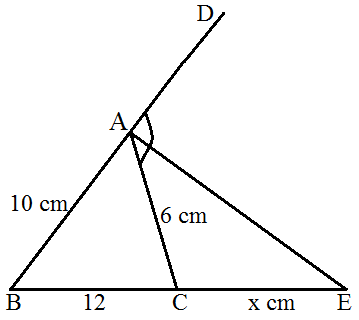
AnswerIn $\triangle\text{ABC, AD}$ is the bisector of $\angle\text{A}.$
We know that, the internal bisector of an angle of a triangle divides the opposite side internally in the retio of the sides containing the angle.
$\therefore\frac{\text{BC}}{\text{CE}}=\frac{\text{AB}}{\text{AC}}\Rightarrow\frac{12-\text{x}}{\text{x}}=\frac{10}{6}$
$\Rightarrow6(12+\text{x})=10\text{x}$
$\Rightarrow72+6\text{x}=10\text{x}$
$\Rightarrow4\text{x}-72=0$
$\Rightarrow\text{x}=\frac{72}{4}=18\text{cm}$
$\therefore\text{CE}=\text{x}=18\text{cm}$
View full question & answer→Question 133 Marks
In a $\triangle\text{ABC,D}\ \text{and E}$ are points on the sides AB and AC respectively such that DE || BC.
If AD = 2cm, AB = 6cm and AC = 9cm, find AE.
Answer
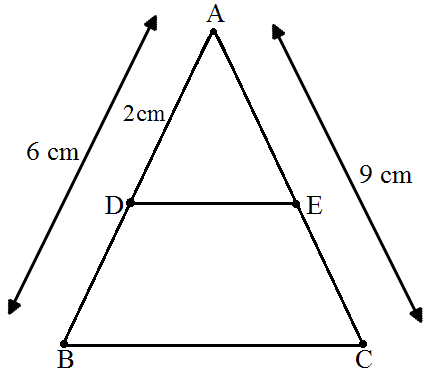 We have,
AD = 2cm, AB = 6cm
$\therefore$ DB = AB - AD
= 6 - 2
$\Rightarrow$ DB = 4cm
And, DE || BC
Therefore, by basic proportionality theorem, we have,
$\frac{\text{AD}}{\text{DB}}=\frac{\text{AE}}{\text{EC}}$
Taking reciprocal on both sides, we get,
$\frac{\text{DB}}{\text{AD}}=\frac{\text{EC}}{\text{AE}}$
$\frac{4}{2}=\frac{\text{EC}}{\text{AE}}$
Adding 1 on both sides, we get
$\frac{4}{2}+1=\frac{\text{EC}}{\text{AE}}+1$
$\Rightarrow\frac{4+2}{2}=\frac{\text{EC}+\text{AE}}{\text{AE}}$
$\Rightarrow\frac{6}{2}=\frac{\text{AC}}{\text{AE}}\ \ [\because\text{EC}+\text{AE}=\text{AC}]$
$\Rightarrow\frac{6}{2}=\frac{9}{\text{AE}}\ \ [\because\text{AC}=9\text{cm}]$
$\text{AE}=\frac{9\times2}{6}$
$\Rightarrow\text{AE}=3\text{cm}$ View full question & answer→Question 143 Marks
In a $\triangle\text{ABC,D}\ \text{and E}$ are points on the sides AB and AC respectively such that DE || BC.
If $\frac{\text{AD}}{\text{DB}}=\frac{2}{3}$ and AC = 18cm, find AE.
AnswerGiven, $\frac{\text{AD}}{\text{DB}}=\frac{2}{3},$ and AC = 18cm
In the figure, DE || BC
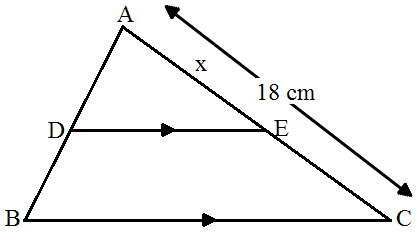
$\therefore\frac{\text{AD}}{\text{DB}}=\frac{\text{AE}}{\text{EC}}$
$\Rightarrow\frac{2}{3}=\frac{\text{AE}}{\text{EC}}$
$\text{Let AE}=\text{x}$
$\therefore\text{EC}=\text{AC}-\text{AE}=18-\text{x}$
$\therefore\frac{\text{x}}{18-\text{x}}=\frac{2}{3}\Rightarrow3\text{x}=36-2\text{x}$
$\Rightarrow3\text{x}+2\text{x}=36\Rightarrow5\text{x}=36$
$\Rightarrow\text{x}=\frac{36}{5}=7.2$
$\therefore\text{AE}=7.2\text{cm}$ View full question & answer→Question 153 Marks
Prove that in an equilateral triangle, three times the square of a side is equal to four times the square of its altitudes.
AnswerGiven: In an equilateral $\triangle\text{ABC},$ $\text{AD}\perp\text{BC}$
To prove: $3AB^2 = 4AD^2$
Proof: The altitude of an equilateral triangle bisects the opposite side
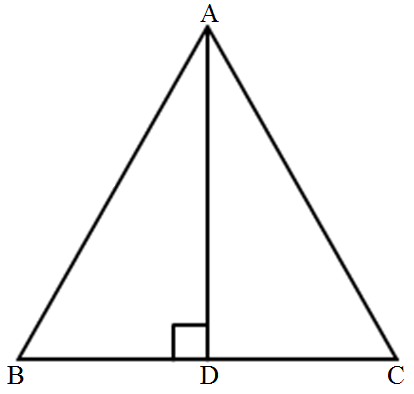
$\because$ D is the mid-point of BC
Now in right $\triangle\text{ABD},$
$AB^2 = BD^2 + AD^2$ (pythagoras Theorem)
$\Rightarrow\text{AB}^2=\Big(\frac{1}{2}\text{BC}\Big)^2+\text{AD}^2=\frac{1}{4}\text{BC}^2+\text{AD}^2$
$\Rightarrow\text{AB}^2=\frac{1}{4}\text{AB}^2+\text{AD}^2$
$\Rightarrow4\text{AB}^2=\text{AB}^2+4\text{AD}^2$
$\Rightarrow4\text{AB}^2-\text{AB}^2=4\text{AD}^2$
$\therefore3\text{AB}^2=4\text{AD}^2$
Hence proved. View full question & answer→Question 163 Marks
If a $\triangle\text{ABC},$ AD is the bisector of $\angle\text{A},$ Meeting side BC at D.
If AB = 3.5cm, AC = 4.2cm and DC = 2.8cm, find BD.
Answer
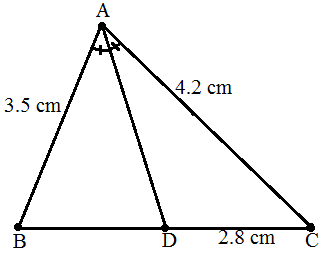 In $\triangle\text{ABC},$ AD is the bisector of $\angle\text{A},$
We know that, the internal bisector of an angle of a triangle divides the opposite side internally in the retio of the sides containing the angle.
$\therefore\frac{\text{BD}}{\text{DC}}=\frac{\text{AB}}{\text{AC}}$
$\Rightarrow\frac{\text{BD}}{2.8}=\frac{3.5}{4.2}$
$=\frac{3.5\times2}{3}$
$=\frac{7}{3}=2.33\text{cm}$ View full question & answer→Question 173 Marks
In the given figure, $\triangle\text{ACB}\sim\triangle\text{APQ}.$ If BC = 10cm, PQ = 5cm, BA = 6.5cm and AP = 2.8cm, find CA and AQ. Also, find the area$ (\triangle\text{ACB)}$ : area $ (\triangle\text{APQ)}.$
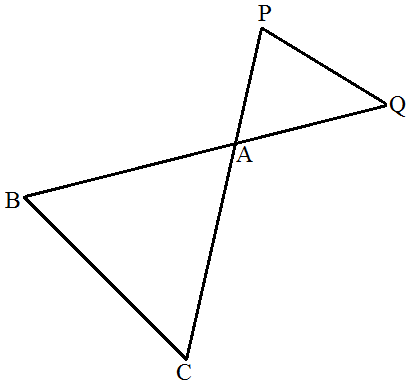
AnswerGiven: $\triangle\text{ACB}$ is similar to $\triangle\text{APQ}$ BC = 10cm, PQ = 5cm, BA = 6.5cm and AP = 2.8cmTo find:
- CA and AQ
- Area of $\triangle\text{ACB}$ : Area of $\triangle\text{APQ}$
- It is given that $\triangle\text{ACB}\sim\triangle\text{APQ}$
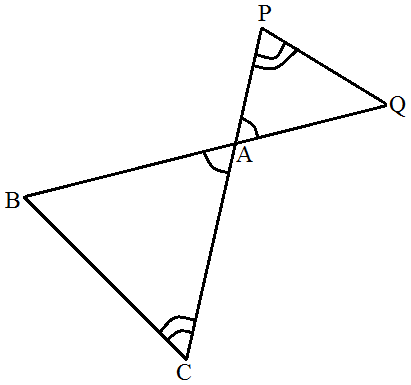
We know that for any two similar triangles the sides are proportional.
Hence, $\frac{\text{AB}}{\text{AQ}}=\frac{\text{BC}}{\text{PQ}}=\frac{\text{AC}}{\text{AP}}$
$\frac{\text{AB}}{\text{AQ}}=\frac{\text{BC}}{\text{PQ}}$
$\frac{6.5}{\text{AQ}}=\frac{10}{5}$
AQ = 3.25cm
Similarly,
$\frac{\text{BC}}{\text{PQ}}=\frac{\text{CA}}{\text{AP}}$
$\frac{\text{CA}}{2.8}=\frac{10}{5}$
CA = 5.6cm
- We know that the ratio of areas of two similar triangles is equal to the ratio of squares of their corresponding sides.
$\frac{\text{ar}(\triangle\text{ACQ})}{\text{ar}(\triangle\text{APQ})}=\Big(\frac{\text{BC}}{\text{PQ}}\Big)^2=\Big(\frac{10}{5}\Big)^2=\Big(\frac{2}{1}\Big)^2=\frac{4}{1}$ View full question & answer→Question 183 Marks
In $\triangle\text{ABC, PQ}$ is a line segment intersecting AB at P and AC at Q such that PQ || BC and PQ divides $\triangle\text{ABC}$ into two parts equal in area. Find $\frac{\text{BP}}{\text{AB}}.$
Answer
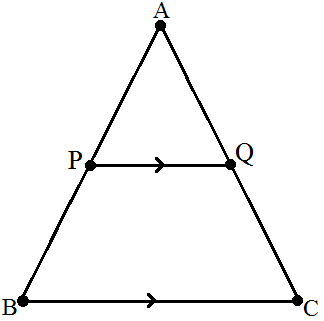 We have,
PQ || BC
And ar $(\triangle\text{APQ})$ = ar(trap. PQCB)
$\Rightarrow\text{ar}(\triangle\text{APQ})=\text{ar}(\triangle\text{ABC})-\text{ar}(\triangle\text{APQ})$
$\Rightarrow\text{2ar}(\triangle\text{APQ})=\text{ar}(\triangle\text{ABC})\ \ ...(\text{i})$
In $\triangle\text{APQ and }\triangle\text{ABC}$
$\angle\text{A}=\angle\text{A}$ [Common]
$\angle\text{APQ}=\angle\text{B}$ [Corresponding angles]
Then, $\triangle\text{APQ}\sim\triangle\text{ABC}$ [By AA similarity]
$\therefore$ By area of similar triangle theorem
$\frac{\text{ar}(\triangle\text{APQ})}{\text{ar}(\triangle\text{ABC})}=\frac{\text{AP}^2}{\text{AB}^2}$
$\Rightarrow\frac{\text{ar}(\triangle\text{APQ})}{\text{ar}(\triangle\text{APQ})}=\frac{\text{AP}^2}{\text{AB}^2}\ \ [\text{By using (i)}]$
$\Rightarrow\frac{1}{2}=\frac{\text{AP}^2}{\text{AB}^2}$
$\Rightarrow\frac{1}{\sqrt{2}}=\frac{\text{AP}}{\text{AB}^2}$
$\Rightarrow\frac{1}{\sqrt{2}}=\frac{\text{AP}}{\text{AB}}$ [Taking square root]
$\Rightarrow\frac{1}{\sqrt{2}}=\frac{\text{AB}-\text{BP}}{\text{AB}}$
$\Rightarrow\frac{1}{\sqrt{2}}=\frac{\text{AB}}{\text{AB}}-\frac{\text{BP}}{\text{AB}}$
$\Rightarrow\frac{1}{\sqrt{2}}=1-\frac{\text{BP}}{\text{AB}}$
$\Rightarrow\frac{\text{BP}}{\text{AB}}=1-\frac{1}{\sqrt{2}}$
$\Rightarrow\frac{\text{BP}}{\text{AB}}=\frac{\sqrt{2}-1}{\sqrt{2}}$ View full question & answer→Question 193 Marks
If a $\triangle\text{ABC},$ AD is the bisector of $\angle\text{A},$ Meeting side BC at D.
If AC = 4.2cm, DC = 6cm and BC = 10cm, find AB.
AnswerAC = 4.2cm, DC = 6cm and BC = 10cm
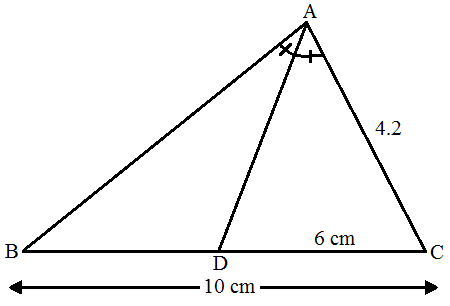
$\because$ BD = BC - DC = 10 - 6 = 4cm
$\because$ AD is the bisector of $\angle\text{A}\ \text{of}\ \triangle\text{ABC}$
$\therefore\frac{\text{AB}}{\text{AC}}=\frac{\text{BD}}{\text{DC}}$
$\Rightarrow\frac{\text{AB}}{4.2}=\frac{4}{6}$
$\Rightarrow\text{AB}=\frac{4\times4.2}{6}=2.8$
$\therefore\text{AB}=2.8\text{cm}$ View full question & answer→Question 203 Marks
In an isosceles triangle $ABC, AB = AC = 25\ cm, BC = 14\ cm$, Calculate the altitude from A on $BC.$
AnswerWe know that altitude that is a perpendicular drawn on the unequal side of the isosceles triangle bisects that side.
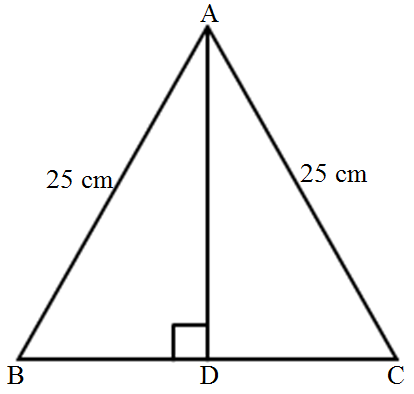
Therefore, $BD = DC = 7cm.$
Let us use the Pythagoras theorem in right angled triangle ADB we get,
$AB^2 = AD^2 + BD^2$^
Substituting the values we get,
$25^2 = AD^2 + 49$
Subtracting 49 from both the sides we get,
$625 - 49 = AD^2$^
$\therefore$
$AD^2 = 576$
Let us take the square root we get,
$AD = 24cm$
Therefore, the altitude of the isosceles triangle is 24cm. View full question & answer→Question 213 Marks
The areas of two similar triangles are $169 cm^2$ and $121 cm^2$ respectively. If the longest side of the larger triangle is $26 \ cm$ , what is the length of the longest side of the smaller triangle?
AnswerLet $\triangle\text{ABC}$ be the larger triangle and $\triangle\text{PQR}$
be the smaller triangle and their longest sides be BC and QR respectively
Area of $\triangle\text{ABC}=169\text{cm}^2$
Area of $\triangle\text{PQR} = 121\text{cm}^2$
$BC = 26cm$
$Let QR = x cm$
$\triangle\text{ABC}\sim\triangle\text{PQR}$
$\therefore\frac{\text{area}\triangle\text{ABC}}{\text{area}\triangle\text{PQR}}=\frac{\text{BC}^2}{\text{QR}^2}$
$\Rightarrow\frac{169}{121}=\frac{(26)^2}{\text{x}^2}$
$\Rightarrow\frac{(13)^2}{(11)^2}=\frac{(26)^2}{(\text{x})^2}\Rightarrow\frac{13}{11}=\frac{26}{\text{x}}$
$\Rightarrow\text{x}=\frac{26\times11}{13}=22$
$\therefore\text{QR}=22\text{cm}$
View full question & answer→Question 223 Marks
In $\triangle\text{ABC},$ the bisector of $\angle\text{A}$ intersects BC in D. If AB = 18cm, AC = 15cm and BC = 22cm, find BD.
Answer
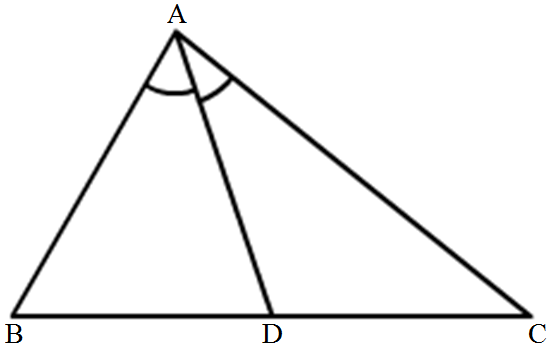 We have to find the value of BD.
Given: AB = 18cm, AC = 15cm and BC = 22cm.
In $\triangle\text{ABC},$ AD the bisector of $\angle\text{A}.$
$\frac{\text{AB}}{\text{AC}}=\frac{\text{BD}}{\text{DC}}$
$\frac{\text{AB}}{\text{AC}}=\frac{\text{BD}}{\text{BC}-\text{BD}}$
$\frac{18}{15}=\frac{\text{BD}}{22-\text{BD}}$
On cross multiplication, we get,
6(22 - BD) = 5 × BD
132 - 6BD = 5BD
132 = 5BD + 6BD
132 = 11BD
$\text{BD}=\frac{132}{11}$
BD = 12cm
Hence, the value of BD is 12cm. View full question & answer→Question 233 Marks
The perimeters of two similar triangles are 25cm and 15cm respectively. If one side of first triangle is 9cm, what is the corresponding side of the other triangle?
AnswerLet perimeter of $\triangle\text{ABC}=25\text{cm}$
and perimeter of $\triangle\text{DEF}=15\text{cm}$
and side BC of $\triangle\text{ABC}=9\text{cm}$
Now we have to find the side EF of $\triangle\text{DEF}$
$\triangle\text{ABC}\sim\triangle\text{DEF}$ (given)
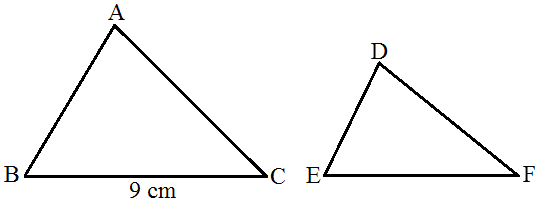
$\therefore\frac{\text{Perimeter of }\triangle\text{ABC}}{\text{Perimeter of }\triangle\text{DEF}}=\frac{\text{BC}}{\text{EF}}$
$\Rightarrow\frac{25}{15}=\frac{9}{\text{EF}}$
$\Rightarrow\text{EF}=\frac{15\times9}{25}=\frac{27}{5}=5.4\text{cm}$ View full question & answer→Question 243 Marks
In a $\triangle\text{ABC,D}\ \text{and E}$ are points on the sides AB and AC respectively such that DE || BC.
If AD = 4, AE = 8, DB = x - 4, and EC = 3x - 19, find x.
Answer
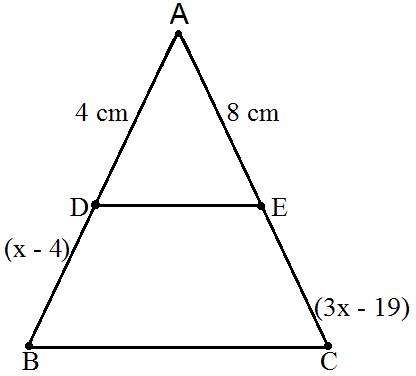 We have,
DE || BC
therefore, by basic proportionally theorem,
We have $\frac{\text{AD}}{\text{DB}}=\frac{\text{AE}}{\text{EC}}$
$\frac{4}{\text{x}-4}=\frac{8}{3\text{x}-19}$
$\Rightarrow4(3\text{x}-19)=8(\text{x}-4)$
$\Rightarrow12\text{x}-76=8\text{x}-32$
$\Rightarrow12\text{x}-8\text{x}=-32+76$
$\Rightarrow4\text{x }=44$
$\Rightarrow\text{x}=\frac{44}{4}=11\text{cm}$
$\therefore\text{x}=11\text{cm}$ View full question & answer→Question 253 Marks
In $\triangle\text{ABC},$ P and Q are points on sides AB and AC respectively such that PQ || BC. If AP = 3cm, PB = 5cm and AC = 8cm, find AQ.
AnswerIn $\triangle\text{ABC},$ P and Q are points on the sides AB and AC such that PQ || BC and AP = 3cm, PQ = 5cm, AC = 8cm
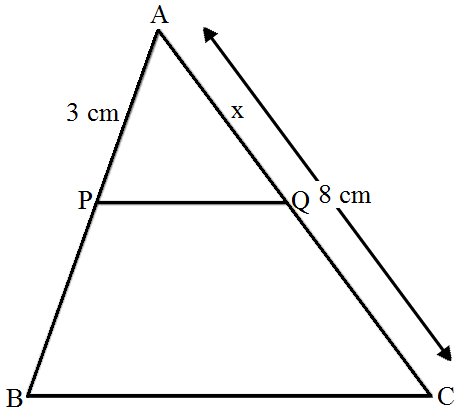
Let AQ = x
Then QC = (8 - x)
$\because$ In $\triangle\text{ABC},$ PQ || BC
$\therefore\frac{\text{AP}}{\text{PB}}=\frac{\text{AQ}}{\text{QC}}\Rightarrow\frac{3}{5}=\frac{\text{x}}{8-\text{x}}$
$\Rightarrow5\text{x}=24-3\text{x}\Rightarrow5\text{x}+3\text{x}=24$
8x = 24
⇒ x = 3
AQ = 3cm. View full question & answer→Question 263 Marks
If the altitude of two similar triangles are in the ratio 2 : 3, what is the ratio of their areas?
AnswerGiven: Altitudes of two similar triangles are in ratio 2 : 3.
To find: Ratio of the areas of two similar triangles.
Let first triangle be $\triangle\text{ABC}$ and the second triangle be $\triangle\text{PQR}$
We know that the areas of two similar triangles are in the ratio of the squares of the corresponding altitudes.
$\Rightarrow\frac{\text{Area}(\triangle\text{ABC})}{\text{Area}(\triangle\text{PQR)}}=\frac{2^2}{3^2}$
$\frac{\text{Area}(\triangle\text{ABC})}{\text{Area}(\triangle\text{PQR)}}=\frac{4}{9}$
View full question & answer→Question 273 Marks
In a $\triangle\text{ABC,D}\ \text{and E}$ are points on the sides AB and AC respectively such that DE || BC.
If AD = 8cm, AB = 12cm and AE = 12cm, find CE.
AnswerAD = 8cm, AB = 12cm, AE = 12cm
DB = AB - AD
DB = 12 - 8
DB = 4cm
by thales theorem,
$\frac{\text{AD}}{\text{DB}}=\frac{\text{AE}}{\text{EC}}$
$\Rightarrow\frac{8}{4}=\frac{12}{\text{EC}}$
$\Rightarrow\text{EC}=\frac{12\times4}{8}$
$\Rightarrow\text{EC}=6\text{cm}$
View full question & answer→Question 283 Marks
M and N are points on the sides PQ and PR respectively of a $\triangle\text{PQR}.$ For the following cases, state whether MN || QR.
PQ = 1.28cm, PR = 2.56cm, PM = 0.16cm, PN = 0.32cm.
AnswerIn $\triangle\text{PQR},$ M and N are points on PQ and PR respectively and PQ = 1.28cm, PR = 2.56cm, PM = 0.16cm, PN = 0.32cm.
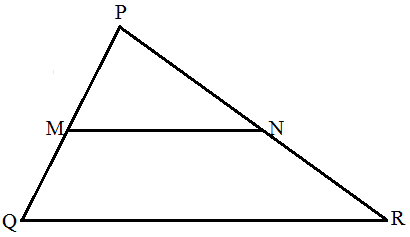
QM = PQ - PM = 1.28 - 0.16 = 1.12 and RN = PR - PN
= 2.56 - 0.32 = 2.24cm
Now $\frac{\text{PM}}{\text{MQ}}=\frac{0.16}{1.12}=\frac{1}{7}$
and $\frac{\text{PN}}{\text{NR}}=\frac{0.32}{2.24}=\frac{1}{7}$
$\because\frac{\text{PM}}{\text{MQ}}=\frac{\text{PN}}{\text{NR}}$
$\therefore\text{MN}||\text{QR}$ View full question & answer→Question 293 Marks
Calculate the height of an equilateral triangle each of whose sides measures $12\ cm.$
Answer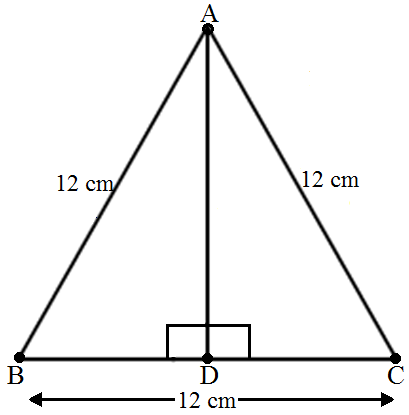
We have,
$\triangle\text{ABC}$ is an equilateral $\triangle$ with side 12cm
Draw $\text{AD}\perp\text{BC}$
In $\triangle\text{ABD}$ and $\triangle\text{ACD}$
$\angle\text{ADB}=\angle\text{ADC}$ [Each 90°]
$AB = AC$ [Each 12cm]
$AD = AD$ [Common]
Then, $\triangle\text{ABD}\cong\triangle\text{ACD}$ [By RHS condition]
$\therefore$ $AD^2 + BD^2 = AB^2$
$\Rightarrow AD^2 + 6^2 = 12^2$
$\Rightarrow AD^2 = 144 - 36 = 108$
$\Rightarrow\text{AD}=\sqrt{108}=10.39\text{cm}$ View full question & answer→Question 303 Marks
In figure, PQ || BC and AP : PB = 1 : 2. Find: $\frac{\text{area}(\triangle\text{APQ})}{\text{area}(\triangle\text{ABC})}$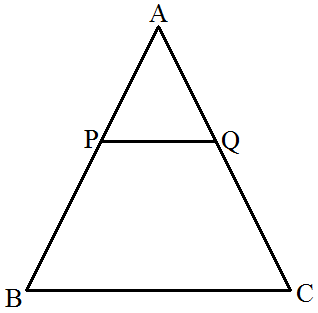
AnswerIn $\triangle\text{ABC}$ PQ || BC
$\triangle\text{APQ}\sim\triangle\text{ABC}$
But AP : PB = 1 : 2
The ratio of the areas of two similar triangles are proportional to the square of their corresponding sides
$\therefore\frac{\text{area}(\triangle\text{APQ})}{\text{area}(\triangle\text{ABC})}=\frac{\text{AP}^2}{\text{AB}^2}=\frac{(1)^2}{(1+2)^2}=\frac{(1)^2}{(3)^2}$
$=\frac{(1)^2}{(3)^2}=\frac{1}{9}$
$\therefore$ Ratio = 1 : 9.
View full question & answer→Question 313 Marks
In a $\triangle\text{ABC,}$ P and Q are points on sides AB and AC respectively, such that PQ || BC. If AP = 2.4cm, AQ = 2cm, QC = 3cm and BC = 6cm, find the AB and PQ.
Answer
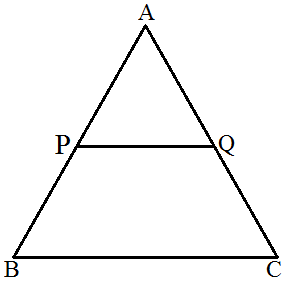 PQ || BC. If AP = 2.4cm, AQ = 2cm, QC = 3cm and BC = 6cm,
$\frac{\text{AP}}{\text{AB}}=\frac{\text{AQ}}{\text{AC}}$ (by thales theorem)
$\Rightarrow\frac{\text{AP}}{\text{AB}}=\frac{\text{AQ}}{\text{AQ}+\text{QC}}$
$\Rightarrow\frac{2.4}{\text{AB}}=\frac{2}{2+3}$
$\Rightarrow\text{AB}=\frac{2.4\times5}{2}$
$\Rightarrow\text{AB}=1.2\times5$
$\Rightarrow\text{AB}=6\text{cm}$
and, $\frac{\text{AP}}{\text{AB}}=\frac{\text{PQ}}{\text{BC}}$
$\Rightarrow\frac{2.4}{6}=\frac{\text{PQ}}{6}$
$\Rightarrow\text{PQ}=\frac{2.4\times6}{6}$
$\Rightarrow\text{PQ}=2.4\text{cm}$
Thus, AB = 6cm and PQ = 2.4cm. View full question & answer→Question 323 Marks
A triangle has sides 5cm, 12cm and 13cm. Find the length to one decimal place, of the perpendicular from the opposite vertex to the side whose length is 13cm.
Answer
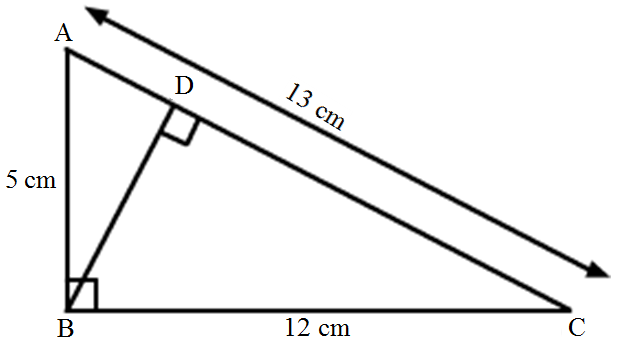 Since $\text{BD}\perp\text{AC}$ we obtained two right angled triangles, $\triangle\text{ABD}$ and $\triangle\text{BDC}.$
In $\triangle\text{ABC}$ and $\triangle\text{ABD}$
$\angle\text{A}=\angle\text{A}$ (Common angle)
$\angle\text{B}=\angle\text{D}$
So, by AA-criterion $\triangle\text{ABC}\sim\triangle\text{ADB}$
$\therefore\frac{\text{AB}}{\text{AD}}=\frac{\text{BC}}{\text{BD}}=\frac{\text{AC}}{\text{AB}}$
$\therefore\frac{\text{BC}}{\text{BD}}=\frac{\text{AC}}{\text{AB}}$
Now we will multiply both sides of the equation by AB × BD.
BC × AB = BD × AC .....(1)
Let us simplify the equation (1) as given below,
$\text{BD}=\frac{\text{BC}\times\text{AB}}{\text{AC}}$
Now we will substitute the values of BC, AB and AC.
$\text{BD}=\frac{12\times5}{13}$
$\therefore\text{BD}=\frac{60}{13}$
$\therefore\text{BD}=4.6\text{cm}$
Therefore, the length of the altitude is 4.6cm. View full question & answer→Question 333 Marks
There is a staircase as shown in the given figure, connecting points A and B. Measurements of steps are marked in the figure. Find the straight line distance between A and B.
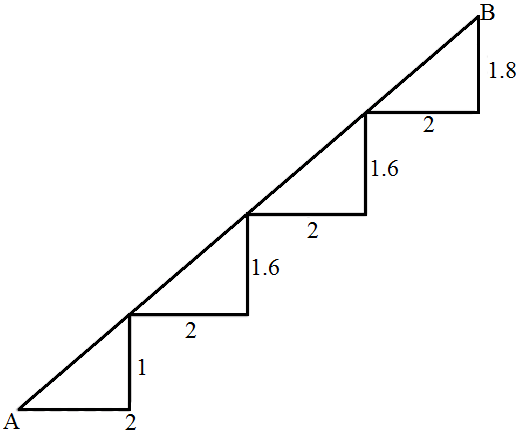
AnswerThere are 4 steps in staircase AB
Taking first step,
In $\triangle\text{ALP}$
$\text{AP}^2=\text{AL}^2+\text{LP}^2$ (Pythagoras Theorem)
$=2^2+1^2=4+1=5$
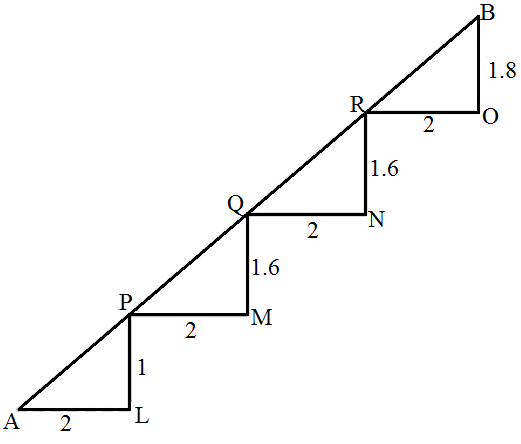
$\therefore\text{AP}=\sqrt{5}=2.236=2.24$
Similarly
$\text{PQ}^2=2^2+1.6^2=4+2.56=6.56$
$\text{PQ}=\sqrt{6.56}=2.56$
$\text{QR}=\sqrt{2^2+1.6^2}=\sqrt{4+2.56}$
$=\sqrt{6.56}=2.56$
$\text{RB}=\sqrt{2^2+(1.8)^2}=\sqrt{4+3.24}$
$=\sqrt{7.24}=2.69$
$\therefore\text{AB}=2.24+2.56+2.56+269$
$=10.05=10\text{cm (Approx})$ View full question & answer→Question 343 Marks
In FIg. check whether AD is the bisector of $\angle\text{A}$ of $\triangle\text{ABC}$ in the following.
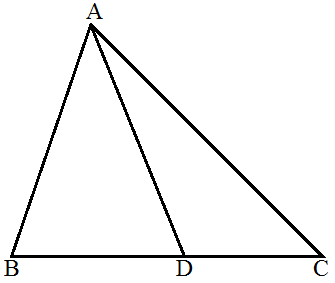
AB = 4cm, AC = 6cm, BD = 1.6cm and CD = 2.4cm. AnswerAB = 4cm, AC = 6cm, BD = 1.6cm and CD = 2.4cm.
Now $\frac{\text{AB}}{\text{AC}}=\frac{4}{6}=\frac{2}{3}$
$\frac{\text{BD}}{\text{CD}}=\frac{1.6}{2.4}=\frac{2}{3}$
$\because\frac{\text{AB}}{\text{AC}}=\frac{\text{BD}}{\text{CD}}$
$\therefore$ AD is the bisector of $\angle\text{A}$
View full question & answer→Question 353 Marks
If D is a point on the side AB of $\triangle\text{ABC}$ such that AD : DB = 3.2 and E is a point on BC such that DE || AC. Find the ratio of areas of $\triangle\text{ABC}$ and $\triangle\text{BDE}.$
AnswerIn $\triangle\text{ABC},$ D is a point on AB such that AD : DB = 3 : 2
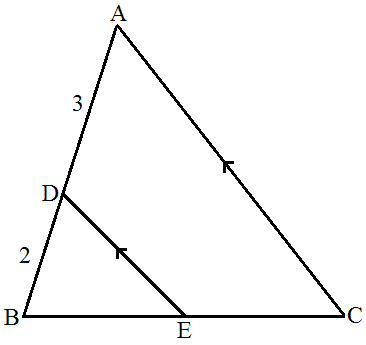
DE || AC is drawn meeting BC is E
$\therefore$ DE || AC
$\therefore\triangle\text{BED}\sim\triangle\text{ABC}$
$\therefore\frac{\text{area}(\triangle\text{ABC)}}{\text{area}(\triangle\text{BDE})}=\frac{\text{AB}^2}{\text{BD}^2}=\frac{(\text{BD+AD})^2}{\text{BD}^2}$
$=\frac{(2+3)^2}{(2)^2}=\frac{(5)^2}{(2)^2}=\frac{25}{4}$
$\therefore$ Ratio = 25 : 4 View full question & answer→Question 363 Marks
Two poles of height 9m and $14\ m$ stand on a plane ground. If the distance between their feet is $12\ m$, find the distance between their tops.
Answer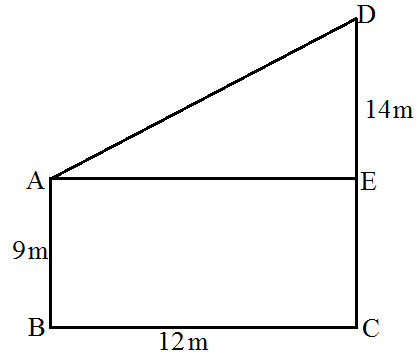
let AB and CD be two poles and distance blw
their feet be $12m$
$AB = 9m, CD = 14m$ and $BC = 12m$
$AB = EC = 9m$
$ED = CD - EC$
$ED = 14 - 9 = 5m$
In $\triangle\text{AED}$
$AD^2 = AE^2 + ED^2$
$\Rightarrow AD^2 = (12)^2 + (5)^2$
$\Rightarrow AD^2 = 144 + 25$
$\Rightarrow AD^2 = 169$
$\Rightarrow AD = 13m$
thus, distance blw top of poles is 13m. View full question & answer→Question 373 Marks
ABCD is a trapezium having AB || DC. Prove that O, the point of intersection of diagonals, divides the two diagonals in the same ratio. Also prove that $\frac{\text{ar}(\triangle\text{OCD})}{\text{ar}(\triangle\text{OAB})}=\frac{1}{9},$ if AB = 3CD.
AnswerGiven: ABCD is a trapezium in which AB || DC and diagonals AC and BD intersect each other at O. 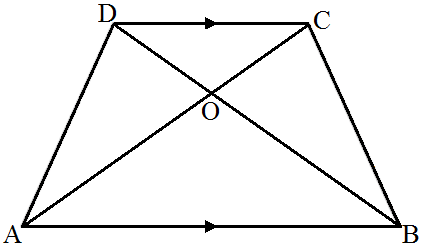 To prove:
- O divides the diagonals in the same ratio or $\frac{\text{OA}}{\text{OC}}=\frac{\text{OB}}{\text{OD}}$
- $\frac{\text{ar}(\triangle\text{OCD})}{\text{ar}(\triangle\text{OAB})}=\frac{1}{9}$ if AB = 3CD
Proof:
- In $\triangle\text{AOB}$ and $\triangle\text{COD}$
$\angle\text{AOB}=\angle\text{COD}$ (Vertically opposite angles)
$\angle\text{OAB}=\angle\text{OCD}$ (Alternate angles)
$\therefore\triangle\text{AOB}\sim\triangle\text{COD}$ (AA criterion)
$\frac{\text{AB}}{\text{DC}}=\frac{\text{OA}}{\text{OC}}=\frac{\text{OB}}{\text{OD}}$
$\Rightarrow\text{OA}\times\text{OD}=\text{OB}\times\text{OC}$
Hence O divides the diagonals in the same ratio
- $\because\triangle\text{AOB}\sim\triangle\text{COD}$ (proved)
$\therefore\frac{\text{area}(\triangle\text{OCD})}{\text{area}(\triangle\text{OAB})}=\frac{\text{CD}^2}{\text{AB}^2}$
But AB = 3CD
$\frac{\text{area}(\triangle\text{OCD})}{\text{area}(\triangle\text{OAB})}=\frac{\text{CD}^2}{(3\text{CD})^2}=\frac{\text{CD}^2}{9\text{CD}^2}=\frac{1}{9}$
Hence proved. View full question & answer→Question 383 Marks
The areas of two similar triangles ABC and PQR are in the ratio 9 : 16. If BC = 4.5cm, find the length of QR.
AnswerGiven: The areas of two similar triangles ABC and PQR are in the ratio 9 : 16, BC = 4.5cm.
To find: length of QR
We know that the ratio of areas of two similar triangle is equal to the ratio of their corresponding sides.
$\frac{\text{ar}(\triangle\text{ABC})}{\text{ar}(\triangle\text{PQR})}=\Big(\frac{\text{BC}}{\text{QR}}\Big)^2$
$\frac{9}{16}=\Big(\frac{4.5}{\text{QR}}\Big)^2$
$\frac{3}{4}=\frac{4.5}{\text{QR}}$
$\text{QR}=\frac{4\times4.5}{3}$
$\text{QR}=6\text{cm}$
View full question & answer→Question 393 Marks
The foot of a ladder is 6m away from a wall and its top reaches a window 8m above the ground. If the ladder is shifted in such a way that its foot is 8m away from the wall, to what height does its tip reach?
AnswerIn first case,
The foot of the ladder are 6m away from the wall and its top reaches window 8m high
Let $AC$ be ladder and $BC = 6m, AB = 8m$
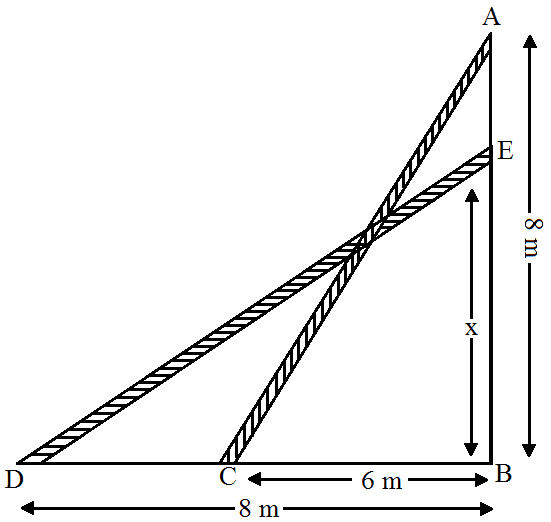
Now in right $\triangle\text{ABC}$
Using Pythagoras Theorem
AC^2 = BC^2 + AB^2 = (6)^2 + (8)^2 = 36 + 64 = 100 = (10)^2
AC = 10m
In second case,
$ED = AC = 10m$
$BD = 8m$, let$ ED = x$
$ED^2 = BD^2 + EB^2$
$\Rightarrow (10)^2 = (8)^2 + x^2$
$\Rightarrow 100 = 64 + x^2$
$\Rightarrow x^2 = 100 – 64 = 36 = (6)^2$
$x = 6$
Height of the ladder on the wall $= 6m$
View full question & answer→Question 403 Marks
In $\triangle\text{ABC},$ D and E are points on sides AB and AC respectively such that AD × EC = AE × DB. Prove that DE || BC.
AnswerGiven: In $\triangle\text{ABC},$ and E are points on sides AB and AC such that AD × EC = AE × DB To Prove: DE || BC 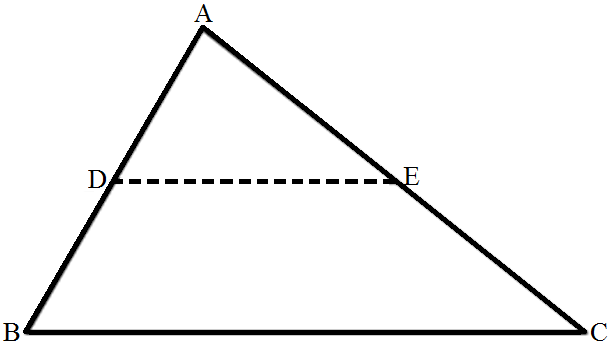 Proof:
Since AD × EC = AE × DB $\Rightarrow\frac{\text{DB}}{\text{AD}}=\frac{\text{EC}}{\text{AE}}$ $\Rightarrow\frac{\text{DB}}{\text{AD}}+1=\frac{\text{EC}}{\text{AE}}+1$ $\Rightarrow\frac{\text{DB}+\text{AD}}{\text{AD}}=\frac{\text{EC}+\text{AE}}{\text{AE}}$ $\Rightarrow\frac{\text{AB}}{\text{AD}}=\frac{\text{AC}}{\text{AE}}$ $\therefore\text{DE}||\text{BC}$ (Converse of basic proportionality theorem) View full question & answer→Question 413 Marks
In the given figure, $\angle\text{A}=\angle\text{CED},$ prove that $\triangle\text{CAB}\sim\triangle\text{CED}.$ Also, find the value of x.
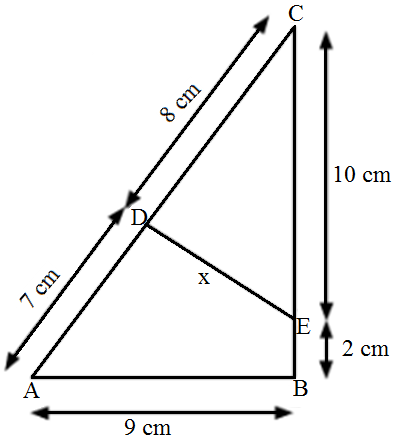
AnswerWe have,
$\angle\text{A}=\angle\text{CED}$
In $\triangle\text{CAB}$ and $\triangle\text{CED}$
$\angle\text{A}=\angle\text{CED}$
$\angle\text{C}=\angle\text{C}$
$\triangle\text{CAB}\sim\triangle\text{CED}$ (By AA criteria)
Now, $\frac{\text{CA}}{\text{CE}}=\frac{\text{AB}}{\text{ED}}$
$\Rightarrow\frac{7+8}{10}=\frac{9}{\text{x}}$
$\Rightarrow\text{x}=\frac{9\times10}{15}$
$\Rightarrow\text{x}=\frac{90}{15}$
$\Rightarrow\text{x}=6\text{cm}.$
View full question & answer→Question 423 Marks
$\triangle\text{ABD}$ is a right triangle right-angled at A and $\text{AC}\perp\text{BD}.$ Show that
$AC^2 = BC \times DC$
Answer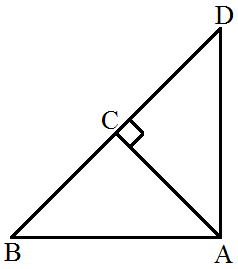
Let $\angle\text{CAB}=\text{x}$
In $\triangle\text{CBA}$
$\angle\text{CBA}=180^\circ-90^\circ-\text{x}$
$\angle\text{CBA}=90^\circ-\text{x}$
Similarly in $\triangle\text{CAD}$
$\angle\text{CAD}=90^\circ-\angle\text{CAD}=90^\circ-\text{x}$
$\angle\text{CDA}=90^\circ-\angle\text{CAB}$
$=90^\circ-\text{x}$
$\angle\text{CDA}=180^\circ-90^\circ-(90^\circ-\text{x})$
$\angle\text{CDA}=\text{x}$
Now in $\triangle\text{CBA}$ and $\triangle\text{CAD}$ we may observe that,
$\angle\text{CBA}=\angle\text{CAD}$
$\angle\text{CAB}=\angle\text{CDA}$
$\angle\text{ACB}=\angle\text{DCA}=90^\circ$
Therefore $\triangle\text{CBA}\sim\triangle\text{CAD}$ (by AAA rule)
Therefore $\frac{\text{AC}}{\text{DC}}=\frac{\text{BC}}{\text{AC}}$
$\Rightarrow\text{AC}^2=\text{DC}\times\text{BC}$ View full question & answer→Question 433 Marks
If $\triangle\text{ABC}$ and $\triangle\text{DEF}$ are similar triangles such that AB = 3cm, BC = 2cm, CA = 2.5cm and EF = 4cm, write the perimeter of $\triangle\text{DEF}.$
Answer$\because\triangle\text{ABC}\sim\triangle\text{DEF}$
$\therefore\frac{\text{AB}}{\text{DE}}=\frac{\text{BC}}{\text{EF}}=\frac{\text{CA}}{\text{FD}}$
But AB = 3cm, BC = 2cm, CA = 2.5cm and EF = 4cm.
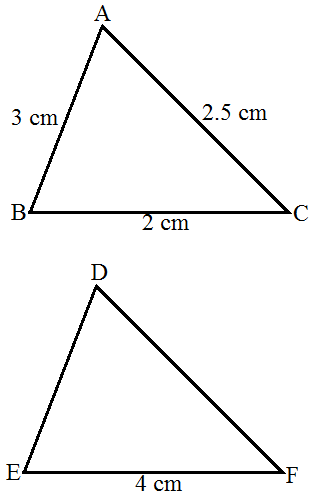
$\therefore\frac{3}{\text{DE}}=\frac{2}{4}=\frac{2.5}{\text{FD}}$
Now $\frac{3}{\text{DE}}=\frac{2}{4}\Rightarrow\text{DE}=\frac{3\times4}{2}=6\text{cm}$
and $\frac{\text{CA}}{\text{FD}}=\frac{2}{4}\Rightarrow\frac{2.5}{\text{FD}}=\frac{2}{4}$
$\text{FD}=\frac{2.5\times4}{2}=5\text{cm}$
$\therefore$ Perimeter of $\triangle\text{DEF}=6+4+5=15\text{cm}$ View full question & answer→Question 443 Marks
In a quadrilateral ABCD, $\angle\text{B}=90^\circ,$ $AD^2 = AB^2 + BC^2 + CD^2,$ prove that $\angle\text{ACD}=90^\circ.$
Answer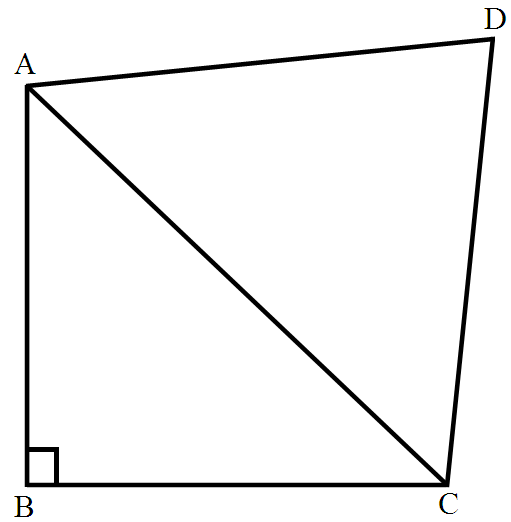
In order to prove angle $\angle\text{ACD}=90^\circ$ it is enough to prove that $AD^2 = AC^2 + CD^2$^
Given: $AD^2 = AB^2 + BC^2 + CD^2$
$AD^2 - CD^2 = AB^2 + BC^2 ......(1)$
Since $\angle\text{B}=90^\circ,$ so applying pythagoras theorem in the right angled triangle ABC, we get,
$AC^2 = AB^2 + BC^2 ....(2)$
From (1) and (2), we get
$AC^2 = AD^2 - CD^2$
$AC^2 + CD^2 = AD^2$^
Therefore, angle $\triangle\text{ACD}=90^\circ.$ (Converse of pythagoras theorem) View full question & answer→Question 453 Marks
In $\triangle\text{ABC},$ given that $AB = AC$ and $\text{BD}\perp\text{AC}.$ Prove that $BC^2 = 2AC \times CD.$
AnswerGiven: In $\triangle\text{ABC},$
$\text{AB} = \text{AC, } \text{BD}\perp\text{AC}$
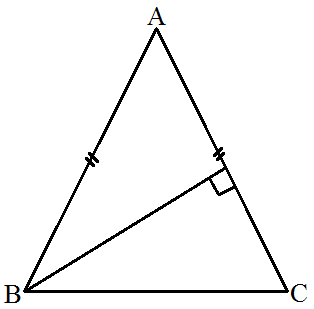
To prove: $BC^2 = 2AC \times CD$
$\therefore$
$AB^2 = BD^2 + AD^2 $(Pythagoras Theorem)
$\Rightarrow BD^2 = AB^2 - AD^2 .....(i)$ Similarly in right
$\triangle\text{BDC},$$ BC^2 = BD^2 + DC^2 = AB^2 - AD^2 + DC^2$^ [From (i)]
$= AB^2 - (AC - CD)^2 + CD^2 $
$= AB^2 - (AC^2 + CD^2 - 2AC \times CD) + CD^2 $
$= AC^2 - AC^2 - CD^2 + 2AC \times CD + CD^2$^
($\because$
$AB = AC) = 2AC \times CD$ (given)
Hence $BC^2 = 2AC \times CD$ View full question & answer→Question 463 Marks
In $\triangle\text{ABC}$ (Fig.), if $\angle1=\angle2,$ prove that $\frac{\text{AB}}{\text{AC}}=\frac{\text{BD}}{\text{DC}}.$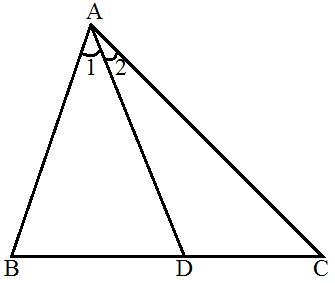
Answer
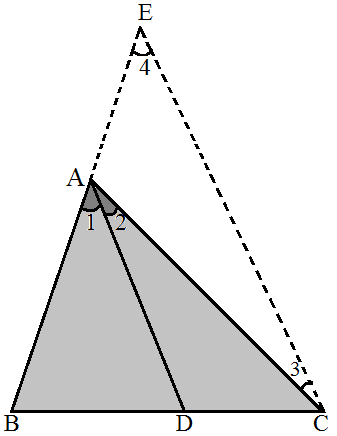 Given: A $\triangle\text{ABC}$ in which $\angle1=\angle2$
To prove: $\frac{\text{AB}}{\text{AC}}=\frac{\text{BD}}{\text{DC}}$
Construction: Draw CE || DA to meet BA produced in E.
Proof: since, CE || DA and AC cuts them.
$\therefore\angle2=\angle3\ ....(\text{i})$ [Alternate angles]
And, $\angle1=\angle4\ ...(\text{ii})$ [Corresponding angles]
But, $\angle1=\angle2$ [Given]
Form (i) and (ii), we get
$\angle3=\angle4$
Thus, in $\triangle\text{ACE},$ we have
$\angle3=\angle4$
$\Rightarrow\text{AE}=\text{AC}\ ...(\text{iii})$ [Sides opposite to equal angles are equal]
Now, In $\triangle\text{BCE},$ we have
DA || CE
$\Rightarrow\frac{\text{BD}}{\text{DC}}=\frac{\text{BA}}{\text{AE}}$ [Using basic proportionality theorem]
$\Rightarrow\frac{\text{BD}}{\text{DC}}=\frac{\text{AB}}{\text{AC}}$ [$\because$ BA - AB and AE - AC from (iii)]
Hence, $\frac{\text{AB}}{\text{AC}}=\frac{\text{BD}}{\text{DC}}$ View full question & answer→Question 473 Marks
In a triangle $ABC, N$ is a point on$ AC$ such that $\text{BN}\perp\text{AC}.$ If $BN^2 = AN \times NC$, prove that $\angle\text{B}=90^\circ.$
AnswerIn $\triangle\text{ABC},\ \text{BN}\perp\text{AC}.$ Also, $BN^2 = AN \times NC$ We have to prove that $\angle\text{B}=90^\circ.$
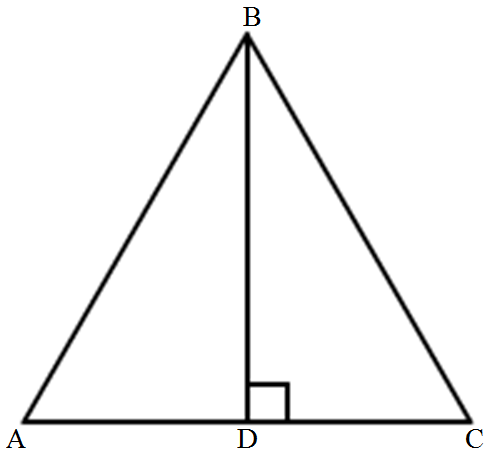
In triangles ABN and BNC,
we have $AB^2 = AN^2 + BN^2 BC^2 = BN^2 + CN^2$ Adding above two equations,
we get $AB^2 + BC^2 = AN^2 + CN^2 + 2BN^2 $
Since $BN^2 = AN \times NC So, AB^2 + BC^2 $
$= AN^2 + CN^2 + 2AN \times NC AB^2 + BC^2 $
$= (AN + NC)^2 AB^2 + BC^2 = AC^2$^
Hence $\angle\text{B}=90^\circ$ View full question & answer→Question 483 Marks
ABCD is a trapezium in which AB || DC. P and Q are points on sides AD and BC such that PQ || AB. If PD = 18, BQ = 35 and QC = 15, find AD.
AnswerIn trapezium ABCD, AB || DC
P and Q are points on AD and BC respectively such that
PQ || AB PD = 18, BQ = 35, QC = 15
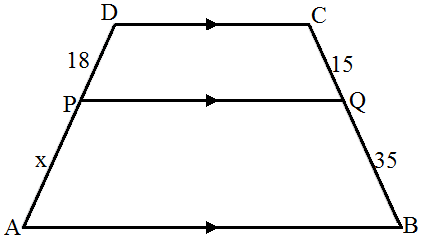
Let AP = x
$\because$ DC || AB || PQ
$\therefore\frac{\text{DP}}{\text{PA}}=\frac{\text{CQ}}{\text{QB}}$
$\Rightarrow\frac{18}{\text{x}}=\frac{15}{35}\Rightarrow\text{x}=\frac{18\times35}{15}=42$
$\therefore\text{AD}=\text{AP}+\text{PD}=42+18=60$ View full question & answer→Question 493 Marks
In $\triangle\text{ABC},$ P divides the side AB such that AP : PB = 1 : 2. Q is a point in AC such that PQ || BC. Find the ratio of the areas of $\triangle\text{APQ},$ and trapezium BPQC.
AnswerIn $\triangle\text{ABC}$ P is a point on AB such that AP : PQ = 1 : 2
PQ || BC
Now we have to find the ratio between area $\triangle\text{APQ}$ and area trap BPQC
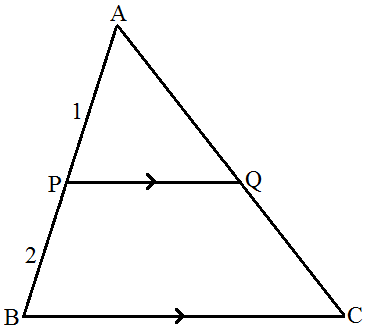
$\because\text{PQ}||\text{BC}$
$\therefore\triangle\text{APQ}\sim\triangle\text{ABC}$
$\frac{\text{area}(\triangle\text{APQ)}}{\text{area}(\triangle\text{ABC})}=\frac{(\text{AP)}^2}{(\text{AB})^2}$.
$=\frac{(1)^2}{(1+2)^2}=\frac{(1)^2}{(3)^2}=\frac{1}{9}$
$\therefore9\text{ area}(\triangle\text{APQ})=\text{area}(\triangle\text{ABC})$
$\Rightarrow9\text{ area}(\triangle\text{APQ})=\text{area}(\triangle\text{APQ})+\text{area (trap BPQC})$
$\Rightarrow9\text{ area}(\triangle\text{APQ})-\text{are}(\triangle\text{APQ})=\text{are trap BPQC}$
$\Rightarrow8\text{ and}(\triangle\text{APQ})=\text{area (trap BPQC)}$
$\frac{\text{area}(\triangle\text{APQ)}}{\text{area}(\text{trap. }\text{BPQC})}=\frac{1}{8}$
$\therefore\text{Ratio} = 1 : 8$ View full question & answer→Question 503 Marks
If $\triangle\text{ABC}$ and $\triangle\text{DEF}$ are two triangles such that $\frac{\text{AB}}{\text{DE}}=\frac{\text{BC}}{\text{EF}}=\frac{\text{CA}}{\text{FD}}=\frac{3}{4},$ then write $\text{Area}(\triangle\text{ABC}):\text{Area}(\triangle\text{DEF.})$
AnswerIn two $\triangle\text{s}$ ABC and DEF
$\frac{\text{AB}}{\text{DE}}=\frac{\text{BC}}{\text{EF}}=\frac{\text{CA}}{\text{FD}}=\frac{3}{4}$
$\therefore\triangle\text{ABC}\sim\triangle\text{DEF}$ (Sides of two similar triangles are proportional)
$\therefore\frac{\text{area}(\triangle\text{ABC})}{\text{area}(\triangle\text{DEF})}=\frac{\text{AB}^2}{\text{DE}^2}=\frac{(3)^2}{(4)^2}=\frac{9}{16}$
$\text{area}(\triangle\text{ABC}):\text{area}(\triangle\text{DEF})=9:16$
View full question & answer→