Question
If two lines intersect, prove that the vertically opposite angles are equal.
Answer

Image
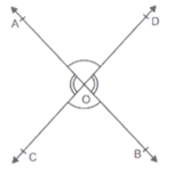
Let two lines $A B$ and $C D$ intersect at point $O$.
To prove: $\angle A O C=\angle B O D\  ($vertically opposite angles$)$
$\angle A O D=\angle B O C \ ($vertically opposite angles$)$
Proof : $(i)$ Since, ray $OA$ stands on the line $CD$.
$\Rightarrow \angle A O C+\angle A O D-180^{\circ} \ldots (1)\ [$Lincar pair axiom$]$
Also, ray $OD$ stands on the line $AB$.
$\angle A O D+\angle B O D=180^{\circ} \ldots (2)\  [$Linear pair axiom$]$
From equations $(1)$ and $(2),$ we get
$\angle A O C+\angle A O D=\angle A O D+\angle B O D$
$\Rightarrow \angle A O C=\angle B O D$
Hence, proved.
$(ii)$ Since, ray $OD$ stands on the line $A B$.
$\therefore \angle A O D+\angle B O D=180^{\circ} \ldots (3) \ [$Linear pair axiom$]$
Also, ray $O B$ stands on the line $C D$.
$\therefore \angle D O B+\angle B O C=180^{\circ} \ldots (4) \ [$linear pair axiom$]$
From equations $(3)$ and $(4),$ we get
$\angle A O D+\angle B O D=\angle B O D+\angle B O C$
$\Rightarrow \angle A O D=\angle B O C$
Hence, proved.

Need a full question paper?

Generate a complete, print-ready paper with questions like this in minutes — across 16+ boards, with answer keys.
Start Generating Free

Similar questions

A soft drink is available in two packs:
$i.$ A tin can with a rectangular base of length $5\ cm$, breadth $4\ cm$ and height $15\ cm.$
$ii.$ A plastic cylinder with circular base of diameter $7\ cm$ and height $10\ cm.$
Which container has greater capacity and by how much?
Show that the quadrilateral formed by joining the midpoints of the pairs of adjacent sides of a rectangle is a rhombus.
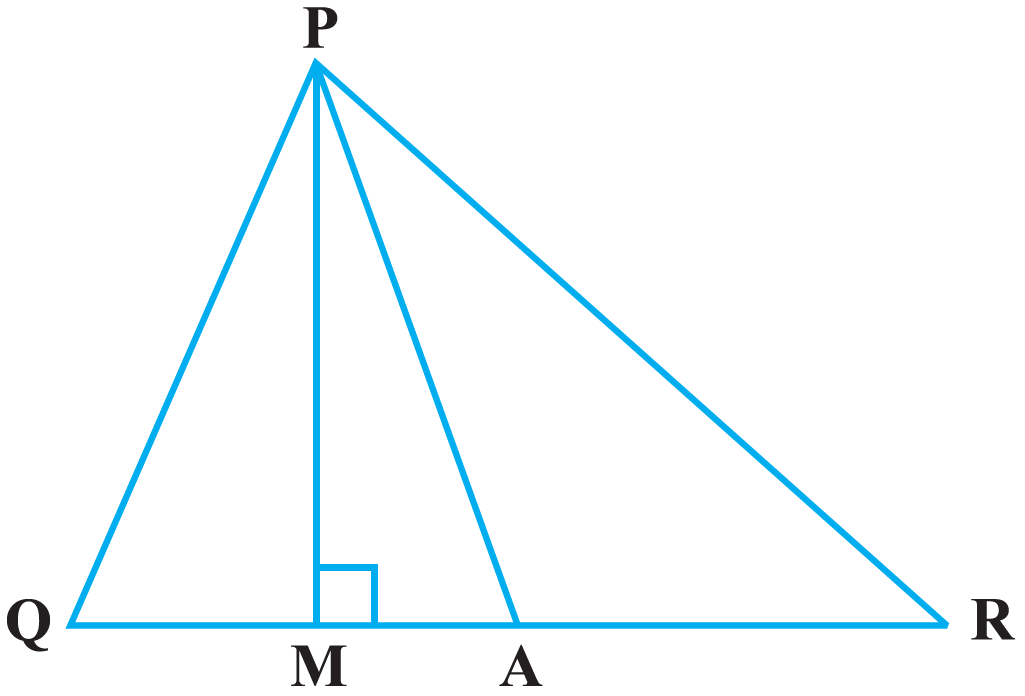
In Fig. $\angle\text{Q}>\angle\text{R}, PA$ is the bisector of $\angle\text{QPR}$ and $\text{PM}\perp\text{QR}$ Prove that $\angle\text{APM}=\frac{1}{2}(\angle\text{Q}-\angle\text{R}).$
The polynomial $p(x)=x^4-2 x^3+3 x^2-a x+3 a-7$ when divided by $x+1$ leave remainder $19 .$ Find the remainder when $p(x)$ is divided by $x +2$.
Draw the graph of the equation $\frac{\text{x}}{3}+\frac{\text{y}}{4}=1.$ Also, find the area of the triangle formed by the line and the coordinates axes.
The runs scored by two teams $A$ and $B$ on the first $60$ balls in a cricket match are given below :
Number of balls Team A Team B
$1-6$ $2$ $5$
$7-12$ $1$ $6$
$13-18$ $8$ $2$
$19-24$ $9$ $10$
$25-30$ $4$ $5$
$31-36$ $5$ $6$
$37-42$ $6$ $3$
$43-48$ $10$ $4$
$49-54$ $6$ $8$
$55-60$ $2$ $10$
Represent the data of both the teams on the same graph by frequency polygons.
[Hint: First make the class intervals continuous.]
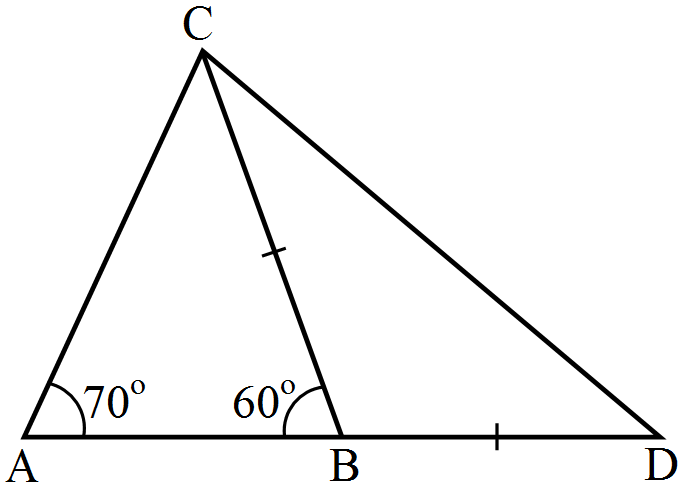
In $\triangle\text{ABC,}$ side $AB$ is produced to $D$ such that $BD = BC$. If $\angle\text{B}=60^{\circ},$ and $\angle\text{B}=60^{\circ},$ prove that:
$i. AD > CD$ and
$ii. AD > AC$.
Prove that in a triangle, other than an equilateral triangle, angle opposite the longest side is greater than $\frac{2}{3}$ of a right angle.
$1500$ families with $2$ children were selected randomly, and the following data were recorded:
No of girls in a family $0$ $1$ $2$
No of girls $211$ $814$ $475$
If a family is chosen at random, compute the probability that it has:
$1.$ No girl.
$2. 1$ girl.
$3. 2$ girls.
$4.$ At most one girl.
$5.$ More girls than boys.
A random survey of the number of children of various age groups playing in a park was found as follows
Age (in years) Number of children
$1-2$ $5$
$2-3$ $3$
$3-5$ $6$
$5-7$ $12$
$7-10$ $9$
$10-15$ $10$
$15-17$ $4$
Draw a histogram to represent the data above.