Questions

5 Marks Questions

Take a timed test

6 questions · self-marked practice — reveal the answer and mark yourself.

Question 15 Marks
Answer
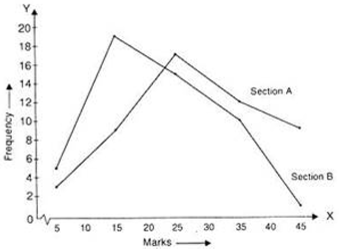
For section A
ClassesClass-MarksFrequency
0-1053
10-20159
20-302517
30-403512
40-50459
For section B
ClassesClass-MarksFrequency
0-1055
10-201519
20-302515
30-403510
40-50451

Image
View full question & answer
Question 25 Marks
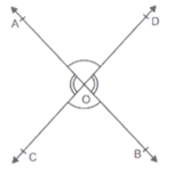
If two lines intersect, prove that the vertically opposite angles are equal.
Answer
Image
Let two lines $A B$ and $C D$ intersect at point $O$.
To prove: $\angle A O C=\angle B O D\  ($vertically opposite angles$)$
$\angle A O D=\angle B O C \ ($vertically opposite angles$)$
Proof : $(i)$ Since, ray $OA$ stands on the line $CD$.
$\Rightarrow \angle A O C+\angle A O D-180^{\circ} \ldots (1)\ [$Lincar pair axiom$]$
Also, ray $OD$ stands on the line $AB$.
$\angle A O D+\angle B O D=180^{\circ} \ldots (2)\  [$Linear pair axiom$]$
From equations $(1)$ and $(2),$ we get
$\angle A O C+\angle A O D=\angle A O D+\angle B O D$
$\Rightarrow \angle A O C=\angle B O D$
Hence, proved.
$(ii)$ Since, ray $OD$ stands on the line $A B$.
$\therefore \angle A O D+\angle B O D=180^{\circ} \ldots (3) \ [$Linear pair axiom$]$
Also, ray $O B$ stands on the line $C D$.
$\therefore \angle D O B+\angle B O C=180^{\circ} \ldots (4) \ [$linear pair axiom$]$
From equations $(3)$ and $(4),$ we get
$\angle A O D+\angle B O D=\angle B O D+\angle B O C$
$\Rightarrow \angle A O D=\angle B O C$
Hence, proved.
View full question & answer
Question 35 Marks
View full question & answer
Question 45 Marks
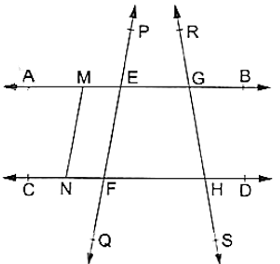
In the adjoining figure, name:
$i.$ Six points
$ii.$ Five line segments
$iii.$  Four rays
$iv.$  Four lines
$v.$  Four collinear points
Image
Answer
Six points: $A,B,C,D,E,F$
Five line segments: $\overline{ EG }, \overline{ FH }, \overline{ EF }, \overline{ GH }, \overline{ MN }$
Four rays: $\overrightarrow{ EP }, \overrightarrow{ GR }, \overrightarrow{ GB }, \overrightarrow{ HD }$
Four lines: $=\overleftrightarrow{A B}, \overleftrightarrow{C D}, \overleftrightarrow{P Q}, \overleftrightarrow{R S}$
Four collinear points: $M, E, G, B$
View full question & answer
Question 55 Marks
Simplify : $\frac{7 \sqrt{3}}{\sqrt{10}+\sqrt{3}}-\frac{2 \sqrt{5}}{\sqrt{6}+\sqrt{5}}-\frac{3 \sqrt{2}}{\sqrt{15}+3 \sqrt{2}}$.
Answer
$\frac{7 \sqrt{3}}{\sqrt{10}+\sqrt{3}}-\frac{2 \sqrt{5}}{\sqrt{6}+\sqrt{5}}-\frac{3 \sqrt{2}}{\sqrt{15}+3 \sqrt{2}}$
$=\frac{7 \sqrt{3}}{\sqrt{10}+\sqrt{3}} \times \frac{\sqrt{10}-\sqrt{3}}{\sqrt{10}-\sqrt{3}}-\frac{2 \sqrt{5}}{\sqrt{6}+\sqrt{5}} \times \frac{\sqrt{6}-\sqrt{5}}{\sqrt{6}-\sqrt{5}}-\frac{3 \sqrt{2}}{\sqrt{15}+3 \sqrt{2}} \times \frac{\sqrt{15}-3 \sqrt{2}}{\sqrt{15}-3 \sqrt{2}}$
$=\frac{7 \sqrt{3}(\sqrt{10}-\sqrt{3})}{10-3}-\frac{2 \sqrt{5}(\sqrt{6}-\sqrt{5})}{6-5}-\frac{3 \sqrt{2}(\sqrt{15}-3 \sqrt{2})}{15-18}$
$=\sqrt{3}(\sqrt{10}-\sqrt{3})-2 \sqrt{5}(\sqrt{6}-\sqrt{5})+\sqrt{2}(\sqrt{15}-3 \sqrt{2})$
$=\sqrt{30}-3-2 \sqrt{30}+10+\sqrt{30}-6$
$=2 \sqrt{30}-9-2 \sqrt{30}+10$
$=1$
View full question & answer
Question 65 Marks
Represent each of the numbers $\sqrt{5}, \sqrt{6}$ and $\sqrt{7}$ the real line.
Answer
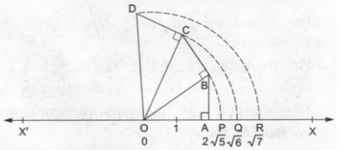
Draw a horizontal line $X'OX,$ taken as the $x-$ axis.
Take $O$ as the origin to represent $0$.
Image
Let $OA =2$ units and let $AB \perp OA$ such that $AB =1$ unit
Join $OB$. Then, by Pythagoras Theorem
$O B=\sqrt{O A^2+A B^2}$
$=\sqrt{2^2+1^2}$
$=\sqrt{5}$
With $O$ as centre and $OB$ as radius, draw an arc, meeting $OX$ at $P$ .
Then, $OP = OB =\sqrt{5}$
Thus $, P$ represents $\sqrt{5}$ or the real line.
Now, draw $BC \perp OB$ and set off $BC =1$ unit.
Join $OC$. Then, by Pythagoras Theorem
$O C=\sqrt{O B^2+B C^2}=\sqrt{(\sqrt{5})^2+1^2}=\sqrt{6}$
With $O$ as centre and $O C$ as radius, draw an arc, meeting $O X$ at $Q$
Then, $O Q=O C=\sqrt{6}$
Thus $,Q$ represents $\sqrt{6}$ on the real line.
Now, draw $CD \perp OC$ and set off $CD =1$ unit.
Join $OD$. Then, by Pythagoras Theorem
$O D=\sqrt{O C^2+C D^2}=\sqrt{(\sqrt{6})^2+1^2}=\sqrt{7}$
With $O$ as centre and $O D$ as radius, draw an arc, meeting $O X$ at $R$.
Then $OR=OD=\sqrt{7}$
Thus, the points $P , Q , R$ represent the real numbers $\sqrt{5}, \sqrt{6}$ and $\sqrt{7}$ respectively
View full question & answer
5 Marks Questions - Maths STD 9 Questions - Vidyadip