MCQ
If two liquids of same masses but densities $\rho_1$ and $\rho_2,$ respectively are mixed, then density of mixture is given by:
  • A
    $\rho=\frac{\rho_1+\rho_2}{2}$
  • B
    $\rho=\frac{\rho_1+\rho_2}{2\rho_1+\rho_2}$
  • $\rho=\frac{2\rho_1\rho_2}{\rho_1+\rho_2}$
  • D
    $\rho=\frac{\rho_1\rho_2}{\rho_1+\rho_2}$
Answer

Correct option: C.
$\rho=\frac{2\rho_1\rho_2}{\rho_1+\rho_2}$

Need a full question paper?

Generate a complete, print-ready paper with questions like this in minutes — across 16+ boards, with answer keys.

Start Generating Free

Similar questions

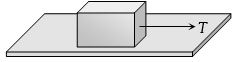
In the figure shown, a block of weight $10 \,N$ resting on a horizontal surface. The coefficient of static friction between the block and the surface ${\mu _s} = 0.4$. A force of $3.5\, N$ will keep the block in uniform motion, once it has been set in motion. A horizontal force of $3 \,N$ is applied to the block, then the block will
A calcite crystal is placed over a dot on a paper sheet and the crystal is rotated. On viewing through the calcite one sees?
If the length of a pendulum is made $9$ times and mass of the bob is made $4$ times then the value of time period becomes
A gas is filled in a cylinder, its temperature is increased by $20\%$ on kelvin scale and volume is reduced by $10\%$ . How much percentage of the gas will leak out at constant pressure  ...... $\%$
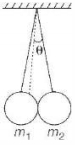
Two spherical objects each of radii $R$ and masses $m_1$ and $m_2$ are suspended using two strings of equal length $L$ as shown in the figure $(R << L)$. The angle $\theta$ which mass $m_2$ makes with the vertical is approximately
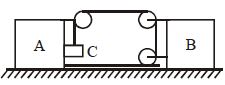
If the block $A$ & $B$ are moving towards each other with acceleration $a$ and $b$. Find the net acceleration of $C$.
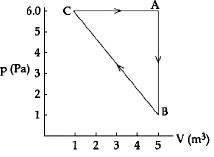
For the given cyclic process $CAB$ as shown for a gas, the work done is ..... $J$
The work done in blowing a soap bubble of $10\, cm$ radius is (Surface tension of the soap solution is $\frac{3}{{100}}N/m$)
A horizontal force of $4\,N$ is needed to keep a block of mass $0.5\, kg$ sliding on a horizontal surface with a constant speed. The coefficient of sliding friction must be :- $[g = 10\, m/s^2]$
Star $A$ has radius $ r$ surface temperature $T$ while star $B$ has radius $4r$ and surface temperature $T/2$ . The ratio of the power of two starts, $P_A : P_B$ is