If two liquids of same volume but different densities ${\rho _1}$ and ${\rho _2}$ are mixed, then density of mixture is given by
Medium
Download our app for free and get started
(a) $\rho = \frac{{{\rm{Total mass}}}}{{{\rm{Total volume }}}} = \frac{{{m_1} + {m_2}}}{{2V}} = \frac{{V\left( {{\rho _1} + {\rho _2}} \right)}}{{2V}}$$ = \frac{{{\rho _1} + {\rho _2}}}{2}$

Download our appand get started for free
Experience the future of education. Simply download our apps or reach out to us for more information. Let's shape the future of learning together!No signup needed.*
Similar Questions
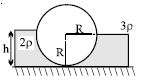
- 1In the figure shown, the heavy cylinder (radius $R$) resting on a smooth surface separates two liquids of densities $2\ \rho$ and $3\ \rho$ . The height $‘h’$ for the equilibrium of cylinder must beView Solution
- 2A manometer connected to a closed tap reads $4.5 \times {10^5}$ pascal. When the tap is opened the reading of the manometer falls to $4 \times {10^5}$ pascal. Then the velocity of flow of water is ........ $m{s^{ - 1}}$View Solution
- 3The fraction of a floating object of volume ${V_0}$ and density ${d_0}$ above the surface of a liquid of density $d$ will beView Solution
- 4A horizontal right angle pipe bend has crosssectional area $=$ $10 $ $cm^2$ and water flows through it at speed $=$ $20$ $m/s$. The force on the pipe bend due to the turning of water is ........ $N$View Solution
- 5A cylinder of height $ 20\; m$ is completely filled with water. The velocity of efflux of water (in $ m/s$) through a small hole on the side wall of the cylinder near its bottom is ....... $m/s$View Solution
- 6A spherical ball of radius $1 \times 10^{-4} \mathrm{~m}$ and density $10^5$ $\mathrm{kg} / \mathrm{m}^3$ falls freely under gravity through a distance $h$ before entering a tank of water, If after entering in water the velocity of the ball does not change, then the value of $h$ is approximately:View Solution
(The coefficient of viscosity of water is $9.8 \times 10^{-6}$ $\left.\mathrm{N} \mathrm{s} / \mathrm{m}^2\right)$
- 7The graph between terminal velocity (along $y-axis$ ) and square of radius (along $x-axis$ ) of spherical body of density $\rho $ allowed to fall through a fluid of density $\rho $ is $a$View Solution
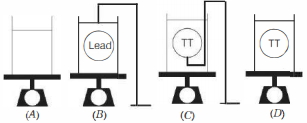
- 8Four identical beakers contain same amount of water as shown below. Beaker $A$ contains only water. A lead ball is held submerged in the beaker $B$ by string from above. A same sized plastic ball, say a table tennis $(TT)$ ball, is held submerged in beaker $C$ by a string attached to a stand from outside. Beaker $D$ contains same sized $TT$ ball which is held submerged from a string attached to the bottom of the beaker. These beakers (without stand) are placed on weighing pans and register readings $w_{A}, w_{B}, w_{C}$ and $w_{D}$ for $A, B, C$ and $D$, respectively. Effects of the mass and volume of the stand and string are to be neglected.View Solution
- 9A barometer is constructed using a liquid (density $\left.=760 \;kg / m ^{3}\right) .$ What would be the height (In $m$) of the liquid column, when a mercury barometer reads $76 \;cm ?$ (density of mercury $\left.=13600 \;kg / m ^{3}\right)$View Solution
- 10A liquid is flowing in a horizontal uniform capillary tube under a constant pressure difference $P$. The value of pressure for which the rate of flow of the liquid is doubled when the radius and length both are doubled isView Solution