The fraction of a floating object of volume ${V_0}$ and density ${d_0}$ above the surface of a liquid of density $d$ will be
Medium
Download our app for free and get started
(c)For the floatation ${V_0}{d_0}g = {V_{in}}\;d\;g$ ==> ${V_{in}} = {V_0}\frac{{{d_0}}}{d}$
${V_{out}} = {V_0} - {V_{in}} = {V_0} - {V_0}\frac{{{d_0}}}{d}$$ = {V_0}\left[ {\frac{{d - {d_0}}}{d}} \right]$
==> $\frac{{{V_{out}}}}{{{V_0}}} = \frac{{d - {d_0}}}{d}.$
${V_{out}} = {V_0} - {V_{in}} = {V_0} - {V_0}\frac{{{d_0}}}{d}$$ = {V_0}\left[ {\frac{{d - {d_0}}}{d}} \right]$
==> $\frac{{{V_{out}}}}{{{V_0}}} = \frac{{d - {d_0}}}{d}.$

Download our appand get started for free
Experience the future of education. Simply download our apps or reach out to us for more information. Let's shape the future of learning together!No signup needed.*
Similar Questions
- 1Three liquids of densities $d,\,2d$ and $3d$ are mixed in equal proportions of weights. The relative density of the mixture isView Solution
- 2A raindrop with radius $R=0.2\, {mm}$ fells from a cloud at a height $h=2000\, {m}$ above the ground. Assume that the drop is spherical throughout its fall and the force of buoyance may be neglected, then the terminal speed attainde by the raindrop is : (In ${ms}^{-1}$)View Solution
[Density of water $f_{{w}}=1000\;{kg} {m}^{-3}$ and density of air $f_{{a}}=1.2\; {kg} {m}^{-3}, {g}=10 \;{m} / {s}^{2}$ Coefficient of viscosity of air $=18 \times 10^{-5} \;{Nsm}^{-2}$ ]
- 3A sudden drop in the mercury level by $10 \,mm$ or more is a sign of ..........View Solution
- 4A thin uniform tube is bent into a circle of radius $r$ in the virtical plane. Equal volumes of two immiscible liquids, whose densities are ${\rho _1}$ and ${\rho _2}\left( {{\rho _1} > {\rho _2}} \right)$ fill half the circle. The angle $\theta$ between the radius vector passing through the common interface and the vertical isView Solution
- 5A wooden cube first floats inside water when a $200\,g$ mass is placed on it. When the mass is removed the cube is $2\,cm$ above water level. The side of cube is ........ $cm$View Solution
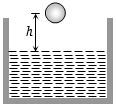
- 6A ball of radius $r $ and density $\rho$ falls freely under gravity through a distance $h$ before entering water. Velocity of ball does not change even on entering water. If viscosity of water is $\eta$, the value of $h$ is given byView Solution
- 7A machine is blowing spherical soap bubbles of different radii filled with helium gas.It is found that, if the bubbles have a radius smaller than $1\,cm$, then they sink to the floor in still air. Larger bubbles float in the air. Assume that the thickness of the soap film in all bubbles is uniform and equal. Assume that the density of soap solution is same as that of water $\left(=1000 \,kg m ^{-3}\right)$. The density of helium inside the bubbles and air are $0.18 \,kg m ^{-3}$ and $1.23 \,kg m ^{-3}$, respectively. Then, the thickness of the soap film of the bubbles is .......... $\mu m$ (Note $1 \,\mu m =10^{-6} \,m$ )View Solution
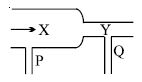
- 8A steady flow of water passes along a horizontal tube from a wide section $X$ to the narrower section $Y$, see figure. Manometers are placed at $P$ and $Q$ at the sections. Which of the statements $A, B, C, D, E$ is most correct?View Solution
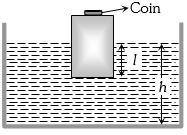
- 9A wooden block, with a coin placed on its top, floats in water as shown in fig. the distance $l $ and $h$ are shown there. After some time the coin falls into the water. ThenView Solution
- 10A large open tank has two holes in the wall. One is a square hole of side $L$ at a depth $y $ from the top and the other is a circular hole of radius $ R$ at a depth $ 4y $ from the top. When the tank is completely filled with water the quantities of water flowing out per second from both the holes are the same. Then $ R$ is equal toView Solution