If two liquids of same volume but different densities ${\rho _1}$ and ${\rho _2}$ are mixed, then density of mixture is given by
Medium


Download our appand get started for free
Experience the future of education. Simply download our apps or reach out to us for more information. Let's shape the future of learning together!No signup needed.*
Similar Questions
- 1A hollow sphere of volume $V$ is floating on water surface with half immersed in it. What should be the minimum volume of water poured inside the sphere so that the sphere now sinks into the waterView Solution
- 2A river $10\,m$ deep is flowing at $5\,m/s$. The shearing stress between horizontal layers of the river is :- $(\eta = 10^{-3}\,SI\,unit)$View Solution
- 3A spherical ball of density $\rho$ and radius $0.003$ $m$ is dropped into a tube containing a viscous fluid filled up to the $0$ $ cm$ mark as shown in the figure. Viscosity of the fluid $=$ $1.260$ $N.m^{-2}$ and its density $\rho_L=\rho/2$ $=$ $1260$ $kg.m^{-3}$. Assume the ball reaches a terminal speed by the $10$ $cm$ mark. The time taken by the ball to traverse the distance between the $10$ $cm$ and $20$ $cm$ mark isView Solution
( $g$ $ =$ acceleration due to gravity $= 10$ $ ms^{^{-2}} )$

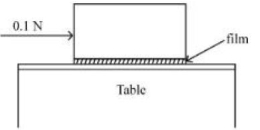
- 4A metal block of base area $0.20\,m ^2$ is placed on a table, as shown in figure. A liquid film of thickness $0.25\,mm$ is inserted between the block and the table. The block is pushed by a horizontal force of $0.1\,N$ and moves with a constant speed. If the viscosity of the liquid is $5.0 \times 10^{-3} \;Pa-s$, the speed of block is $.........\times 10^{-3}\,m / s$View Solution
- 5$10,000 $ small balls, each weighing $1\, gm$, strike one square cm of area per second with a velocity $100 \,m/s$ in a normal direction and rebound with the same velocity. The value of pressure on the surface will beView Solution
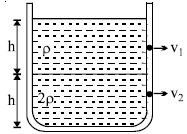
- 6Equal volumes of two immiscible liquids of densities $\rho$ and $2\rho$ are filled in a vessel as shown in figure. Two small holes are punched at depth $h/ 2$ and $3h/2$ from the surface of lighter liquid. If $v_1 $ and $v_2 $ are the velocities of a flux at these two holes, then $v_1/v_2 $ is :View Solution
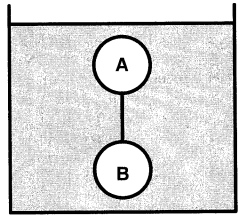
- 7Two solid spheres $A$ and $B$ of equal volumes but of different densities $d_A$ and $d_B$ are connected by a string. They are fully immersed in a fluid of density $d_F$. They get arranged into an equilibrium state as shown in the figure with a tension in the string. The arrangement is possible only ifView Solution
$(A)$ $d_Ad_F$ $(B)$ $d_B > d_F$ $(C)$ $d_A>d_F$ $(D)$ $d_A+d_B=2 d_F$
- 8What will be the nature of flow of water from a circular tap, when its flow rate increased from $0.18\, L / min$ to $0.48\, L / min$ ? The radius of the tap and viscosity of water are $0.5\, cm$ and $10^{-3}\, Pa s$, respectively.View Solution
(Density of water : $10^{3}\, kg / m ^{3}$ )
- 9A $0.5\ kg$ mass of lead is submerged in a container filled to the brim with water and a block of wood floats on top. The lead mass is slowly lifted from the container by a thin wire and as it emerges into air the level of the water in the container drops a bit. The lead mass is now placed on the block of wood. As the lead is placed on the wood.View Solution
- 10A wide vessel with a small hole at the bottom is filled with two liquids. The density and heightof one liquid are $\rho_1$ and $h_1$ and that of the otherare $\rho_2$ and $h_2 \ (\rho_1 >\rho_2)$. The velocity of liquid coming out of the hole is :View Solution