MCQ
If $u = \sqrt {{a^2}{{\cos }^2}\theta + {b^2}{{\sin }^2}\theta } + \sqrt {{a^2}{{\sin }^2}\theta + {b^2}{{\cos }^2}\theta } $, then difference between the maximum and minimum values of ${u^2}$ is given by
  • ${(a - b)^2}$
  • B
    $2\sqrt {{a^2} + {b^2}} $
  • C
    ${(a + b)^2}$
  • D
    $2({a^2} + {b^2})$

Answer

Correct option: A.
${(a - b)^2}$
a
(a) $2u = \sqrt {{a^2}{{\cos }^2}\theta + {b^2}{{\sin }^2}\theta } + \sqrt {{a^2}{{\sin }^2}\theta + {b^2}{{\cos }^2}\theta } $
${u^2} = {a^2} + {b^2} + 2\sqrt {({a^2}{{\cos }^2}\theta + {b^2}{{\sin }^2}\theta )({a^2}{{\sin }^2}\theta + {b^2}{{\cos }^2}\theta )} $
$ = {a^2} + {b^2} + 2\sqrt {t({a^2} + {b^2} - t)} $
$ = {a^2} + {b^2} + 2\sqrt { - {t^2} + ({a^2} + {b^2})t} $
where $t = {a^2}{\cos ^2}\theta + {b^2}{\sin ^2}\theta ,\,({a^2} > {b^2})$
${t_{\max }} = {a^2}$ and ${t_{\min }} = {b^2}.$
Let $y = - {t^2} + ({a^2} + {b^2})t$
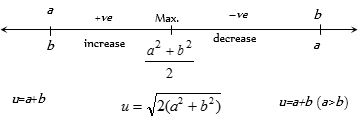
Now $\frac{{dy}}{{dt}} = 0 \Rightarrow - 2t + ({a^2} + {b^2}) = 0 \Rightarrow t = \frac{{{a^2} + {b^2}}}{2}$
Sign scheme for $\frac{{dy}}{{dt}}$
$\therefore$ ${({u_{\max }})^2} - {({u_{\min }})^2} = 2({a^2} + {b^2}) - {(a + b)^2} = {(a - b)^2}$

Need a full question paper?

Generate a complete, print-ready paper with questions like this in minutes — across 16+ boards, with answer keys.

Start Generating Free

Similar questions

Matrix $\left[ {\begin{array}{*{20}{c}}0&{ - 4}&1\\4&0&{ - 5}\\{ - 1}&5&0\end{array}} \right]$is
The maximum value of $12\,\,  sin\theta\,\, -\,\,  9\,\,  sin^2\theta$ is
Let $Q$ be the cube with the set of vertices $\left\{\left(\mathrm{x}_1, \mathrm{x}_2, \mathrm{x}_3\right) \in \mathbb{R}^3: \mathrm{x}_1, \mathrm{x}_2, \mathrm{x}_3\{0,1\}\right\}$. Let $\mathrm{F}$ be the set of all twelve lines containing the diagonals of the six faces of the cube $Q$. Let $S$ be the set of all four lines containing the main diagonals of the cube $\mathrm{Q}$; for instance, the line passing through the vertices $(0,0,0)$ and $(1,1,1)$ is in $\mathrm{S}$. For lines $\ell_1$ and $\ell_2$, let $\mathrm{d}\left(\ell_1, \ell_2\right)$ denote the shortest distance between them. Then the maximum value of $\mathrm{d}\left(\ell_1, \ell_2\right)$, as $\ell_1$ varies over $\mathrm{F}$ and $\ell_2$ varies over $\mathrm{S}$, is
Let the f: R → R be defined by $\text{f(x)}=2\text{x}+\cos\text{x}$ then f:
$\int_{\; - \pi }^\pi {\frac{{{{\sin }^4}x}}{{{{\sin }^4}x + {{\cos }^4}x}}\;dx} = $
Find the determinant of the matrix $\text{A}=\begin{bmatrix}9&8\\7&6\end{bmatrix}$ is:
  1. -1
  2. 1
  3. 2
  4. -2
Let $A$ be a set consisting of $10$ elements. The number of non-empty relations from $A$ to $A$ that are reflexive but not symmetric is
For what value of $k$, the function given below is continuous at $x=0$ ?
$f(x)=\left\{\begin{array}{cc}\frac{\sqrt{4+x}-2}{x} & , x \neq 0 \\ k & , x=0\end{array}\right.$
$\int_{}^{} {\sec x{{\tan }^3}x\;dx = } $
If $\int {\frac{{dx}}{{{{\left( {{x^2} - 2x + 10} \right)}^2}}} = A\left( {{{\tan }^{ - 1}}\left( {\frac{{x - 1}}{3}} \right) + \frac{{f\left( x \right)}}{{{x^2} - 2x + 10}}} \right)}  + C$ Where $C$ is a constant of integration, then