MCQ
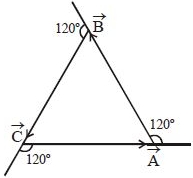
If $\vec A,\vec B$ and $\vec C$ are vectors having a unit magnitude. If $\vec A + \vec B + \vec C = \vec 0$ then $\vec A.\vec B + \vec B.\vec C + \vec C.\vec A$ will be 
  • A
    $1$
  • $ - 1.5$
  • C
    $ -0.5$
  • D
    $0$

Answer

Correct option: B.
$ - 1.5$
b
$\overrightarrow{\mathrm{A}} \cdot \overrightarrow{\mathrm{B}}+\overrightarrow{\mathrm{B}} \cdot \overrightarrow{\mathrm{C}}+\overrightarrow{\mathrm{C}} \cdot \overrightarrow{\mathrm{A}}$

$=\mathrm{AB} \cos 120^{\circ}+\mathrm{BC} \cos 120^{\circ}+\mathrm{AC} \cos 120^{\circ}$

as $A=B=C=1$

$\overrightarrow{\mathrm{A}} \cdot \overrightarrow{\mathrm{B}}+\overrightarrow{\mathrm{B}} \cdot \overrightarrow{\mathrm{C}}+\overrightarrow{\mathrm{C}} \cdot \overrightarrow{\mathrm{A}}=3 \cos 120^{\circ}=-3 / 2$
Need a full question paper?

Generate a complete, print-ready paper with questions like this in minutes — across 16+ boards, with answer keys.
Start Generating Free

Similar questions

The ranges and heights for two projectiles projected with the same initial velocity at angles $42^{\circ}$ and $48^{\circ}$ with the horizontal are ${R}_{1}, {R}_{2}$ and ${H}_{1}$, ${H}_{2}$ respectively. Choose the correct option:
A loaded spring gun of mass M fires a 'shot' of mass m with a velocity at an angle of elevation $\theta.$ The gun is initially at rest on a horizontal frictionless surface. After firing, the centre of mass of the gun-shot system.
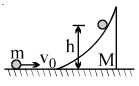
A particle of mass $m$ moving horizontally with $v_0$ strikes $a$ smooth wedge of mass $M$, as shown in figure. After collision, the ball starts moving up the inclined face of the wedge and rises to $a$ height $h$. Identify the correct statement $(s)$ related to the situation when the particle starts moving downward.
If the Earth has no rotational motion, the weight of a person on the equator is $W$. Determine the speed with which the earth would have to rotate about its axis so that the person at the equator will weight $\frac{3}{4}\,W$ . Radius of the Earth is $6400\, km$ and $g = 10\, m/s^2$
What is the value of linear velocity, if $\vec \omega = 3\hat i - 4\hat j + \hat k$ and $\vec r = 5\hat i - 6\hat j + 6\hat k$
When the temperature of a gas is $20^{\circ} C$ and pressure is changed from $P_1=1.01 \times 10^5 \,Pa$ to $P_2=1.165 \times$ $10^5 \,Pa$, then the volume changes by $10 \%$. The Bulk modulus is .........$\times 10^5 \,Pa$
A drop of water breaks into two droplets of equal size. In this process, which of the following statement is correct
The two ends of a metal rod are maintained at temperatures $100 ^o C$ and $110^o C$. The rate of heat flow in the rod is found to be $4.0\ J/s$. If the ends are maintained at temperatures $200^o\  C$ and $210^o\ C$, the rate of heat flow will be.... $J/s$
A car is travelling with linear velocity $v$ on a circular road of radius $r$. If it is increasing its speed at the rate of $'a'$ $meter/{\sec ^2}$, then the resultant acceleration will be