MCQ
The ranges and heights for two projectiles projected with the same initial velocity at angles $42^{\circ}$ and $48^{\circ}$ with the horizontal are ${R}_{1}, {R}_{2}$ and ${H}_{1}$, ${H}_{2}$ respectively. Choose the correct option:
  • A
    ${R}_{1}>{R}_{2}$ and ${H}_{1}={H}_{2}$
  • ${R}_{1}={R}_{2}$ and ${H}_{1}<{H}_{2}$
  • C
    ${R}_{1}<{R}_{2}$ and ${H}_{1}<{H}_{2}$
  • D
    ${R}_{1}={R}_{2}$ and ${H}_{1}={H}_{2}$
Answer

Correct option: B.
${R}_{1}={R}_{2}$ and ${H}_{1}<{H}_{2}$
b
Range ${R}=\frac{{u}^{2} \sin 2 \theta}{{g}}$ and same for $\theta$ and $90-\theta$

So same for $42^{\circ}$ and $48^{\circ}$

Maximum height ${H}=\frac{{u}^{2} \sin ^{2} \theta}{2 {g}}$

${H}$ is high for higher $\theta$

So ${H}$ for $48^{\circ}$ is higher than ${H}$ for $42^{\circ}$

Need a full question paper?

Generate a complete, print-ready paper with questions like this in minutes — across 16+ boards, with answer keys.

Start Generating Free

Similar questions

A body of mass $m_1$ exerts a force on another body of mass $m_2$. If the magnitude of acceleration of $m_2$ is $a_2$, then the magnitude of the acceleration of $m_1$ is (considering only two bodies in space)
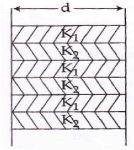
A wall consists of alternating blocks of length $d$ and coefficient of thermal conductivity $K_{1}$ and $K_{2}$ respectively as shown in figure. The cross sectional area of the blocks are the same. The equivalent coefficient of thermal conductivity of the wall between left and right is
According to Poiseuille's law, the pressure drop per unit length required (overcome viscous forces is $\Delta P =\frac{8 \eta v }{ r ^2}$, where $r$ is the radius of cross section, $v$ is the fluid velocity and $\eta$ is the coefficient of viscosity. A capillary tube of radius a is dipped in a liquid of density $\rho$, surface tension $T$ and coefficient of viscosity $\eta$. The liquid starts rising in it so that its height $h ( t )$ is a function of time t. The resulting rate of change of the momentum of liquid column in the capillary (taking vertically up to be positive direction and the contact angle to be close to $\left.0^{\circ}\right)$ is $-\pi a ^2 \rho gh + F$. Then $F$ is $[ g$ is the acceleration due to gravity):
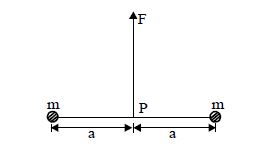
Two particles of mass $m$ each are tied at the ends of a light string of length $2a$ . The whole system is kept on a frictionless horizontal surface with the string held tight so that each mass is at a distance $'a'$ from the centre $P$ (as shown in the figure). Now, the mid-point of the string is pulled vertically upwards with a small but constant force $F$ . As a result, the particles move towards each other on the surface. The magnitude of acceleration, when the separation between them becomes $2x$ , is
If $L$ denotes the inductance of an inductor through which a current $i$ is flowing, the dimensions of $L{I^2}$ are
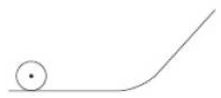
A solid sphere and solid cylinder of identical radii approach an incline with the same linear velocity (see figure). Both roll without slipping all throughout. The two climb maximum heights $h_{sph}$ and $h_{cyl}$ on the incline. The radio $\frac{{{h_{sph}}}}{{{h_{cyl}}}}$ is given by
A spring balance is graduated on sea level. If a body is weighed with this balance at consecutively increasing heights from earth's surface, the weight indicated by the balance
The angle of projection for a projectile to have same horizontal range and maximum height is :
Two wires are in unison. If the tension in one of the wires is increased by $2\%, 5$ beats are produced per second. The initial frequency of each wire is  .... $Hz$
A solid cylinder $(i)$ rolls down $(ii)$ slides down an inclined plane. The ratio of the accelerations in these conditions