MCQ
If $\vec{\mathrm{L}}$ and $\vec{\mathrm{P}}$ represent the angular momentum and linear momentum respectively of a particle of mass '$m$' having position vector $\vec{\mathrm{r}}=\mathrm{a}(\hat{\mathrm{i}} \cos \omega \mathrm{t}+\hat{\mathrm{j}} \sin \omega \mathrm{t})$. The direction of force is
  • Opposite to the direction of $\vec{\mathrm{r}}$
  • B
    Opposite to the direction of $\vec{\mathrm{L}}$
  • C
    Opposite to the direction of $\vec{\mathrm{P}}$
  • D
    Opposite to the direction of $\vec{\mathrm{L}} \times \vec{\mathrm{P}}$

Answer

Correct option: A.
Opposite to the direction of $\vec{\mathrm{r}}$
(A) Opposite to the direction of $\vec{\mathrm{r}}$
$\vec{\mathrm{a}}=-\omega^{2} \vec{\mathrm{r}}$
$\therefore \vec{\mathrm{F}}$ opposite to $\vec{\mathrm{r}}-$

Need a full question paper?

Generate a complete, print-ready paper with questions like this in minutes — across 16+ boards, with answer keys.

Start Generating Free

Similar questions

$A$ block of mass $m$ moving with a velocity $v_0$ on a smooth horizontal surface strikes and compresses a spring of stiffness $k$ till mass comes to rest as shown in the figure. This phenomenon is observed by two observers:

$A$: standing on the horizontal surface

$B$: standing on the block 

According to observer $B$, the potential energy of the spring increases

The ratio of escape velocity of a planet to the escape velocity of earth will be:Given : Mass of the planet is $16$ times mass of earth and radius of the planet is $4$ times the radius of earth.
The half life of a radioactive substance is $5$ years. After $x$ years a given sample of the radioactive substance gest reduced to $6.25 \%$ of its initial value of $x$ is ...............
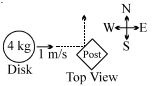
$A$ $4$ -kilogram disk slides over level ice toward the east at a velocity of $1$ meter per second, as shown. The disk strikes a post and rebounds toward the north at the same speed. The change in the magnitude of the eastward component of the momentum of the disk is ............. $\mathrm{kg}$ $ \cdot $ $\mathrm{m}/ \mathrm{s}$ 
From which source a continuous emission spectrum and a line absorption spectrum are simultaneously obtained
Five gas molecules chosen at random are found to have speeds of $500,600,700,800$ and $900 m / s$. Then which of the following statements is correct?
Calculate the amount of heat (in calories) required to convert $5\,gm$ of ice at $0°C$ to steam at $100°C$
Consider an atom with atomic number $Z$ as consisting of a positive point charge at the centre and surrounded by a distribution of negative electricity uniformly distributed within a sphere of radius $R$. The electric field at a point inside the atom at a distance $r$ from the centre is
A point object $O$ is placed on the principal axis of a convex lens of focal length $20 \,cm$ at a distance of $40 \,cm$ to the left of it. The diameter of the lens is $10 \,cm$. If the eye is placed $60\, cm$ to the right of the lens at a distance $h$ below the principal axis, then the maximum value of $h$ to see the image will be.......$cm$
The maximum speed of a car on a road-turn of radius $30\, m$, if the coefficient of friction between the tyres and the road is $0.4$, will be .......... $m/sec$