MCQ 14 Marks
Considering the Bohr model of hydrogen like atoms, the ratio of the ratio of the radius $5^{\text {th }}$ orbit of the electron in $\mathrm{Li}^{2+}$ and $\mathrm{He}^{+}$is
- A
$\frac{3}{2}$
- B
$\frac{4}{9}$
- C
$\frac{9}{4}$
- ✓
$\frac{2}{3}$
AnswerCorrect option: D. $\frac{2}{3}$
(D) $\frac{2}{3}$
$\mathrm{r}=\mathrm{r} \cdot \frac{\mathrm{n}^{2}}{2}$
for $\mathrm{Li}^{2+}$
$\mathrm{r}_{5}=\mathrm{r} \cdot \frac{25}{3}$
for $\mathrm{He}^{+}$
$\mathrm{r}_{5}=\mathrm{r} \cdot \frac{25}{2}$
$\therefore \frac{\mathrm{r}_{\mathrm{Li}^{+}}}{\mathrm{r}_{\mathrm{He}^{+}}}=\frac{2}{3}$
View full question & answer→MCQ 24 Marks
Two small spherical balls of mass 10g each with charges $-2 \mu \mathrm{C}$ and $2 \mu \mathrm{C}$, are attached to two ends of very light rigid rod of length 20 cm. The arrangement is now placed near an infinite nonconducting charge sheet with uniform charge density of $100 \mu \mathrm{C} / \mathrm{m}^{2}$ such that length of rod makes an angle of $30^{\circ}$ with electric field generated by charge sheet. Net torque acting on the rod is:
(Take $\varepsilon_{0}: 8.85 \times 10^{-12} \mathrm{C}^{2} / \mathrm{Nm}^{2}$)
Answer(B) 1.12 Nm
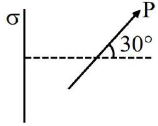
$\mathrm{E}=\frac{\sigma}{2 \varepsilon_{0}}$
$\tau=\mathrm{PE}~ \sin \theta$
$=\left[\left(2 \times 10^{-6}\right)\left(\frac{2}{10}\right)\right]\left[\frac{100 \times 10^{-6}}{2 \times 8.85 \times 10^{-12}}\right]\left(\frac{1}{2}\right)$
$=\frac{10}{8.85}=1.12 \mathrm{Nm}$ View full question & answer→MCQ 34 Marks
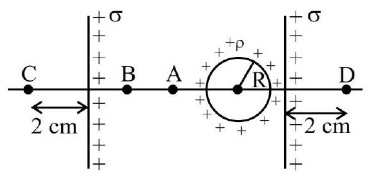
Two infinite identical charged sheets and a charged spherical body of charge density '$\rho$' are arranged as shown in figure. Then the correct relation between the electrical fields at $\mathrm{A}, \mathrm{B}, \mathrm{C}$ and D points is
- A
$\vec{\mathrm{E}}_{\mathrm{A}}=\vec{\mathrm{E}}_{\mathrm{B}} ; \vec{\mathrm{E}}_{\mathrm{C}}=\vec{\mathrm{E}}_{\mathrm{D}}$
- B
$\vec{\mathrm{E}}_{\mathrm{A}}>\vec{\mathrm{E}}_{\mathrm{B}} ; \vec{\mathrm{E}}_{\mathrm{C}}=\vec{\mathrm{E}}_{\mathrm{D}}$
- ✓
$\vec{\mathrm{E}}_{\mathrm{C}} \neq \vec{\mathrm{E}}_{\mathrm{D}} ; \vec{\mathrm{E}}_{\mathrm{A}}>\vec{\mathrm{E}}_{\mathrm{B}}$
- D
$\left|\vec{\mathrm{E}}_{\mathrm{A}}\right|=\left|\vec{\mathrm{E}}_{\mathrm{B}}\right| ; \vec{\mathrm{E}}_{\mathrm{C}}>\vec{\mathrm{E}}_{\mathrm{D}}$
AnswerCorrect option: C. $\vec{\mathrm{E}}_{\mathrm{C}} \neq \vec{\mathrm{E}}_{\mathrm{D}} ; \vec{\mathrm{E}}_{\mathrm{A}}>\vec{\mathrm{E}}_{\mathrm{B}}$
(C) $\vec{\mathrm{E}}_{\mathrm{C}} \neq \vec{\mathrm{E}}_{\mathrm{D}} ; \vec{\mathrm{E}}_{\mathrm{A}}>\vec{\mathrm{E}}_{\mathrm{B}}$
Conceptual
$\mathrm{E}_{\mathrm{C}} \neq \mathrm{E}_{\mathrm{D}}$
$\mathrm{E}_{\mathrm{A}}>\mathrm{E}_{\mathrm{B}}$
View full question & answer→MCQ 44 Marks
Two simple pendulums having lengths $l_{1}$ and $l_{2}$ with negligible string mass undergo angular displacements $\theta_{1}$ and $\theta_{2}$, from their mean positions, respectively. If the angular accelerations of both pendulums are same, then which expression is correct?
- A
$\theta_{1} l_{2}^{2}=\theta_{2} l_{1}^{2}$
- B
$\theta_{1} l_{1}=\theta_{2} l_{2}$
- C
$\theta_{1} l_{1}^{2}=\theta_{2} l_{2}^{2}$
- ✓
$\theta_{1} l_{2}=\theta_{2} l_{1}$
AnswerCorrect option: D. $\theta_{1} l_{2}=\theta_{2} l_{1}$
(D) $\theta_{1} l_{2}=\theta_{2} l_{1}$
$\omega=\sqrt{\frac{\mathrm{g}}{\ell}}$
$\alpha=-\omega^{2} \theta$
$\therefore \frac{\mathrm{g}}{\ell_{1}} \theta_{1}=\frac{\mathrm{g}}{\ell_{2}} \theta_{2}$
$\Rightarrow \theta_{1} \ell_{2}=\theta_{2} \ell_{2}$
View full question & answer→MCQ 54 Marks
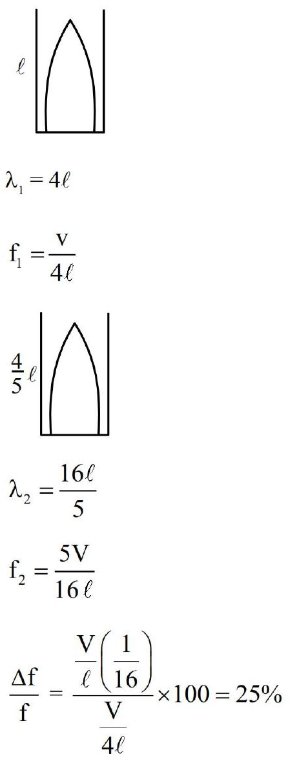
In an experiment with a closed organ pipe, it is filled with water by $\left(\frac{1}{5}\right)$ th of its volume. The frequency of the fundamental note will change by
- ✓
$25 \%$
- B
$20 \%$
- C
$-20 \%$
- D
$-25 \%$
AnswerCorrect option: A. $25 \%$
(A) $25 \%$
View full question & answer→MCQ 64 Marks
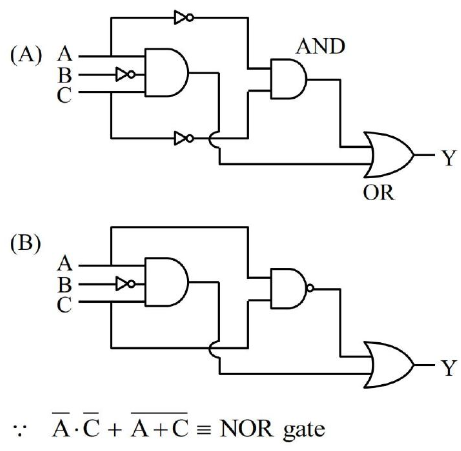
The Boolean expression $\mathrm{Y}=\mathrm{A} \overline{\mathrm{B}} \mathrm{C}+\overline{\mathrm{A}} \overline{\mathrm{C}}$ can be realised with which of the following gate configurations.
A. One 3-input AND gate, 3 NOT gates and one 2-input OR gate, One 2-input AND gate,
B. One 3-input AND gate, 1 NOT gate, One 2-input NOR gate and one 2 -input OR gate
C. 3-input OR gate, 3 NOT gates and one 2-input AND gate
Choose the correct answer from the options given below
Answer(B) A,B Only
View full question & answer→MCQ 74 Marks
Given below are two statements : one is labelled as Assertion A and the other is labelled as Reason R
Assertion A : The kinetic energy needed to project a body of mass $m$ from earth surface to infinity is $\frac{1}{2} mgR$, where R is the radius of earth.
Reason R : The maximum potential energy of a body is zero when it is projected to infinity from earth surface.
In the light of the above statements, choose the correct answer from the option given below
- ✓
- B
Both A and R are true and R is the correct explanation of A
- C
- D
Both A and R are true but R is NOT the correct explanation of A
Answer(A) A False but R is true
$\mathrm{KE}=\frac{1}{2} \mathrm{~m}\left(\frac{2 \mathrm{Gm}}{\mathrm{R}}\right)=\mathrm{mgR}$
Assertion wrong
at $\infty \quad U=0$
$\therefore$ Reason correct.
View full question & answer→MCQ 84 Marks
Current passing through a wire as function of time is given as $I(t)=0.02 t+0.01 \mathrm{~A}$. The charge that will flow through the wire from $t=1 \mathrm{~s}$ to $\mathrm{t}=2 \mathrm{~s}$ is :
Answer(D) 0.04 C
$\mathrm{q}=\int \mathrm{idt}$
$\int_{0}^{2}(0.02 t+0.01) d t$
$\mathrm{q}=\left[0.02 \frac{\mathrm{t}^{2}}{2}+0.01 \mathrm{t}\right]_{1}^{2}$
$=0.01(3)+0.01(1)$
$=0.04 \mathrm{C}$
View full question & answer→MCQ 94 Marks
A body of mass $m$ is suspended by two strings making angles $\theta_{1}$ and $\theta_{2}$ with the horizontal ceiling with tensions $T_{1}$ and $T_{2}$ simultaneously. $T_{1}$ and $T_{2}$ are related by $T_{1}=\sqrt{3} T_{2}$. the angles $\theta_{1}$ and $\theta_{2}$ are
- A
$\theta_{1}=30^{\circ} \theta_{2}=60^{\circ}$ with $\mathrm{T}_{2}=\frac{3 \mathrm{mg}}{4}$
- ✓
$\theta_{1}=60^{\circ} \theta_{2}=30^{\circ}$ with $\mathrm{T}_{2}=\frac{\mathrm{mg}}{2}$
- C
$\theta_{1}=45^{\circ} \theta_{2}=45^{\circ}$ with $\mathrm{T}_{2}=\frac{3 \mathrm{mg}}{4}$
- D
$\theta_{1}=30^{\circ} \theta_{2}=60^{\circ}$ with $\mathrm{T}_{2}=\frac{4 \mathrm{mg}}{5}$
AnswerCorrect option: B. $\theta_{1}=60^{\circ} \theta_{2}=30^{\circ}$ with $\mathrm{T}_{2}=\frac{\mathrm{mg}}{2}$
(B) $\theta_{1}=60^{\circ} \theta_{2}=30^{\circ}$ with $\mathrm{T}_{2}=\frac{\mathrm{mg}}{2}$
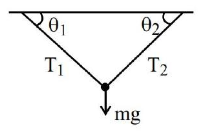
$\mathrm{T}_{1} \sin \theta_{1}+\mathrm{T}_{2} \sin \theta_{2}=\mathrm{mg} \& \mathrm{~T}_{1}=\sqrt{3} \mathrm{~T}_{2}$
$\Rightarrow \mathrm{T}_{2}\left[\sqrt{3} \sin \theta_{1}+\sin \theta_{2}\right]=\mathrm{mg}$
for $\theta_{1}=60^{\circ} \& \theta_{2}=30^{\circ}$
$\mathrm{T}_{2}=\frac{\mathrm{mg}}{2}$ View full question & answer→MCQ 104 Marks
If $\vec{\mathrm{L}}$ and $\vec{\mathrm{P}}$ represent the angular momentum and linear momentum respectively of a particle of mass '$m$' having position vector $\vec{\mathrm{r}}=\mathrm{a}(\hat{\mathrm{i}} \cos \omega \mathrm{t}+\hat{\mathrm{j}} \sin \omega \mathrm{t})$. The direction of force is
- ✓
Opposite to the direction of $\vec{\mathrm{r}}$
- B
Opposite to the direction of $\vec{\mathrm{L}}$
- C
Opposite to the direction of $\vec{\mathrm{P}}$
- D
Opposite to the direction of $\vec{\mathrm{L}} \times \vec{\mathrm{P}}$
AnswerCorrect option: A. Opposite to the direction of $\vec{\mathrm{r}}$
(A) Opposite to the direction of $\vec{\mathrm{r}}$
$\vec{\mathrm{a}}=-\omega^{2} \vec{\mathrm{r}}$
$\therefore \vec{\mathrm{F}}$ opposite to $\vec{\mathrm{r}}-$
View full question & answer→MCQ 114 Marks
Given below are two statements: one is labelled as Assertion A and the other is labelled as Reason R
Assertion A : In photoelectric effect, on increasing the intensity of incident light the stopping potential increases.
Reason R : Increase in intensity of light increases the rate of photoelectrons emitted, provided the frequency of incident light is greater than threshold frequency.
In the light of the above statements, choose the correct answer from the options given below
- A
Both A and R are true but R is NOT the correct explanation of A
- ✓
- C
- D
Both A and R are true and R is the correct explanation of A
Answer(B) 80 cm away from the mirror.
$\mathrm{V}_{\mathrm{S}}=\frac{\mathrm{hv}-\phi}{\mathrm{e}}$
so stopping potential doesn't
depend on Intensity
$I=\frac{\eta h v}{A}$
On increasing intensity no. of photons per sec. $n$ increases so the no. of electrons.
View full question & answer→MCQ 124 Marks
When an object is placed 40 cm away from a spherical mirror an image of magnification $\frac{1}{2}$ is produced. To obtain an image with magnification of $\frac{1}{3}$, the object is to be moved :
- ✓
40 cm away from the mirror.
- B
80 cm away from the mirror.
- C
20 cm towards the mirror.
- D
20 cm away from the mirror.
AnswerCorrect option: A. 40 cm away from the mirror.
(A) 40 cm away from the mirror.
$m=\frac{1}{2}=\frac{f}{f-u}$
$\frac{1}{2}=\frac{\mathrm{f}}{\mathrm{f}-(-40)}$
$\mathrm{f}+40=2 \mathrm{f} \Rightarrow \mathrm{f}=40 \mathrm{~cm}$
now $\mathrm{m}=\frac{1}{3}=\frac{40}{40-\mathrm{u}}$
$40-\mathrm{u}=120 \Rightarrow \mathrm{u}=-80$
View full question & answer→MCQ 134 Marks
In an electromagnetic system, the quantity representing the ratio of electric flux and magnetic flux has dimension of $\mathrm{M}^{\mathrm{P}} \mathrm{L}^{\mathrm{Q}} \mathrm{T}^{\mathrm{R}} \mathrm{A}^{\mathrm{S}}$, where value of 'Q' and 'R' are
- A
$(3,-5)$
- B
$(-2,2)$
- C
$(-2,1)$
- ✓
$(1,-1)$
AnswerCorrect option: D. $(1,-1)$
(D) $(1,-1)$
$\frac{\phi_{\mathrm{E}}}{\phi_{\mathrm{M}}}=\frac{\mathrm{EA}}{\mathrm{BA}}=\frac{\mathrm{E}}{\mathrm{B}}$
$\mathrm{B}=\frac{\mathrm{M} \ell \mathrm{T}^{-2}}{\mathrm{ATLT}^{-1}}$
So $\left[\frac{E}{B}\right]=\frac{M L^{-3} A^{-1}}{M T^{-2} A^{-1}}=\mathrm{LT}^{-1}$
Or
$E = c . B \quad( c =$ Speed of light $)$
$\left[\frac{ E }{ B }\right]= LT ^{-1}$
View full question & answer→MCQ 144 Marks
Consider the sound wave travelling in ideal gases of $\mathrm{He}, \mathrm{CH}_{4}$, and $\mathrm{CO}_{2}$. All the gases have the same ratio $\frac{P}{\rho}$, where $P$ is the pressure and $\rho$ is the density. The ratio of the speed of sound through the gases $\text v_{\mathrm{He}}: \mathrm{v}_{\mathrm{CH}_{4}}: \mathrm{v}_{\mathrm{CO}_{2}}$ is given by
- A
$\sqrt{\frac{7}{5}}: \sqrt{\frac{5}{3}}: \sqrt{\frac{4}{3}}$
- B
$\sqrt{\frac{5}{3}}: \sqrt{\frac{4}{3}}: \sqrt{\frac{7}{5}}$
- ✓
$\sqrt{\frac{5}{3}}: \sqrt{\frac{4}{3}}: \sqrt{\frac{4}{3}}$
- D
$\sqrt{\frac{4}{3}}: \sqrt{\frac{5}{3}}: \sqrt{\frac{7}{5}}$
AnswerCorrect option: C. $\sqrt{\frac{5}{3}}: \sqrt{\frac{4}{3}}: \sqrt{\frac{4}{3}}$
(C) $\sqrt{\frac{5}{3}}: \sqrt{\frac{4}{3}}: \sqrt{\frac{4}{3}}$
$\mathrm{V}_{\text {sound }}=\sqrt{\frac{\gamma \mathrm{p}}{\rho}}$
$\gamma=1+\frac{2}{\mathrm{f}}$
$\gamma_{\mathrm{He}}=\frac{5}{3}$;
$\gamma_{\mathrm{CH}_{4}}=\gamma_{\mathrm{CO}_{2}} \approx 1.33=\frac{4}{3} \quad$ (Experimental data)
View full question & answer→MCQ 154 Marks
An alternating current is represented by the equation,
$\mathrm{i}=100 \sqrt{2} \sin (100 \pi \mathrm{t})$ ampere. The RMS value of current and the frequency of the given alternating current are
- A
$100 \sqrt{2} \mathrm{~A}, 100 \mathrm{~Hz}$
- B
$\frac{100}{\sqrt{2}} \mathrm{~A}, 100 \mathrm{~Hz}$
- ✓
$100 \mathrm{~A}, 50 \mathrm{~Hz}$
- D
$50 \sqrt{2} \mathrm{~A}, 50 \mathrm{~Hz}$
AnswerCorrect option: C. $100 \mathrm{~A}, 50 \mathrm{~Hz}$
(C) $100 \mathrm{~A}, 50 \mathrm{~Hz}$
$i_{r}=\frac{i_{0}}{\sqrt{2}}=100 \mathrm{~A}$
$\mathrm{f}=\frac{\mathrm{w}}{2 \pi}=\frac{100 \pi}{2 \pi}=50 \mathrm{~Hz}$
View full question & answer→MCQ 164 Marks
In a Young's double slit experiment, the slits are separated by 0.2 mm. If the slits separation is increased to 0.4 mm, the percentage change of the fringe width is :
- A
$0 \%$
- B
$100 \%$
- ✓
$50 \%$
- D
$25 \%$
AnswerCorrect option: C. $50 \%$
(C) $50 \%$
$\beta=\frac{D \lambda}{d} \propto \frac{1}{d}$
If d is doubled then $\beta$ is half so $50 \%$ decrement.
View full question & answer→MCQ 174 Marks
Which of the following are correct expression for torque acting on a body?
A. $\vec{\tau}=\vec{\mathrm{r}} \times \vec{\mathrm{L}}$
B. $\vec{\tau}=\frac{\mathrm{d}}{\mathrm{dt}}(\vec{\mathrm{r}} \times \vec{\mathrm{p}})$
C. $\vec{\tau}=\vec{\mathrm{r}} \times \frac{\mathrm{d} \vec{\mathrm{p}}}{\mathrm{dt}}$
D. $\vec{\tau}=\mathrm{I} \vec{\alpha}$
E. $\vec{\tau}=\vec{\mathbf{r}} \times \vec{\mathrm{F}}$
( $\vec{\mathrm{r}}=$ position vector; $\vec{\mathrm{p}}=$ linear momentum;
$\vec{\mathrm{L}}=$ angular momentum; $\vec{\alpha}=$ angular acceleration;
$\mathrm{I}=$ moment of inertia; $\vec{\mathrm{F}}=$ force; $\mathrm{t}=$ time)
Choose the correct answer from the options given below :
Answer(C) B, C, D and E Only
Conceptual
View full question & answer→MCQ 184 Marks
Two liquids $A$ and $B$ have $\theta_{A}$ and $\theta_{B}$ as contact angles in a capillary tube. If $K=\cos \theta_{A} / \cos \theta_{B}$. then identify the correct statement :
AnswerCorrect option: C. K is negative, then liquid A has concave meniscus and liquid $B$ has convex meniscus
(C) K is negative, then liquid A has concave meniscus and liquid B has convex meniscus
$\mathrm{k}=\frac{\cos \theta_{\mathrm{A}}}{\cos \theta_{\mathrm{B}}}$
It is negative when $\cos \theta_{A} ~\&~ \cos \theta_{B}$ are of opposite sign.
View full question & answer→MCQ 194 Marks
A small mirror of mass $m$ is suspended by a massless thread of length $l$. Then the small angle through which the thread will be deflected when a short pulse of laser of energy $E$ falls normal on the mirror
($\mathrm{c}=$ speed of light in vacuum and $\mathrm{g}=$ acceleration due to gravity)
- A
$\theta=\frac{3 \mathrm{E}}{4 \mathrm{mc} \sqrt{\mathrm{g} l}}$
- B
$\theta=\frac{E}{\operatorname{mc} \sqrt{g l}}$
- C
$\theta=\frac{E}{2 \mathrm{mc} \sqrt{\mathrm{g} l}}$
- ✓
$\theta=\frac{2 \mathrm{E}}{\mathrm{mc} \sqrt{g l}}$
AnswerCorrect option: D. $\theta=\frac{2 \mathrm{E}}{\mathrm{mc} \sqrt{g l}}$
(D) $\theta=\frac{2 \mathrm{E}}{\mathrm{mc} \sqrt{g l}}$
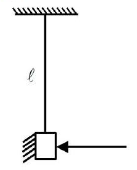
Force due to beam assuming complete reflection
$\mathrm{F}=\frac{2 \mathrm{P}}{\mathrm{C}}=\frac{2}{\mathrm{C}} \frac{\mathrm{dE}}{\mathrm{dt}} ; \mathrm{P}$ is power
So change in momentum of mirror.
$m(V-0)=\int F d t=\frac{2}{C} \int d E=\frac{2 E}{C}$
Now using work energy theorem $\qquad\ldots(1)$
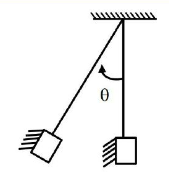
$\mathrm{W}_{\mathrm{g}}=\Delta \mathrm{k}$
$-\mathrm{mg} \ell(1-\cos \theta)=0-\frac{1}{2} \mathrm{mv}^{2}$
$\mathrm{g} \ell\left(2 \sin ^{2} \frac{\theta}{2}\right)=\frac{\mathrm{v}^{2}}{2}$
as $\theta$ is small
$\mathrm{g} \ell 2\left(\frac{\theta}{2}\right)^{2}=\frac{1}{2} \frac{4 \mathrm{E}^{2}}{\mathrm{~m}^{2} \mathrm{c}^{2}} \quad$ (from eq. (1))
$\mathrm{g} \ell \theta^{2}=\frac{4 \mathrm{E}^{2}}{\mathrm{~m}^{2} \mathrm{c}^{2}}$
$\theta=\frac{2 \mathrm{E}}{\mathrm{mc} \sqrt{\mathrm{g} \ell}}$ View full question & answer→MCQ 204 Marks
The mean free path and the average speed of oxygen molecules at 300 K and 1 atm are $3 \times 10^{-7} \mathrm{~m}$ and $600 \mathrm{~m} / \mathrm{s}$, respectively. Find the frequency of its collisions.
- A
$2 \times 10^{10} / \mathrm{s}$
- B
$9 \times 10^{5} / \mathrm{s}$
- ✓
$2 \times 10^{9} / \mathrm{s}$
- D
$5 \times 10^{8} / \mathrm{s}$
AnswerCorrect option: C. $2 \times 10^{9} / \mathrm{s}$
(C) $2 \times 10^{9} / \mathrm{s}$
Frequency $=\frac{1}{T}=\frac{V_{\text {avg }}}{\lambda}$
$=\frac{600}{3 \times 157}=2 \times 10^{9} \sec ^{-1}$
View full question & answer→