MCQ
If $\vec{A}+\vec{B}=\vec{A}-\vec{B}$ then vector $\overrightarrow{ B }$ must be
  • zero vector
  • B
    unit vector
  • C
    Non zero vector
  • D
    equal to $\vec{A}$

Answer

Correct option: A.
zero vector
zero vector

Need a full question paper?

Generate a complete, print-ready paper with questions like this in minutes — across 16+ boards, with answer keys.
Start Generating Free

Similar questions

An electric fan has blades of length 30 cm as measured from the axis of rotation. If the fan is rotating at 1200 r.p.m., the acceleration of a point on the tip of the blade is about
A particle moves around a circular path of radius ' $r$ ' with uniform speed ' $V$ '. After moving half the circle, the average acceleration of the particle is
Speed of sound is maximum in
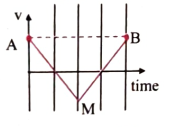
If the velocity time graph has the shape AMB, what would be the shape of the corresponding acceleration time graph?
Image
The equation of motion of a projectile is $y=a x-b x^2$ where a and b are constants of motion. The horizontal range of the projectile is.
If pressure of air gets doubled at constant temperature then velocity of sound in air ……………….
A body starting from rest, accelerates at a constant rate a $m / s ^2$ for some time, after which it decelerates at a constant rate b $m / s ^2$ to come to rest finally. If the total time elapsed is t s the maximum velocity attained by the body is given by
Two point charges of A = +5.0 µC and B = -5.0 µC are separated by 5.0 cm. A point charge C = 1.0 µC is placed at 3.0 cm away from the centre on the perpendicular bisector of the line joining the two point charges. The charge at C will experience a force directed towards
A particle is moving with constant acceleration and $v_1, v_2$ and $v_3$ are the average velocities of the particle in three successive intervals $t_1, t_2$ and $t_3.$ Which of the following relations will be correct?