MCQ 11 Mark
If $\vec{A}, \vec{B}$, and $\vec{C}$ are three vectors, then which of the following is not correct?
- A
$\vec{A} \cdot(\vec{B}+\vec{C})=\vec{A} \cdot \vec{B}+\vec{A} \cdot \vec{C}$
- B
$\overrightarrow{ A } \cdot \overrightarrow{ B }=\overrightarrow{ B } \cdot \overrightarrow{ A }$
- ✓
$\vec{A} \times \vec{B}=\vec{B} \times \vec{A}$
- D
$\vec{A} \times(\vec{B} \times \vec{C})=\vec{A} \times \vec{B}+\vec{B} \times \vec{C}$
AnswerCorrect option: C. $\vec{A} \times \vec{B}=\vec{B} \times \vec{A}$
View full question & answer→MCQ 21 Mark
The magnitude of vector product of two unit vectors making an angle of 60° with each other is
- A
- B
- C
$\frac{3}{2}$
- ✓
$\frac{\sqrt{3}}{2}$
AnswerCorrect option: D. $\frac{\sqrt{3}}{2}$
$\frac{\sqrt{3}}{2}$
View full question & answer→MCQ 31 Mark
The magnitude of scalar product of two unit vectors perpendicular to each other is
MCQ 41 Mark
For two vectors to be equal, they should have the
- A
- B
- ✓
same magnitude and direction
- D
same magnitude but opposite direction
AnswerCorrect option: C. same magnitude and direction
View full question & answer→MCQ 51 Mark
The resultant of two forces 10 N and 15 N acting along + x and – x-axes respectively, is
MCQ 61 Mark
A certain vector in the $y z$ plane has a $y$-component of $12 m$ and a $z$-component of $8 m$. It is then rotated in the $y z$ plane so that its $y$-component is halved. Then its new $z$-component is approximately
- A
$14 m$
- ✓
$13.11 m$
- C
$10 m$
- D
$2.0 m$
AnswerCorrect option: B. $13.11 m$
(b) : Let $\vec{A}$ be a vector in $y z$ plane. Its $y$ and $z$ components are $A_y=12 m , A_z=8 m$ respectively.
The magnitude of vector $\vec{A}$ is
$
A=\sqrt{A_y^2+A_z^2}=\sqrt{(12)^2+(8)^2}=\sqrt{208} m
$
When this vector is rotated in $y z$ plane such that its $y$ component becomes halved and its new $z$ component be $A_z^{\prime}$. Then
$
A=\sqrt{\left(\frac{A_y}{2}\right)^2+A_z^{\prime 2}}, \sqrt{208}=\sqrt{(6)^2+A_z^{\prime 2}}
$
Squaring both sides, we get
$
\begin{aligned}
208 & =(6)^2+A_z^{\prime 2} \text { or } A_z^{\prime 2}=208-36=172 \\
A_z^{\prime} & =\sqrt{172}=13.11 m
\end{aligned}
$
View full question & answer→MCQ 71 Mark
$\vec{P}$ and $\vec{Q}$ are two non-zero vectors inclined to each other at angle $\theta . \hat{P}$ and $\hat{q}$ are unit vectors along $\vec{P}$ and $\vec{Q}$ respectively. The component of $\vec{Q}$ in the direction of $\vec{P}$ will be
AnswerCorrect option: A. $\hat{P} \cdot \vec{Q}$
(a) : Given, $\vec{P}$ and $\vec{Q}$ are two non-zero vectors inclined to each other at angle $\theta . \hat{P}$ and $\hat{q}$ are unit vectors along $\vec{P}$ and $\vec{Q}$ respectivel
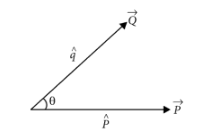
$\therefore$ Component of $\vec{Q}$ in the direction of $\vec{P}$ will be, $Q \cos \theta=|\vec{Q}||\hat{P}| \cos \theta=\vec{Q} \cdot \hat{P}$ View full question & answer→MCQ 81 Mark
If $\sqrt{A^2+B^2}$ represents the magnitude of resultant of two vectors $(\vec{A}+\vec{B})$ and $(\vec{A}-\vec{B})$, then the angle between two vectors is
- A
$\cos ^{-1}\left[-\frac{2\left(A^2-B^2\right)}{\left(A^2+B^2\right)}\right]$
- B
$\cos ^{-1}\left[-\frac{A^2-B^2}{A^2 B^2}\right]$
- ✓
$\cos ^{-1}\left[-\frac{\left(A^2+B^2\right)}{2\left(A^2-B^2\right)}\right]$
- D
$\cos ^{-1}\left[-\frac{\left(A^2-B^2\right)}{A^2+B^2}\right]$
AnswerCorrect option: C. $\cos ^{-1}\left[-\frac{\left(A^2+B^2\right)}{2\left(A^2-B^2\right)}\right]$
(c) : Given that,
$
\begin{aligned}
& \sqrt{(|\vec{A}+\vec{B}|)^2+(|\vec{A}-\vec{B}|)^2+2(\vec{A}+\vec{B}) \cdot(\vec{A}-\vec{B}) \cos \theta} \\
& =\sqrt{A^2+B^2}
\end{aligned}
$
Squaring both sides, we get,
$
\left(A^2+B^2\right)+\left(A^2+B^2\right)+2\left(A^2-B^2\right) \cos \theta=\left(A^2+B^2\right)
$
$\begin{aligned} & \left(A^2+B^2\right)=-2\left(A^2-B^2\right) \cos \theta \\ & \Rightarrow \cos \theta=-\frac{\left(A^2+B^2\right)}{2\left(A^2-B^2\right)} \\ & \Rightarrow \theta=\cos ^{-1}\left[-\frac{\left(A^2+B^2\right)}{2\left(A^2-B^2\right)}\right]\end{aligned}$
View full question & answer→MCQ 91 Mark
The resultant $\vec{R}$ of $\vec{P}$ and $\vec{Q}$ is perpendicular to $\vec{P}$. Also $|\vec{P}|=|\vec{R}|$. The angle between $\vec{P}$ and $\vec{Q}$ is [ $\tan 45^{\circ}=1$ ]
- A
$\frac{5 \pi}{4}$
- B
$\frac{7 \pi}{4}$
- C
$\frac{\pi}{4}$
- ✓
$\frac{3 \pi}{4}$
AnswerCorrect option: D. $\frac{3 \pi}{4}$
(d) : Given, $\vec{R}$ is resultant of $\vec{P}$ and $\vec{Q} ; \vec{R} \perp \vec{P}$ and $|\vec{R}|=|\vec{P}|$. Using law of vector addition we get,
$
\tan \alpha=\frac{Q \sin \theta}{P+Q \cos \theta}
$
where $\alpha$ is the angle between $\vec{R}$ and $\vec{P}$.
$
\begin{aligned}
& \therefore \tan 90^{\circ}=\frac{Q \sin \theta}{P+Q \cos \theta} \\
& \Rightarrow \frac{1}{0}=\frac{Q \sin \theta}{P+Q \cos \theta} \Rightarrow P+Q \cos \theta=0 \\
& \text { or } \cos \theta=-\frac{P}{Q}...(i) \\
& \because|\vec{R}|=\sqrt{P^2+Q^2+2 P Q \cos \theta}
\end{aligned}
$
Squaring both sides we get,
$
\begin{aligned}
& \Rightarrow R^2=P^2+Q^2+2 P Q \cos \theta \\
& \Rightarrow P^2=P^2+Q^2+2 P Q \cos \theta \quad(\because|\vec{R}|=|\vec{P}|) \\
& \Rightarrow Q^2=-2 P Q \cos \theta \Rightarrow Q=-2 P \cos \theta \\
& \Rightarrow Q=-2 P \cdot\left(-\frac{P}{Q}\right) \Rightarrow Q^2=2 P^2 \Rightarrow Q=\sqrt{2} P \\
& \Rightarrow \quad \frac{P}{Q}=\frac{1}{\sqrt{2}} \Rightarrow-\cos \theta=+\frac{1}{\sqrt{2}} \quad \text { (Using (i)) } \\
& \Rightarrow \cos \theta=-\frac{1}{\sqrt{2}}=\cos \left(\frac{3 \pi}{4}\right) \Rightarrow \theta=\frac{3 \pi}{4}
\end{aligned}
$
View full question & answer→MCQ 101 Mark
A unit vector is represented as $(0.8 \hat{i}+b \hat{j}+0.4 \hat{k})$. Hence the value of ' $b$ ' must be
- A
- B
$\sqrt{0.6}$
- C
- ✓
$\sqrt{0.2}$
AnswerCorrect option: D. $\sqrt{0.2}$
(d) : For unit vector, $|0.8 \hat{i}+b \hat{j}+0.4 \hat{k}|=1$
$
\begin{aligned}
& \sqrt{(0.8)^2+(b)^2+(0.4)^2}=1 \\
& \sqrt{0.64+b^2+0.16}=1
\end{aligned}
$
$\begin{aligned} & \sqrt{0.80+b^2}=1 \\ & 0.8+b^2=1 \Rightarrow b^2=0.2 \Rightarrow b=\sqrt{0.2}\end{aligned}$
View full question & answer→MCQ 111 Mark
If $\vec{A}=3 \hat{i}-2 \hat{j}+\hat{k}, \vec{B}=\hat{i}-3 \hat{j}+5 \hat{k}$ and $\vec{C}=2 \hat{i}+\hat{j}-4 \hat{k}$ form a right angled triangle. Then out of the following which one is satisfied?
- A
$\vec{A}=\vec{B}+\vec{C}$ and $A^2=B^2+C^2$
- ✓
$\vec{A}=\vec{B}+\vec{C}$ and $B^2=A^2+C^2$
- C
$\vec{B}=\vec{A}+\vec{C}$ and $B^2=A^2+C^2$
- D
$\vec{B}=\vec{A}+\vec{C}$ and $A^2=B^2+C^2$
AnswerCorrect option: B. $\vec{A}=\vec{B}+\vec{C}$ and $B^2=A^2+C^2$
$|\vec{A}|=\sqrt{9+4+1}=\sqrt{14}$
$|\vec{B}|=\sqrt{1+9+25}=\sqrt{35}$
$|\vec{C}|=\sqrt{4+1+16}=\sqrt{21}$
$\vec{A} \cdot \vec{C}=0$
$\therefore \vec{A}$ and $\vec{B}$ are perpendicular to each other.
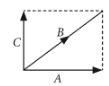
$\therefore B^2=A^2+C^2$
Also, $\vec{A}=3 \hat{i}-2 \hat{j}+\hat{k}=\vec{B}+\vec{C}$ View full question & answer→MCQ 121 Mark
The unit vector along $\hat{i}+\hat{j}$ is
AnswerCorrect option: C. $\frac{\hat{ i }+\hat{ j }}{\sqrt{2}}$
$\frac{\hat{ i }+\hat{ j }}{\sqrt{2}}$
View full question & answer→MCQ 131 Mark
The resultant of two forces of 3 N and 4 N is 5 N, the angle between the forces is
MCQ 141 Mark
Choose the WRONG statement
- A
The division of vector by scalar is valid.
- B
The multiplication of vector by scalar is valid.
- C
The multiplication of vector by another vector is valid by using vector algebra.
- ✓
The division of a vector by another vector is valid by using vector algebra.
AnswerCorrect option: D. The division of a vector by another vector is valid by using vector algebra.
The division of a vector by another vector is valid by using vector algebra.
View full question & answer→MCQ 151 Mark
$\vec{A}=5 \vec{i}-2 \vec{j}+3 \vec{k}$ and $\vec{B}=2 \vec{i}+\vec{j}+2 \vec{k}$, then component of $\vec{B}$ along $\vec{A}$ is
- A
$\frac{\sqrt{28}}{38}$
- B
$\frac{28}{\sqrt{38}}$
- C
$\frac{\sqrt{28}}{48}$
- ✓
$\frac{14}{\sqrt{38}}$
AnswerCorrect option: D. $\frac{14}{\sqrt{38}}$
$\frac{14}{\sqrt{38}}$
View full question & answer→MCQ 161 Mark
What vector must be added to the sum of two vectors $2 \hat{i}-\hat{j}+3 \hat{k}$ and $3 \hat{i}-2 \hat{j}-2 \hat{k}$ so that the resultant is a unit vector along Z axis?
AnswerCorrect option: B. $-5 \hat{i}+3 \hat{j}$
$-5 \hat{i}+3 \hat{j}$
View full question & answer→MCQ 171 Mark
Three vectors $\vec{A}, \vec{B}$ and $\vec{C}$ satisfy the relation $\vec{A} \cdot \vec{B}=0$ and $\vec{A} \cdot \vec{C}=0$, then $\vec{A}$ is parallel to
AnswerCorrect option: C. $\overrightarrow{ B } \times \overrightarrow{ C }$
$\overrightarrow{ B } \times \overrightarrow{ C }$
View full question & answer→MCQ 181 Mark
The magnitude of scalar product of the vectors $\overrightarrow{ A }=2 \hat{ i }+5 \hat{ k }$ and $\vec{B}=3 \hat{ i }+4 \hat{ k }$ is
View full question & answer→MCQ 191 Mark
$(\vec{P}+\vec{Q})$ is a unit vector along $X$-axis. If $\vec{P}=\hat{i}-\hat{j}+\hat{k}$ then $\vec{Q}$ is
AnswerCorrect option: B. $\hat{j}-\hat{k}$
$\hat{j}-\hat{k}$
View full question & answer→MCQ 201 Mark
What is the angle between $\hat{i}+\hat{j}+\hat{k}$ and $\hat{i}$ ?
- A
- B
$\frac{\pi}{6}$
- C
$\frac{\pi}{3}$
- ✓
View full question & answer→MCQ 211 Mark
The expression $\frac{1}{\sqrt{2}}(\hat{ i }+\hat{ j })$ is a
View full question & answer→MCQ 221 Mark
The vectors $\vec{A}$ and $\vec{B}$ are such that $\vec{A}+\vec{B}=\vec{C}$ and $A^2+B^2=C^2$. Angle $\theta$ between positive directions of $\vec{A}$ and $\vec{B}$ is
- ✓
$\frac{\pi}{2}$
- B
- C
$\pi$
- D
$\frac{2 \pi}{3}$
AnswerCorrect option: A. $\frac{\pi}{2}$
$\frac{\pi}{2}$
View full question & answer→MCQ 231 Mark
The resultant of two vectors of magnitude $|\overrightarrow{ P }|$ is also $|\overrightarrow{ P }|$. They act at an angle
View full question & answer→MCQ 241 Mark
What is the maximum n Limber of components into which a force can be resolved?
MCQ 251 Mark
The magnitude of the $X$ and $Y$ components of $\vec{A}$ are 7 and 6 . Also the magnitudes of the $X$ and $Y$ components of $\vec{A}+\vec{B}$ are 11 and 9 respectively. What is the magnitude of
View full question & answer→MCQ 261 Mark
The maximum value of magnitude of $(\vec{A}-\vec{B})$ is
View full question & answer→MCQ 271 Mark
A person moves from a point S and walks along the path which is a square of each side 50 m. He runs east, south, then west and finally north. Then the total displacement covered is
MCQ 281 Mark
If $\vec{A}=\hat{i}+2 \hat{j}+3 \hat{k}$ and $\overrightarrow{ B }=3 \hat{ i }-2 \hat{ j }+\hat{ k }$, then the area of parallelogram formed from these vectors as the adjacent sides will be
- A
$2 \sqrt{3}$ square units
- B
$4 \sqrt{ } 3$ square units
- C
$6 \sqrt{3}$ square units
- ✓
$8 \sqrt{3}$ square units
AnswerCorrect option: D. $8 \sqrt{3}$ square units
$8 \sqrt{3}$ square units
View full question & answer→MCQ 291 Mark
If $\vec{A}=\vec{B}+\vec{C}$ and magnitudes of $\vec{A}, \vec{B}$ and $\vec{C}$ are 5,4 and 3 unit respectively, then angle between $\vec{A}$ and $\vec{B}$ is
- A
$\sin ^{-1}(3 / 4)$
- ✓
$\cos ^{-1}(4 / 5)$
- C
$\tan ^{-1}(5 / 3)$
- D
$\cos ^{-1}(3 / 5)$
AnswerCorrect option: B. $\cos ^{-1}(4 / 5)$
$\cos ^{-1}(4 / 5)$
View full question & answer→MCQ 301 Mark
A river is flowing at the rate of $6 \ km h^{-1}.$ A man swims across it with a velocity of $9 \ km h^{-1}.$ The resultant velocity of the man will be
- A
$\sqrt{15} km h ^{-1}$
- B
$\sqrt{45} km h ^{-1}$
- ✓
$\sqrt{117} km h ^{-1}$
- D
$\sqrt{225} km h ^{-1}$
AnswerCorrect option: C. $\sqrt{117} km h ^{-1}$
$\sqrt{117} km h ^{-1}$
View full question & answer→MCQ 311 Mark
A force of 60 N acting perpendicular to a force of 80 N, magnitude of resultant force is
MCQ 321 Mark
Two quantities of 5 and 12 unit when added gives a quantity 13 unit. This quantity is
MCQ 331 Mark
If $\hat{ n }$ is the unit vector in the direction of $\overrightarrow{ A }$, then,
- ✓
$\hat{n}=\frac{\vec{A}}{|\vec{A}|}$
- B
$\hat{ n }=\overrightarrow{ A }|\overrightarrow{ A }|$
- C
$\hat{ n }=\frac{|\overrightarrow{ A }|}{\overrightarrow{ A }}$
- D
$\hat{ n }=\hat{ n } \times \overrightarrow{ A }$
AnswerCorrect option: A. $\hat{n}=\frac{\vec{A}}{|\vec{A}|}$
$\hat{n}=\frac{\vec{A}}{|\vec{A}|}$
View full question & answer→MCQ 341 Mark
If $\vec{A}+\vec{B}=\vec{A}-\vec{B}$ then vector $\overrightarrow{ B }$ must be
View full question & answer→MCQ 351 Mark
The minimum number of numerically equal vectors whose vector sum can be zero is
MCQ 361 Mark
The equation $\vec{a}+\vec{a}=\vec{a}$ is
AnswerCorrect option: D. true only when $\overrightarrow{ a }=0$
true only when $\overrightarrow{ a }=0$
View full question & answer→MCQ 371 Mark
Which of the throwing is a vector?