Question
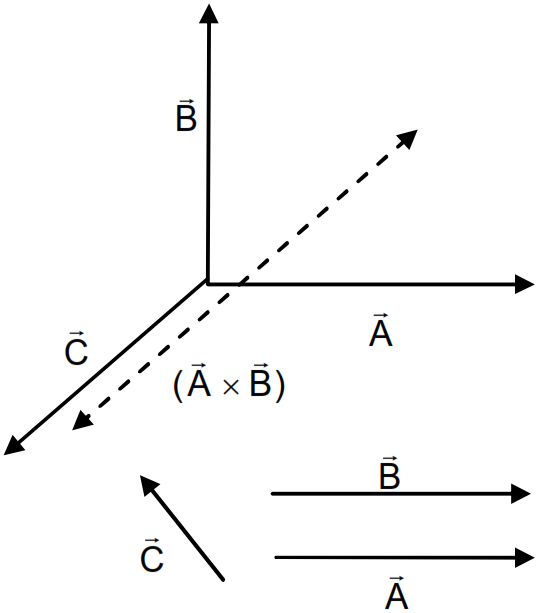
If $\vec{\text{A}},\vec{\text{B}},\vec{\text{C}}$ are mutually perpendicular, show that $\vec{\text{C}}\times(\vec{\text{A}}\times\vec{\text{B}})=0.$ Is the converse true?

Answer

Given that $\vec{\text{A}},\vec{\text{B}}$ and $\vec{\text{C}}$ are mutually perpendicular$\vec{\text{A}}\times\vec{\text{B}}$ is a vector which direction is perpendicular to the plane containing $\vec{\text{A}}$ and $\vec{\text{B}}.$

Also $\vec{\text{C}}$ is perpendicular to $\vec{\text{A}}$ and $\vec{\text{B}}$

$\therefore$ Angle between $\vec{\text{C}}$ and $\vec{\text{A}}\times\vec{\text{B}}$ is $0^{\circ}$ or $180^{\circ}$

So, $\vec{\text{C}}\times(\vec{\text{A}}\times\vec{\text{B}})=0$

The converse is not true.

For example, if two of the vector are parallel, then also

$\vec{\text{C}}\times(\vec{\text{A}}\times\vec{\text{B}})=0$

So, they need not be mutually perpendicular.
Need a full question paper?

Generate a complete, print-ready paper with questions like this in minutes — across 16+ boards, with answer keys.
Start Generating Free

Similar questions

The magnetic field B inside a long solenoid, carrying a current of 5.00A, is 3.14 × 10⁻²T. Find the number of turns per unit length of the solenoid.
  1. Write symbolically the β decay process of$\frac{15}{32}$P.
  2. Derive an expression for the average life of a radionuclide. Give its relationship with the half-life.
In a periodic table the average atomic mass of magnesium is given as 24.312 u. The average value is based on their relative natural abundance on earth. The three isotopes and their masses are $^{24}_{12}\text{Mg }23.98504\text{u}),^{25}_{12}\text{Mg }(24.98584\text{u})\text{ and }^{26}_{12}\text{Mg }(25.98259\text{u}).$ The natural abundance of $^{24}_{12}\text{Mg}\text{ is }78.99\%$ by mass. Calculate the abundances of other two isotopes.
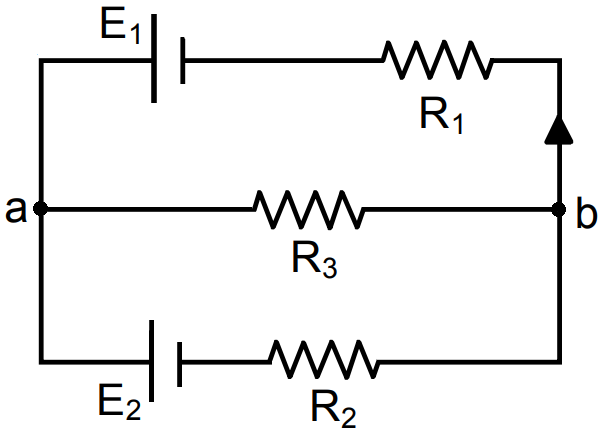
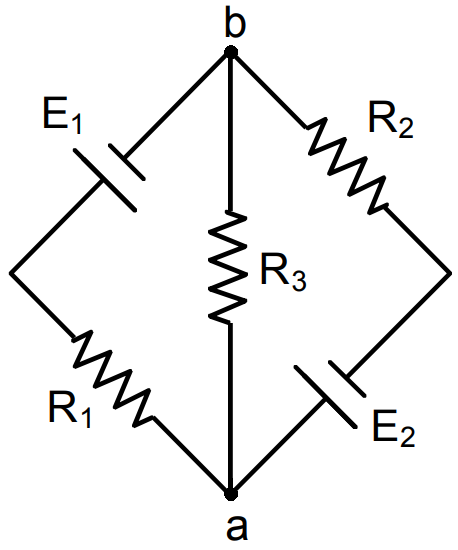
Find the potential difference Va - Vb in the circuits shown in figure.


A cylinder rotating at an angular speed of 50rev/s is brought in contact with an identical stationary cylinder. Because of the kinetic friction, torques act on the two cylinders, accelerating the stationary one and decelerating the moving one. If the common magnitude of the acceleration and deceleration be one revolution per second square, how long will it take before the two cylinders have equal angular speed?
Define the terms ‘stopping potential’ and ‘threshold frequency’ in relation to photoelectric effect. How does one determine these physical quantities using Einstein’s equation?
Describe the motion of a charged particle in a cyclotron if the frequency of the radio frequency (rf) field were doubled.
Plot a graph showing the variation of photoelectric current with intensity of light. The work function for the following metals is given:
Na : 2.75 eV and Mo : 4.175 eV.
Which of these will not give photoelectron emission from a radiation of wavelength 3300 Å from a laser beam? What happens if the source of laser beam is brought closer?
An infinitely long thin wire carrying a uniform linear static charge density λ is placed along the z-axis. The wire is set into motion along its length with a uniform velocity $\text{v}=\text{v}\hat{\text{k}}_\text{z}$. Calculate the poynting vector $\text{S}=\frac{1}{\mu_0}(\text{E}\times\text{B})$.

Consider two pairs of neutrons. In each pair, the separation between the neutrons is the same. Can the force between the neutrons have different magnitudes for the two pairs?