Question
  1. Write symbolically the β decay process of$\frac{15}{32}$P.
  2. Derive an expression for the average life of a radionuclide. Give its relationship with the half-life.

Answer

β decay process
$^{32}_{15}\text{P}\rightarrow^{32}_{16}\text{S} + \text{e}^{-} + \overline{\text{v}}\text{ or }^{32}_{15}\text{P}\rightarrow^{32}_{15}\text{X} + _{-1}\text{e}^{0} + \overline{\text{v}}$
Derivation of average life:
$\tau=\frac{\lambda\text{N}_{0}\int\limits_{0}^{\infty}\text{te}^{-\lambda\text{t}}\text{dt}}{\text{N}_{0}} = \lambda\int\limits_{0}^{\infty}\text{te}^{-\lambda\text{t}}\text{dt}$
$\Rightarrow\tau = 1/ \lambda$
Relation of average life with half life:
$\text{T}_{1/2} = \frac{\ell\text{n}2}{\lambda} = \tau\ell\text{n} 2$

Need a full question paper?

Generate a complete, print-ready paper with questions like this in minutes — across 16+ boards, with answer keys.

Start Generating Free

Similar questions

A battery of emf 10 V and internal resistance $3\ \Omega$ is connected to a resistor. If the current in the circuit is 0.5 A, what is the resistance of the resistor? What is the terminal voltage of the battery when the circuit is closed?
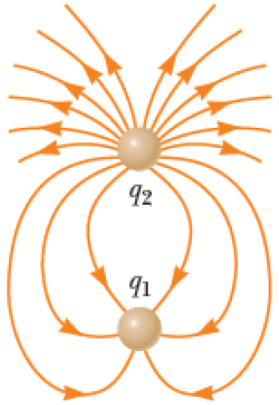
Consider the situation shown in figure. What are the signs of q1 and q2? If the lines are drawn in proportion to the charge, what is the ratio $\frac{\text{q}_1}{\text{q}_2}?$

Explain, with the help of a schematic diagram, the principle and working of a Light Emitting Diode. What criterion is kept in mind while choosing the semiconductor material for such a device? Write any two advantages of Light Emitting Diode over conventional incandescent lamps.
Figure shows a 11.7ft wide ditch with the approach roads at an angle of 15° with the horizontal. With what minimum speed should a motorbike be moving on the road so that it safely crosses the ditch?
Assume that the length of the bike is 5ft, and it leaves the road when the front part runs out of the approach road.

An ammeter and a milliammeter are converted from the same galvanometer. Out of the two, which current measuring instrument has a higher resistance?
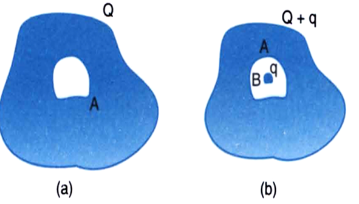
  1. A conductor A with a cavity as shown in Fig. 1.36(a) is given a charge Q. Show that the entire charge must appear on the outer surface of the conductor.
  2. Another conductor B with charge q is inserted into the cavity keeping B insulated from A. Show that the total charge on the outside surface of A is Q + q [Fig. 1.36(b)].
  3. A sensitive instrument is to be shielded from the strong electrostatic fields in its environment. Suggest a possible way.

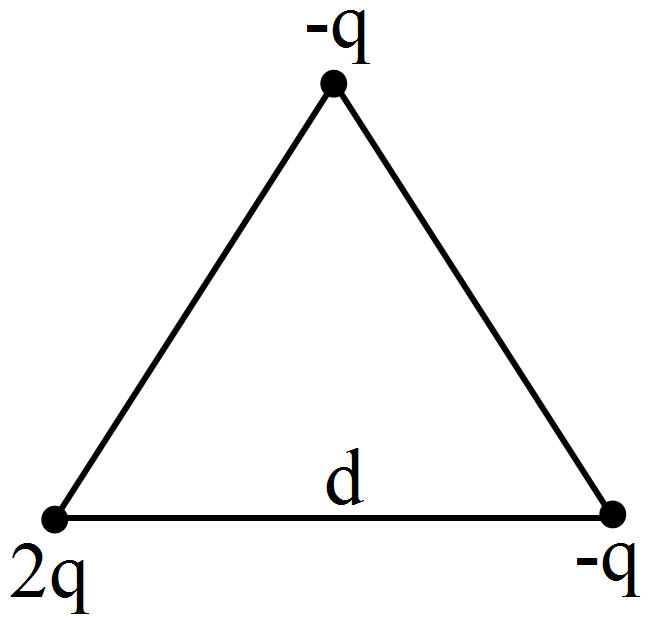
Three charges are arranged on the vertices of an equilateral triangle as shown in figure. Find the dipole moment of the combination.

  1. A screen is placed at a distance of 100 cm from an object. The image of the object is formed on the screen by a convex lens for two different locations of the lens separated by 20 cm. Calculate the focal length of the lens used.
  2. A converging lens is kept coaxially in contact with a diverging lens - both the lenses being of equal focal length. What is the focal length of the combination?
Find the angle of minimum deviation for an equilateral prism made of a material of refractive index 1.732. What is the angle of incidence for this deviation?
  1. A student wants to use two p-n junction diodes to convert alternating current into direct current. Draw the labelled circuit diagram she would use and explain how it works.
  2. Give the truth table and circuit symbol for NAND gate.