Question
If $\vec{\text{a}},\vec{\text{b}},\vec{\text{c}}$ are three non-coplanar vectors, then $\big(\vec{\text{a}}+\vec{\text{b}}+\vec{\text{c}}\big).\big[\big(\vec{\text{a}}+\vec{\text{b}}\big)\times\big(\vec{\text{a}}+\vec{\text{c}}\big)\big]$ equals:
  1. $0$
  2. $\big[\vec{\text{a}}\vec{\text{b}}\vec{\text{c}}\big]$
  3. $2\big[\vec{\text{a}}\vec{\text{b}}\vec{\text{c}}\big]$
  4. $-\big[\vec{\text{a}}\vec{\text{b}}\vec{\text{c}}\big]$

Answer

  1. $-\big[\vec{\text{a}}\vec{\text{b}}\vec{\text{c}}\big]$
Solution:
$\big(\vec{\text{a}}+\vec{\text{b}}+\vec{\text{c}}\big).\big[\big(\vec{\text{a}}+\vec{\text{b}}\big)\times\big(\vec{\text{a}}+\vec{\text{c}}\big)\big]$
$=\big(\vec{\text{a}}+\vec{\text{b}}+\vec{\text{c}}\big).\big(\vec{\text{a}}\times\vec{\text{a}}+\vec{\text{a}}\times\vec{\text{c}}+\vec{\text{b}}\times\vec{\text{a}}+\vec{\text{b}}\times\vec{\text{c}}\big)$
$=\big(\vec{\text{a}}+\vec{\text{b}}+\vec{\text{c}}\big).\big(\vec{\text{a}}\times\vec{\text{c}}+\vec{\text{b}}\times\vec{\text{a}}+\vec{\text{b}}\times\vec{\text{c}}\big)$
$=0+0+\big[\vec{\text{a}}\vec{\text{b}}\vec{\text{c}}\big]+\big[\vec{\text{b}}\vec{\text{a}}\vec{\text{c}}\big]+0+0+0+\big[\vec{\text{c}}\vec{\text{b}}\vec{\text{a}}\big]+0$
$=-\big[\vec{\text{a}}\vec{\text{b}}\vec{\text{c}}\big]$

Need a full question paper?

Generate a complete, print-ready paper with questions like this in minutes — across 16+ boards, with answer keys.

Start Generating Free

Similar questions

Let $\sin\text{y}=\text{x}\sin(\text{a}+\text{y}),$ then $\frac{\text{dy}}{\text{dx}}$ is:
  1. $\frac{\sin\text{a}}{\sin\text{a}\sin^2(\text{a}+\text{y})}$
  2. $\frac{\sin^2(\text{a}+\text{y})}{\sin\text{a}}$
  3. $\sin\text{a}\sin^2(\text{a}+\text{y})$
  4. $\frac{\sin^2(\text{a}+\text{y})}{\sin\text{a}}$
Z = 8x + 10y, subject to $2\text{x}+\text{y}\geq1,2\text{x}+3\text{y}\geq15,\text{y}\geq2,\text{x}\geq0,\text{y}\geq0.$ The minimum value of Z occurs at.
Namita walks 14 metres towards west, then turns to her right and walks 14 metres and then turns to her left and walks 10 metres.Again turning to her left she walks 14 metres.What is the shortest distance (in metres) between her starting point and the present position?
  1. 10
  2. 24
  3. 28
  4. 38
If the function $\text{f}(\text{x})=2\tan\text{x}+(2\text{a}+1)\log_\text{e}|\sec\text{x}|+(\text{a}-2)\text{x}$ is increasing on R, then:
  1. $\text{a}\in\Big(\frac{1}{2},\infty\Big)$
  2. $\text{a}\in\Big(-\frac{1}{2},\frac{1}{2}\Big)$
  3. $\text{a}=\frac{1}{2}$
  4. $\text{a}\in\text{R}$
Let $\text{A}=\begin{bmatrix} 1 & 2 \\ 3 & -5 \end{bmatrix}\text{ and B}=\begin{bmatrix} 1 & 0 \\ 0 & 2 \end{bmatrix}$ and $X$ be a matrix such that $A = BX,$ then $X$ is equal to:
Out of 30 consecutive integers, 2 are chosen at random. The probability that their sum is odd, is
Choose the correct answer from the given four options.
The corner points of the feasible region determined by the system of linear constraints are (0, 0), (0, 40), (20, 40), (60, 20), (60, 0). The objective function is Z = 4x + 3y.
Compare the quantity in Column A and Column B.
Column A
Column B
Maximum of Z
325
  1. The quantity in column A is greater .
  2. The quantity in column B is greater.
  3. The two quantities are equal.
  4. The relationship can not be determined on the basis of the information supplied.
Which of the following triplets give the direction cosines of a line:
If the direction ratios of two lines are given by 3lm - 4ln + mn = 0 and l + 2m + 3n = 0, then the angle between the lines is:
  1. $\frac{\pi}{6}$
  2. $\frac{\pi}{4}$
  3. $\frac{\pi}{3}$
  4. $\frac{\pi}{2}$
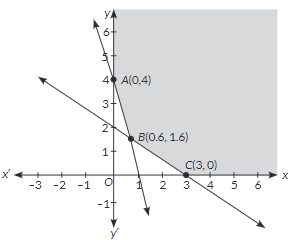
The corner points of the shaded unbounded feasible region of an LPP are $(0,4),(0.6,1.6)$ and $(3,0)$ as shown in the figure. The minimum value of the objective function $Z=4 x+6 y$ occurs at
Image