Sample QuestionsVECTOR ALGEBRA questions
One sample from each question group in this chapter. Select any group above to see the full set with answer keys.
If the projection of $\vec{\text{a}}=\hat{\text{i}}-2\hat{\text{j}}+3\hat{\text{k}}$ on $\vec{\text{b}}=2\hat{\text{i}}+\lambda\hat{\text{k}}$ is zero, then the value of $\lambda$ is:
- $0$
- $1$
- $\frac{-2}{3}$
- $\frac{-3}{2}$
View full solution →If the projection of $\vec{\text{a}}=\hat{\text{i}}-2\hat{\text{j}}+3\hat{\text{k}}$ on $\vec{\text{b}}=2\hat{\text{i}}+\lambda\hat{\text{k}}$ is zero, then the value of $\lambda$ is:
- $0$
- $1$
- $\frac{-2}{3}$
- $\frac{-3}{2}$
View full solution →If the projection of $\vec{\text{a}}=\hat{\text{i}}-2\hat{\text{j}}+3\hat{\text{k}}$ on $\vec{\text{b}}=2\hat{\text{i}}+\lambda\hat{\text{k}}$ is zero, then the value of $\lambda$ is:
- $0$
- $1$
- $\frac{-2}{3}$
- $\frac{-3}{2}$
View full solution →The ratio in which 2x + 3y + 5z = 1 divides the line joining the points (1, 0, -3) and (1, -5, 7) is:
- 5 : 3
- 3 : 2
- 2 : 1
- 1 : 3
If G is the intersection of diagonals of a parallelogram ABCD and O is any point, then $\overrightarrow{\text{OA}}+\overrightarrow{\text{OB}}+\overrightarrow{\text{OC}}+\overrightarrow{\text{OD}}=$
- $2\overrightarrow{\text{OG}}$
- $4\overrightarrow{\text{OG}}$
- $5\overrightarrow{\text{OG}}$
- $3\overrightarrow{\text{OG}}$
View full solution →Directions: In these questions, a statement of Assertion is followed by a statement of Reason is given.Choose the correct answer out of the following choices:
Assertion: The adjacent sides of a parallelogramarealong $\overline{\text{a}}=\hat{\text{i}}+2\hat{\text{j}}$ and $\overline{\text{b}}=2\hat{\text{i}}+\hat{\text{j}}$ The angle between the diagonals is $150^\circ$.
Reason: Two vectors are perpendicular to each other if their dot product is zero.
- Assertion and Reason both are correct statements and Reason is the correct explanation of Assertion.
- Assertion and Reason both are correct statements but Reason is not the correct explanation of Assertion.
- Assertion is correct statement but Reason is wrong statement.
- Assertion is wrong statement but Reason is correct statement.
View full solution →Directions: In these questions, a statement of Assertion is followed by a statement of Reason is given.Choose the correct answer out of the following choices:
Let $\overline{\text{a}}=\hat{\text{i}}+\hat{\text{j}}=3\hat{\text{k}}$ and $\overline{\text{b}}=\hat{2\text{i}}+\hat{\text{j}}=\hat{\text{k}}$
Assertion: Vectors $\overline{\text{a}}$ and $\overline{\text{b}}$ are perpendicular to each other.
Reason: $\overline{\text{a}}.\overline{\text{b}}=0$
- Assertion and Reason both are correct statements and Reason is the correct explanation of Assertion.
- Assertion and Reason both are correct statements but Reason is not the correct explanation of Assertion.
- Assertion is correct statement but Reason is wrong statement.
- Assertion is wrong statement but Reason is correct statement.
View full solution →Directions: In these questions, a statement of Assertion is followed by a statement of Reason is given.Choose the correct answer out of the following choices:
Assertion: If $\vec{\text{a}}+\vec{\text{b}}+\vec{\text{c}}=\vec{0},|\vec{\text{a}}|=3,|\vec{\text{b}}|=4,|\vec{\text{c}}|=5,$ then $\vec{\text{a}}.\vec{\text{b}}+\vec{\text{b}}.\vec{\text{c}}+\vec{\text{c}}.\vec{\text{a}}$ is equal to $-25.$
Reason: If $\vec{\text{a}}+\vec{\text{b}}+\vec{\text{c}}=\vec0,$ then the$\angle\theta$ between $\vec{\text{b}}$ and $\vec{\text{c}}$ is given by $\cos\theta=\frac{\vec{\text{a}}^2-\vec{\text{b}}^2-\vec{\text{c}}^2}{2\vec{\text{b}}{\vec{\text{c}}}}$
- Assertion and Reason both are correct statements and Reason is the correct explanation of Assertion.
- Assertion and Reason both are correct statements but Reason is not the correct explanation of Assertion.
- Assertion is correct statement but Reason is wrong statement.
- Assertion is wrong statement but Reason is correct statement.
View full solution →Directions: In these questions, a statement of Assertion is followed by a statement of Reason is given.Choose the correct answer out of the following choices:
Assertion: The magnitude of the resultant of vectors $\overline{\text{a}}=2\hat{\text{i}}+\hat{\text{j}}+\hat{\text{k}}$ and $\hat{\text{b}}=\hat{\text{i}}+2\hat{\text{j}}+3\hat{\text{k}}$
Reason: The magnitude of a vector can never be negative.
- Assertion and Reason both are correct statements and Reason is the correct explanation of Assertion.
- Assertion and Reason both are correct statements but Reason is not the correct explanation of Assertion.
- Assertion is correct statement but Reason is wrong statement.
- Assertion is wrong statement but Reason is correct statement.
View full solution →Directions: In these questions, a statement of Assertion is followed by a statement of Reason is given.Choose the correct answer out of the following choices:
Assertion: If $ (\vec{\text{a}}\times\vec{\text{b}})+(\vec{\text{a}}.\vec{\text{b}})=400$ and $|\vec{\text{a}}|=4,$ then $|\vec{\text{b}}|=9.$
Reason: If $\vec{\text{a}}$ and $\vec{\text{b}}$ are any two vectors, then $(\vec{\text{a}}\times\vec{\text{b}})^2$ is equal to $(\vec{\text{a}})^2(\vec{\text{b}})^2-(\vec{\text{a}}.\vec{\text{b}})^2.$
- Assertion and Reason both are correct statements and Reason is the correct explanation of Assertion.
- Assertion and Reason both are correct statements but Reason is not the correct explanation of Assertion.
- Assertion is correct statement but Reason is wrong statement.
- Assertion is wrong statement but Reason is correct statement.
View full solution →Write the position vector of the point which divides the join of points with position vectors $3\overrightarrow{\text{a}} - 2\overrightarrow{\text{b}} \text{and } 2\overrightarrow{\text{a}} + 3\overrightarrow{\text{b}}$ in the ratio $2:1.$
View full solution →Write the number of vectors of unit length perpendicular to both the vectors $\overrightarrow{\text{a}} = 2\hat{\text{i}} + \hat{j} + 2\hat{\text{k}} \text{ and} \overrightarrow{\text{b}} = \hat{\text{j}} + \hat{\text{k}}.$
View full solution →Find a vector of magnitude $\sqrt{171}$ which is perpendicular to both of the vectors $\overrightarrow{\text{a}} = \hat{\text{i}} + 2\hat{\text{j}} - 3\hat{\text{k}}$ $\text{and} \overrightarrow{\text{b}} = 3\hat{\text{i}} - \hat{\text{j}} + 2\hat{\text{k}}.$
View full solution →If $\overrightarrow{\text{a}}$and$\overrightarrow{\text{b}}$ are perpendicular vectors,|$\overrightarrow{\text{a}}$+$\overrightarrow{\text{b}}$|= 13 and |$\overrightarrow{\text{a}}$| = 5 find the value of|$\overrightarrow{\text{b}}$|.
View full solution →Write the position vector of the point which divides the join of points with position vectors $3\overrightarrow{\text{a}} - 2\overrightarrow{\text{b}} \text{and } 2\overrightarrow{\text{a}} + 3\overrightarrow{\text{b}}$ in the ratio $2:1.$
View full solution →If $\theta$ is the angle between two vectors $\hat{\text{i}}-2\hat{\text{j}}+3\hat{\text{k}}\ \text{and}\ 3\hat{\text{i}}-2\hat{\text{j}}+\hat{\text{k}},$ find $\sin\theta.$
View full solution →If $\theta$ is the angle between two vectors $\hat{\text{i}}-2\hat{\text{j}}+3\hat{\text{k}}\ \text{and}\ 3\hat{\text{i}}-2\hat{\text{j}}+\hat{\text{k}},$ find $\sin\theta.$
View full solution →If $\theta$ is the angle between two vectors $\hat{\text{i}}-2\hat{\text{j}}+3\hat{\text{k}}\ \text{and}\ 3\hat{\text{i}}-2\hat{\text{j}}+\hat{\text{k}},$ find $\sin\theta.$
View full solution →If $\vec{\text{a}}$ and $\vec{\text{b}}$ are two vectors such that $\big|\vec{\text{a}}\big|=4,\big|\vec{\text{b}}\big|=3$ and $\vec{\text{a}}.\vec{\text{b}}=6,$ find the angle between $\vec{\text{a}}$ and $\vec{\text{b}}$.
View full solution →If $\vec{\text{a}}$ and $\vec{\text{b}}$ are two vectors such that $\big(\vec{\text{a}}+\vec{\text{b}}\big).\big(\vec{\text{a}}-\vec{\text{b}}\big).=0,$ find the relation betwen the magnitudes of $\vec{\text{a}}$ and $\vec{\text{b}}.$
View full solution →Find the projection of $\vec{b}+\vec{c}$ on $\vec{a}$ where $\vec{a}=\hat{i}+2\hat{j}+\hat{k},\text{ }\vec{b}=\hat{i}+3\hat{j}+\hat{k}$ and $\vec{c}=\hat{i}+\hat{k}.$
View full solution →Find the value of $\lambda$ which makes the vectors $\vec{a},\vec{b},\vec{c}$ coplanar, where $\vec{a}=-4\hat{\text{i}}-6\hat{\text{j}}-2\hat{\text{k}},\text{ }\vec{b}=-\hat{\text{i}}+4\hat{\text{j}}+3\hat{\text{k}}$ and $\vec{c}=-8\hat{\text{i}}-\hat{\text{j}}+\lambda\hat{\text{k}.}$
View full solution →Find the angle between the vectors $\vec{\text{a}}+\vec{\text{b}}\text{ and }\vec{\text{a}}-\vec{\text{b}}\text{ if }\text{ }\vec{\text{a}}=2\hat{\text{i}}-\hat{\text{j}}+3\hat{\text{k}}\text{ and }\vec{\text{b}}\text{ }=3\hat{\text{i}}+\hat{\text{j}}-2\hat{\text{k}}.$
View full solution →Using vectors, prove that in a $\Delta$ ABC,$\frac{\text{a}}{\sin\text{A}}=\frac{\text{b}}{\sin\text{B}}=\frac{\text{c}}{\sin\text{C}}$
Where a, b and c are lengths of the sides opposite, respectively, to the angles A, B and C of $\Delta$ ABC.
View full solution →Find the projection of $\overrightarrow{b} + \overrightarrow{c} $ on $\overrightarrow{a}$ where $\overrightarrow{a} = 2\hat{i} - 2\hat{j} + \hat{k}, \overrightarrow{b} = \hat{i} + 2\hat{j} - 2\hat{k} $ and $\overrightarrow{c} = 2\hat{i} - \hat{j} + 4\hat{k}.$
View full solution →If $ \vec{\text{a}}=2\hat{\text{i}}-\hat{\text{j}}-2\hat{\text{k}}\ \text{and}\ \vec{\text{b}}=7\hat{\text{i}}+2\hat{\text{j}}-3\hat{\text{k}}, $ then express $ \overrightarrow{\text{b}}$ in the form of $\overrightarrow{\text{b}}=\ \overrightarrow{\text{b}}_1+\overrightarrow{\text{b}}_2,$ where $ \overrightarrow{\text{b}}_1$ is parallel to $\overrightarrow{\text{a}}$ and $ \overrightarrow{\text{b}}_2$ is perpendicular to$\overrightarrow{\text{a}}$.
View full solution →A manufacturing company makes two types of teaching aids A and B of Mathematics for class XII. Each type of A requires 9 labour hours of fabricating and 1 labour hour for finishing. Each type of B requires 12 labour hours for fabricating and 3 labour hours for finishing. For fabricating and finishing, the maximum labour hours available per week are 180 and 30 respectively. The company makes a profit of A and ₹ 80 on each piece of type ₹ 120 on each piece of type B. How many pieces of type A and type B should be manufactured per week to get a maximum profit? Make it as an LPP and solve graphically. What is the maximum profit per week?
A manufacturing company makes two types of teaching aids A and B of Mathematics for class XII. Each type of A requires 9 labour hours of fabricating and 1 labour hour for finishing. Each type of B requires 12 labour hours for fabricating and 3 labour hours for finishing. For fabricating and finishing, the maximum labour hours available per week are 180 and 30 respectively. The company makes a profit of A and ₹ 80 on each piece of type ₹ 120 on each piece of type B. How many pieces of type A and type B should be manufactured per week to get a maximum profit? Make it as an LPP and solve graphically. What is the maximum profit per week?
Find the value of $\lambda,$ if four points with position vectors $3\hat{\text{i}} + 6\hat{\text{j}} + 9\hat{\text{k}}, \hat{\text{i}} + 2\hat{\text{j}} + 3\hat{\text{k}}, 2\hat{\text{i}} + 3\hat{\text{j}} + \hat{\text{k}} \text{ and } 4\hat{\text{i}} + 6\hat{\text{j}} + \lambda\hat{\text{k}}$are coplanar.
View full solution →Show that the points A, B, C with position vectors $2\hat{\text{i}} - \hat{\text{j}} + \hat{\text{k}}, \hat{\text{i}} - 3\hat{\text{j}} - 5\hat{\text{k}} \text{ and } 3\hat{\text{i}} - 4\hat{\text{j}} - 4\hat{\text{k}}$ respectively, are the vertices of a right-angled triangle. Hence find the area of the triangle.
View full solution →Teams A, B, Cwent for playing a tug of war game. Teams A, B, C have attached a rope to a metal ring and is trying to pull the ring into their own area ( team areas shown below).
Team A pulls with force $\text{F}_1=4\hat{\text{i}}+0\hat{\text{j}}\text{KN}$
Team $\text{B}\rightarrow\text{F}_2=-2\hat{\text{i}}+4\hat{\text{j}}\text{KN}$
Team $\text{C}\rightarrow\text{F}_3=-3\hat{\text{i}}+3\hat{\text{j}}\text{KN}$
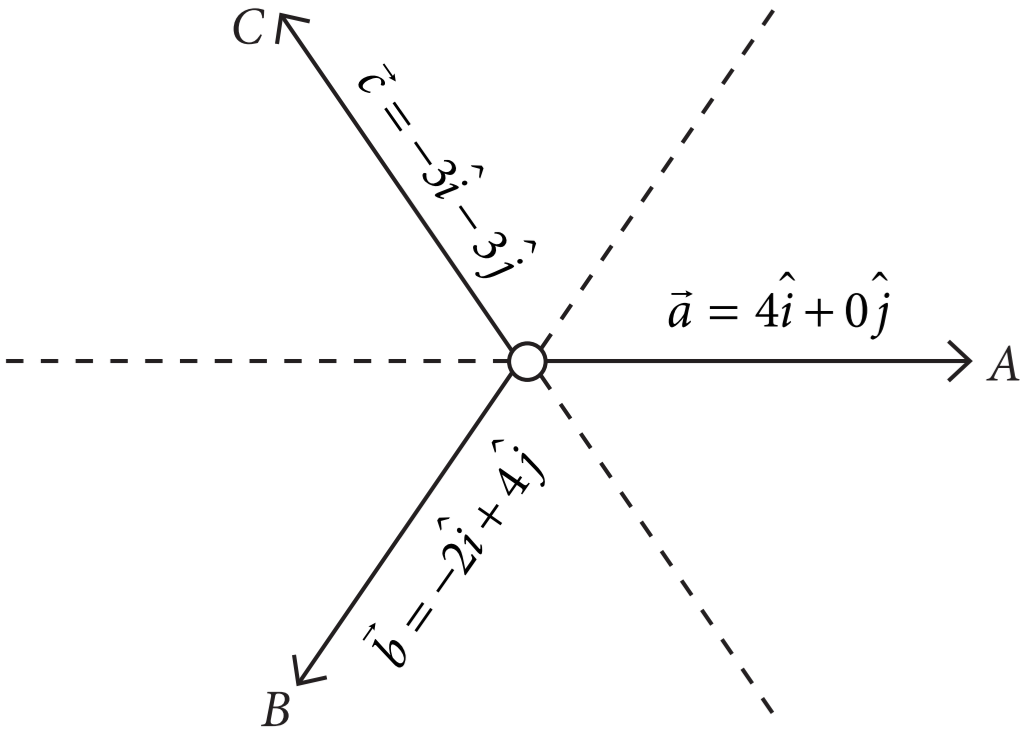
Based on the above information, answer the following questions.
- Which team will win the game?
- Team B
- Team A
- Team C
- No one
- What is the magnitude of the teams combined force?
- 7KN
- 1.4KN
- 1.5KN
- 2KN
- In what direction is the ring getting pulled?
- 2.0 radian
- 2.5 radian
- 2.4 radian
- 3 radian
- What is the magnitude of the force of Team B?
- $2\sqrt{5}\text{KN}$
- 6 KN
- 2 KN
- $\sqrt{6}\text{KN}$
- How many KN force is applied by Team A?
- 5KN
- 4KN
- 2KN
- 16KN
View full solution →Ritika starts walking from his house to shopping mall. Instead of going to the mall directly, she first goes to a ATM, from there to her daughter's school and then reaches the mall. ln the diagram, A, B, C, and D represent the coordinates of House, ATM, School and Mall respectively.
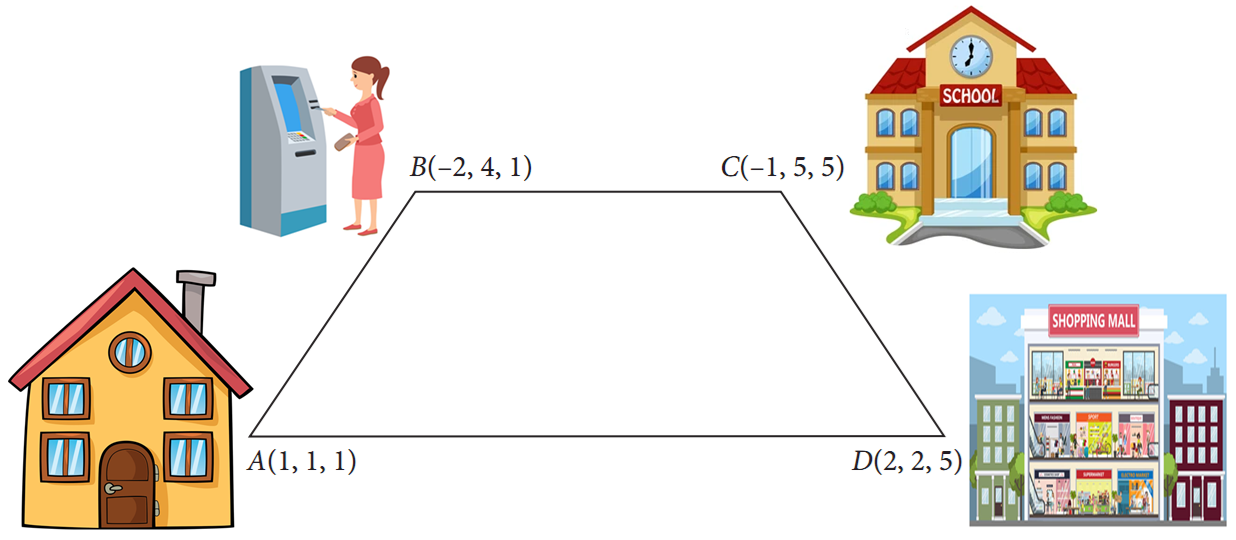
Based on the above information, answer the following questions.
- Distance between House (A) and ATM (B) is:
- $3\text{ units}$
- $3\sqrt{2}\text{ units}$
- $\sqrt{2}\text{ units}$
- $4\sqrt{2}\text{ units}$
- Distance between ATM (B) and School (C) is:
- $\sqrt{2}\text{ units}$
- $2\sqrt{2}\text{ units}$
- $3\sqrt{2}\text{ units}$
- $4\sqrt{2}\text{ units}$
- Distance between School (C) and Shopping mall (D) is:
- $3\sqrt{2}\text{ units}$
- $5\sqrt{2}\text{ units}$
- $7\sqrt{2}\text{ units}$
- $10\sqrt{2}\text{ units}$
- What is the total distance travelled by Ritika:
- $4\sqrt{2}\text{ units}$
- $6\sqrt{2}\text{ units}$
- $8\sqrt{2}\text{ units}$
- $9\sqrt{2}\text{ units}$
- What is the extra distance travelled by Ritika in reaching the shopping mall?
- $3\sqrt{2}\text{ units}$
- $5\sqrt{2}\text{ units}$
- $6\sqrt{2}\text{ units}$
- $7\sqrt{2}\text{ units}$
View full solution →Ginni purchased an air plant holder which is in the shape of a tetrahedron.
Let A, B, C, and Dare the coordinates of the air plant holder where $\text{A}\equiv(1,1,1),\text{B}\equiv(2,1,3),\text{C}\equiv(3,2,2)$ and $\text{D}\equiv(3,3,4).$
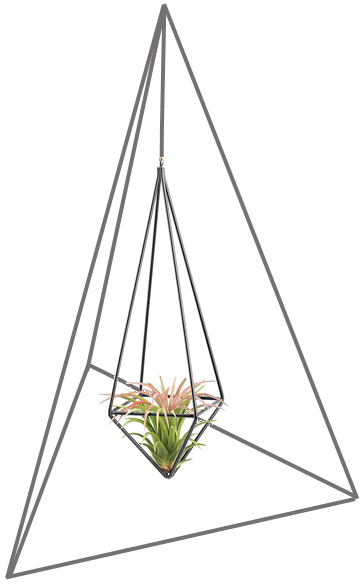
Based on the above information, answer the following questions.
- Find the position vector of $\overline{\text{AB}}.$
- $-\hat{\text{i}}-2\hat{\text{k}}$
- $2\hat{\text{i}}+\hat{\text{k}}$
- $\hat{\text{i}}+2\hat{\text{k}}$
- $-2\hat{\text{i}}-\hat{\text{k}}$
- Find the position vector of $\overline{\text{AC}}.$
- $2\hat{\text{i}}-\hat{\text{j}}-\hat{\text{k}}$
- $2\hat{\text{i}}+\hat{\text{j}}+\hat{\text{k}}$
- $-2\hat{\text{i}}-\hat{\text{j}}+\hat{\text{k}}$
- $\hat{\text{i}}+2\hat{\text{j}}+\hat{\text{k}}$
- Find the position vector of $\overline{\text{AD}}.$
- $2\hat{\text{i}}-2\hat{\text{j}}-3\hat{\text{k}}$
- $\hat{\text{i}}+\hat{\text{j}}-3\hat{\text{k}}$
- $3\hat{\text{i}}+2\hat{\text{j}}+2\hat{\text{k}}$
- $2\hat{\text{i}}+2\hat{\text{j}}+3\hat{\text{k}}$
- Area of $\triangle\text{ABC}=$
- $\frac{\sqrt{11}}{2}\text{sq}.\text{units}$
- $\frac{\sqrt{14}}{2}\text{sq}.\text{units}$
- $\frac{\sqrt{13}}{2}\text{sq}.\text{units}$
- $\frac{\sqrt{17}}{2}\text{sq}.\text{units}$
- Find the unit vector along $\overline{\text{AD}}.$
- $\frac{1}{\sqrt{17}}(2\hat{\text{i}}+2\hat{\text{j}}+3\hat{\text{k}})$
- $\frac{1}{\sqrt{17}}(3\hat{\text{i}}+3\hat{\text{j}}+2\hat{\text{k}})$
- $\frac{1}{\sqrt{11}}(2\hat{\text{i}}+2\hat{\text{j}}+3\hat{\text{k}})$
- $(2\hat{\text{i}}+2\hat{\text{j}}+3\hat{\text{k}})$
View full solution →A building is to be constructed in the form of a triangular pyramid, ABCD as shown in the figure.
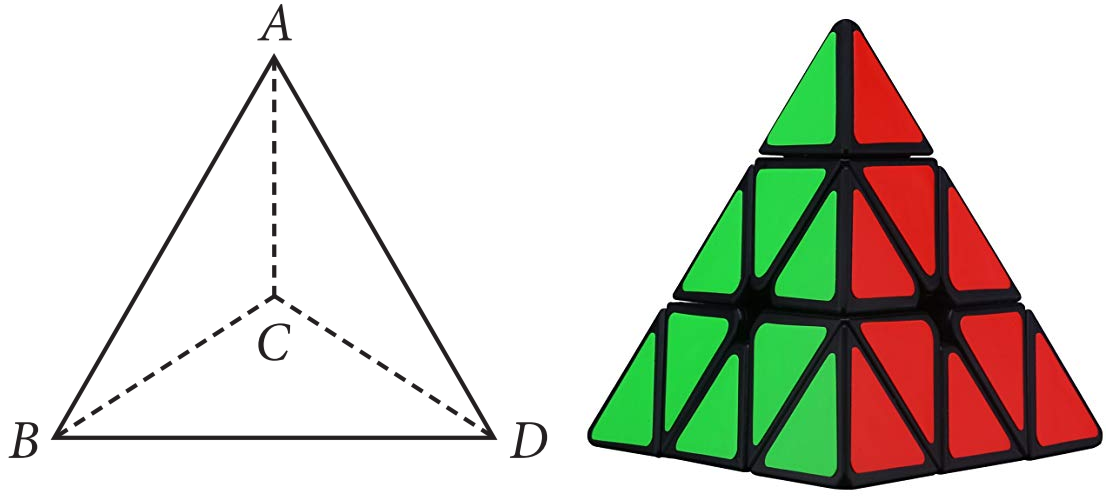
Let its angular points are A(0, 1, 2), B(3, 0, 1), C(4, 3, 6), and D(2, 3, 2), and G be the point of intersection of the medians of $\triangle\text{BCD}.$
Based on the above information, answer the following questions.
- The coordinates of point Gare:
- (2, 3, 3)
- (3, 3, 2)
- (3, 2, 3)
- (0, 2, 3)
- The length of vector $\overline{\text{AG}}$ is:
- $\sqrt{17}\text{ units}$
- $\sqrt{11}\text{ units}$
- $\sqrt{13}\text{ units}$
- $\sqrt{19}\text{ units}$
- Area of $\triangle\text{ABC}$ (in sq. units) is:
- $\sqrt{10}$
- $2\sqrt{10}$
- $3\sqrt{10}$
- $5\sqrt{10}$
- The sum of lengths of $\overline{\text{AB}}$ and $\overline{\text{AC}}$ is:
- 5 units
- 9.32 units
- 10 units
- 11 units
- The length of the perpendicular from the vertex D on the opposite face is:
- $\frac{6}{\sqrt{10}}\text{ units}$
- $\frac{2}{\sqrt{10}}\text{ units}$
- $\frac{3}{\sqrt{10}}\text{ units}$
- $8\sqrt{10}\text{ units}$
View full solution →Ishaan left from his village on weekend. First, he travelled up to temple. After this, he left for the zoo. After this, he left for shopping in a mall. The positions of Jshaan at different places is given in the following graph.
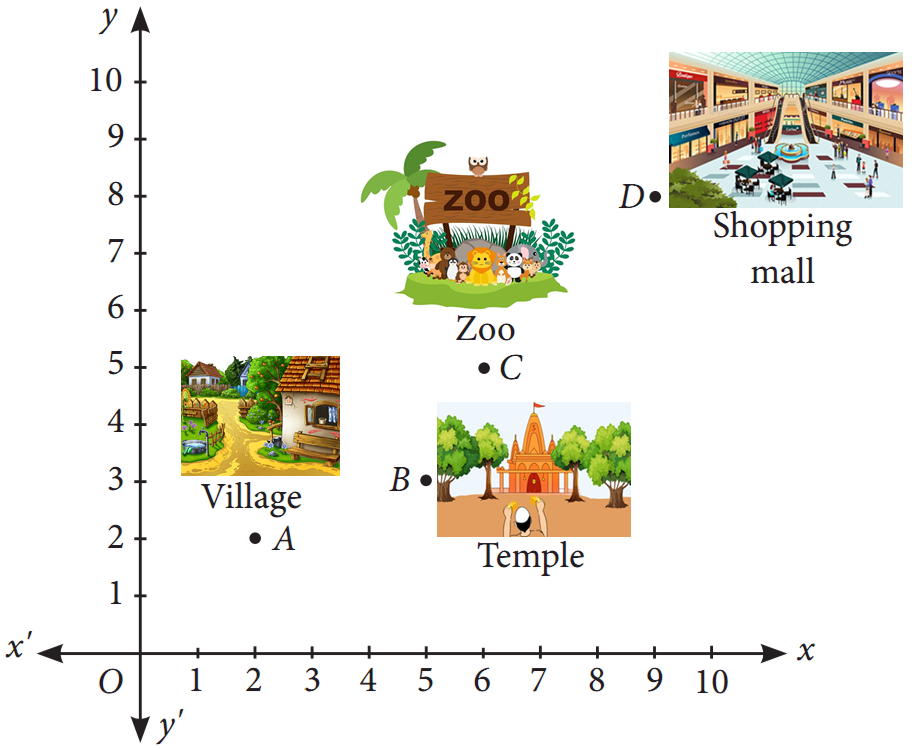
Based on the above information, answer the following questions.
- Position vector of B is:
- $3\hat{\text{i}}+5\hat{\text{j}}$
- $5\hat{\text{i}}+3\hat{\text{j}}$
- $-5\hat{\text{i}}-3\hat{\text{j}}$
- $-5\hat{\text{i}}+3\hat{\text{j}}$
- Position vector of D is:
- $5\hat{\text{i}}+3\hat{\text{j}}$
- $3\hat{\text{i}}+5\hat{\text{j}}$
- $8\hat{\text{i}}+9\hat{\text{j}}$
- $9\hat{\text{i}}+8\hat{\text{j}}$
- Find the vector $\overline{\text{BC}}$ in terms of $\hat{\text{i}},\hat{\text{j}}.$
- $\hat{\text{i}}-2\hat{\text{j}}$
- $\hat{\text{i}}+2\hat{\text{j}}$
- $2\hat{\text{i}}+\hat{\text{j}}$
- $2\hat{\text{i}}-\hat{\text{j}}$
- Length of vector $\overline{\text{AB}}$ is:
- $\sqrt{67}\text{ units}$
- $\sqrt{85}\text{ units}$
- 90 units
- 100 units
- If $\vec{\text{M}}=4\hat{\text{j}}+3\hat{\text{k}},$ then its unit vector is:
- $\frac{4}{5}\hat{\text{j}}+\frac{3}{5}\hat{\text{k}}$
- $\frac{4}{5}\hat{\text{j}}-\frac{3}{5}\hat{\text{k}}$
- $-\frac{4}{5}\hat{\text{j}}+\frac{3}{5}\hat{\text{k}}$
- $-\frac{4}{5}\hat{\text{j}}-\frac{3}{5}\hat{\text{k}}$
View full solution →Fill in the blanks.
If $\vec{\text{a}}$ is any non-zero vector, then $(\vec{\text{a}}\cdot\vec{\text{i}})\vec{\text{i}}+(\vec{\text{a}}\cdot\vec{\text{j}})\vec{\text{j}}+(\vec{\text{a}}\cdot\vec{\text{k}})\vec{\text{k}}$ equal ________.
View full solution →Fill in the blanks.
If $\vec{\text{r}}\cdot\vec{\text{a}}=0,\vec{\text{r}}\cdot\vec{\text{b}}=0,$ and $\vec{\text{r}}\cdot\vec{\text{c}}=0$ for some non-zero vector $\vec{\text{r}},$ then the value of $\vec{\text{a}}(\vec{\text{b}}\times\vec{\text{c}})$ is _______.
View full solution →Fill in the blanks.
The value of the expression $|\vec{\text{a}}\times\vec{\text{b}}|^2+(\vec{\text{a}}\cdot\vec{\text{b}})^2$ is ________.
View full solution →Fill in the blanks.
The values of k for which $|\text{k}\vec{\text{a}}|<|\vec{\text{a}}|$ and $\text{k}\vec{\text{a}}=\frac{1}{2}\vec{{\text{a}}}$ is a parallel to $\vec{\text{a}}$ holds true are _________.
View full solution →Fill in the blanks.
The vector $\vec{\text{a}}+\vec{\text{b}}$ bisects the angle between the non-collinear vectors $\vec{\text{a}}$ and $\vec{\text{b}}$ if _________.
View full solution →State True or False for the following:
The formula $(\vec{\text{a}}+\vec{\text{b}})=\vec{\text{a}}^2+\vec{\text{b}}^2+2\vec{\text{a}}\times\vec{\text{b}}$ is valid for non-zero vectors $\vec{\text{a}}$ and $\vec{\text{b}}.$
View full solution →State True or False for the following:
If $|\vec{\text{a}}|=|\vec{\text{b}}|,$ then necessarily it implies $\vec{\text{a}}=\pm\vec{\text{b}}.$
View full solution →Two vectors having same magnitude are collinear.
State True or False for the following:
Position vector of a point $\vec{\text{P}}$ is a vector whose initial point is origin.
View full solution →State True or False for the following:
If $|\vec{\text{a}}+\vec{\text{b}}|=|\vec{\text{a}}-\vec{\text{b}}|,$ then the vector $\vec{\text{a}}$ and $\vec{\text{b}}$ are orthogonal.
View full solution →