MCQ
If velocity $v$, acceleration $A$ and force $F$ are chosen as fundamental quantities, then the dimensional formula of angular momentum in terms of $v,\,A$ and $F$ would be
  • A
    $F{A^{ - 1}}v$
  • $F{v^3}{A^{ - 2}}$
  • C
    $F{v^2}{A^{ - 1}}$
  • D
    ${F^2}{v^2}{A^{ - 1}}$

Answer

Correct option: B.
$F{v^3}{A^{ - 2}}$
b
(b) $L \propto {v^x}{A^y}{F^z}$ $ \Rightarrow $ $L = k{v^x}{A^y}{F^z}$

Putting the dimensions in the above relation

$[M{L^2}{T^{ - 1}}] = k{[L{T^{ - 1}}]^x}{[L{T^{ - 2}}]^y}{[ML{T^{ - 2}}]^z}$

$⇒$ $[M{L^2}{T^{ - 1}}] = k[{M^z}{L^{x + y + z}}{T^{ - x - 2y - 2z}}]$

Comparing the powers of $M,\,L$ and $T$

$z = 1$ …$(i)$

$x + y + z = 2$ …$(ii)$

$ - x - 2y - 2z = - 1$ …$(iii)$

On solving $(i)$, $(ii)$ and $(iii)$ $x = 3,\,y = - 2,\,z = 1$

So dimension of $L$ in terms of $v,\,A$ and $f$
$[L] = [F{v^3}{A^{ - 2}}]$

Need a full question paper?

Generate a complete, print-ready paper with questions like this in minutes — across 16+ boards, with answer keys.

Start Generating Free

Similar questions

A vehicle is moving with speed $v$ on a curved road of radius $r$. The coefficient of friction between the vehicle and the road is $\mu$. The angle $\theta$ of banking needed is given by
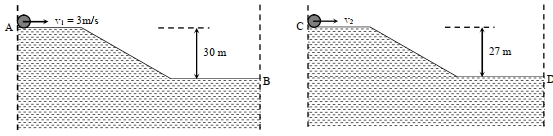
Two identical uniform discs roll without slipping on two different surfaces $AB$ and $CD$ (see figure) starting at $A$ and $C$ with linear speeds $v _1$ and $v _2$, respectively, and always remain in contact with the surfaces. If they reach $B$ and $D$ with the same linear speed and $v_1=3 \ m / s$, then $v_2$ in $m / s$ is $\left(g=10 \ m / s ^2\right)$
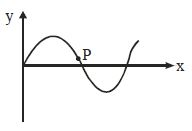
A transverse sinusoidal wave moves along a string in the positive $x-$ direction at a speed of $10\, cm/s$. The wavelength of the wave is $0.5\, m$ and its amplitude is $10\, cm$. At a prticular time $t$, the snap-shot of the wave is shown in the figure. the velocity of point $P$ when its displacement is $5\, cm$, is 
Unlike a laboratory sonometer, a stringed instrument is seldom plucked in the middle. Supposing a sitar string is plucked at about $\frac{1}{4}$th of its length from the end. The most prominent harmonic would be
The speed of sound in oxygen $\left( O _{2}\right)$ at a certain temperature is $460 \;ms ^{-1}$. The speed of sound in helium $(He)$ at the same temperature will be (asume both gases to be ideal)
$Assertion$ : The length of the day is slowly increasing.
$Reason$ : The dominant effect causing a slowdown in the rotation of the earth is the gravitational pull of other planets in the solar system.
Consider the following two statements: $(A)$ The linear momentum of a particle is independent of the frame of reference. $(B)$ The kinetic energy of a particle is independent of the frame of reference.
A particle which is constrained to move along the $x-$axis, is subjected to a force in the same direction which varies with the distance $x$ of the particle from the origin as $F(x) = - kx + a{x^3}$. Here k and a are positive constants. For $x \ge 0$, the functional from of the potential energy $U(x)$ of the particle is
If $A _x$ and $A _y$ are components of a vector then the magnitude of that vector will be :
A solid object is placed in water contained in an adiabatic container for some time. The temperature of water falls during this period and there is no appreciable change in the shape of the object. The temperature of the solid object: