If ${V_H},\,\,{V_N}$ and ${V_O}$ denote the root-mean square velocities of molecules of hydrogen, nitrogen and oxygen respectively at a given temperature, then
Medium


Download our appand get started for free
Experience the future of education. Simply download our apps or reach out to us for more information. Let's shape the future of learning together!No signup needed.*
Similar Questions
- 1View SolutionThe root mean square velocity of molecules of gas is
- 2The equation of a certain gas can be written as: ${\left( {\frac{{{T^7}}}{{{P^2}}}} \right)^{1/5}} = $ constant. The specific heat at constant volume of this gas is in $\left( {in\frac{J}{{mol\,K}}} \right)$View Solution
- 3For a gas, the difference between the two specific heats is $4150\, J\, kg^{-1}\, K^{-1}$ and the ratio of the two specific heats is $1.4$. What is the specific heat of the gas at constant volume in units of $J\, kg^{-1}\, K^{-1}$ ?View Solution
- 4View SolutionThe specific heat of a gas in a polytropic process is given by
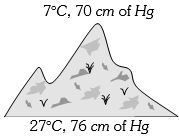
- 5At the top of a mountain a thermometer reads $7°C$ and a barometer reads $70\, cm$ of $Hg.$ At the bottom of the mountain these read $27°C$ and $76 \,cm$ of $Hg$ respectively. Comparison of density of air at the top with that of bottom isView Solution
- 6What is the ratio of specific heats of constant pressure and constant volume for $N{H_3}$View Solution
- 7View SolutionAt constant volume, for different diatomic gases the molar specific heat is
- 8The average translational kinetic energy of ${O_2}$ (molar mass $32$) molecules at a particular temperature is $ 0.048\, eV.$ The translational kinetic energy of ${N_2}$ (molar mass $28$) molecules in $eV$ at the same temperature isView Solution
- 9View SolutionOn colliding in a closed container the gas molecules
- 10An ideal gas of Molar mass $M$ is contained in a vertical tube of height $H$, closed at both ends. The tube is accelerating vertically upwards with acceleration $g$ Then, the ratio of pressure at the bottom and the mid point of the tube will beView Solution