If water is flowing in a pipe with speed $2 \,m / s$ then its kinetic energy per unit volume is ........... $J ^2 m ^3$
, Easy
Download our app for free and get started
(d)
$\frac{ EK }{ V }=\frac{1}{2} \rho V ^2$
$=\frac{1}{2} \times 1000 \times 2^2$
$=\frac{1}{2} \times 1000 \times 4$
$=2000\,J / m ^3$

Download our appand get started for free
Experience the future of education. Simply download our apps or reach out to us for more information. Let's shape the future of learning together!No signup needed.*
Similar Questions
- 1A large tank is filled with water to a height $H$. A small hole is made at the base of the tank. It takes ${T_1}$ time to decrease the height of water to $\frac{H}{\eta }\,(\eta > 1)$; and it takes ${T_2}$ time to take out the rest of water. If ${T_1} = {T_2}$, then the value of $\eta $ isView Solution
- 2The terminal velocity $\left( v _{ t }\right)$ of the spherical rain drop depends on the radius ( $r$ ) of the spherical rain drop asView Solution
- 3Acontainer of large surface area is filled with liquid of density $\rho$ .Acubical block of side edge $a$ and mass $M$ is floating in it with four-fifth of its volume submerged. If a coin of mass $m$ is placed gently on the top surface of the block is just submerged. $M$ isView Solution
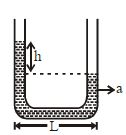
- 4In a $U-$ tube, the liquid level stands at same level when it is at rest. When $U-$ tube is accelerated towards right, as shown in figure, the difference $h$ between level of two arms will beView Solution
- 5A $50 \;kg$ girl wearing high heel shoes balances on a single heel. The heel is circular with a diameter $1.0 \;cm$. What is the pressure exerted by the heel on the horizontal floor ?View Solution
- 6A $50 \;kg$ girl wearing high heel shoes balances on a single heel. The heel is circular with a diameter $1.0 \;cm$. What is the pressure exerted by the heel on the horizontal floor ?View Solution
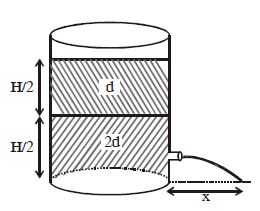
- 7A container of large uniform cross-sectional area $A$ is resting on a horizontal surface holds two immiscible, non-viscous and incompressible liquids of densities $d$ and $2d$ each of height $\frac{H}{2}$ as shown. The lower density of liquid is open to atmosphere. A small hole is made on the wall of container at height $h\left( {h < \frac{H}{2}} \right)$. The initial speed of efflux of the liquid at the hole isView Solution
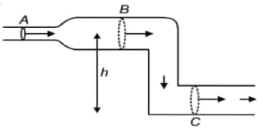
- 8Water is flowing through a channel (lying in a vertical plane) as shown in the figure. Three sections $A, B$ and $C$ are shown. Sections $B$ and $C$ have equal area of cross section. If $P_A, P_B$ and $P_C$ are the pressures at $A, B$ and $C$ respectively thenView Solution
- 9A air bubble of radius $1\,cm$ in water has an upward acceleration $9.8\, cm\, s ^{-2}$. The density of water is $1\, gm\, cm ^{-3}$ and water offers negligible drag force on the bubble. The mass of the bubble is$.......gm$View Solution
$\left( g =980 \,cm / s ^{2}\right)$
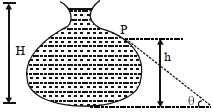
- 10Figure here shows the vertical cross section of a vessel filled with a liquid of density $\rho$. The normal thrust per unit area on the walls of the vessel at the point $P$, as shown, will beView Solution