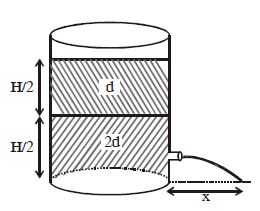
A container of large uniform cross-sectional area $A$ is resting on a horizontal surface holds two immiscible, non-viscous and incompressible liquids of densities $d$ and $2d$ each of height $\frac{H}{2}$ as shown. The lower density of liquid is open to atmosphere. A small hole is made on the wall of container at height $h\left( {h < \frac{H}{2}} \right)$. The initial speed of efflux of the liquid at the hole is
A$\left( {3H - 4h} \right)g$
B$\frac{{\left( {3H - 4h} \right)g}}{2}$
C$\sqrt {\left( {3H - 4h} \right)g} $
D$\sqrt {\frac{{\left( {3H - 4h} \right)g}}{2}} $
Medium
Download our app for free and get started
D$\sqrt {\frac{{\left( {3H - 4h} \right)g}}{2}} $
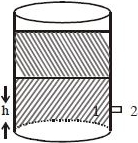
d Applying Bemoulli theorem between points $1$ and $2$
Experience the future of education. Simply download our apps or reach out to us for more information. Let's shape the future of learning together!No signup needed.*
The average mass of rain drops is $3.0\times10^{-5}\, kg$ and their avarage terminal velocity is $9\, m/s$. Calculate the energy transferred by rain to each square metre of the surface at a place which receives $100\, cm$ of rain in a year
A thin tube sealed at both ends is $100\, cm$ long. It lies horizontally, the middle $20\, cm$ containing mercury and two equal ends containing air at standard atmospheric pressure . If the tube is now turned to a vertical position, by what amount will the mercury be displaced ? (Given : cross-section of the tube can be assumed to be uniform) ........ $cm$
Two water pipes $P$ and $Q$ having diameters $2$$ \times 10^{-2} $ $m$ and $4$ $\times 10^{-2}$ $m$, respectively, are joined in series with the main supply line of water. The velocity of water flowing in pipe $P$ is
The pressure at the bottom of a water tank is $4 P$. where $P$ is atmospheric pressure. If water is drawn out till the water level decreases by $\frac{3}{5}$ th, then pressure at the bottom of the tank is .........
Three capillaries of length $L, \frac{L}{2}$ and $\frac{L}{3}$ are connected in series. Their radii are $r, \frac{r}{2}$ and $\frac{r}{3}$ respectively. Then if stream-line flow is to be maintained and the pressure across the first capillary is $P$, then ............
If a ball of steel (density $\rho=7.8 \;gcm ^{-3}$) attains a terminal velocity of $10 \;cms ^{-1}$ when falling in a tank of water (coefficient of viscosity $\eta_{\text {water }}=8.5 \times 10^{-4} \;Pa - s$ ) then its terminal velocity in glycerine $\left(\rho=12 gcm ^{-3}, \eta=13.2\right)$ would be nearly
Two uniform solid balls of same density and of radii $r$ and $2r$ are dropped in air and fall vertically downwards. The terminal velocity of the ball with radius $r$ is $1\,cm\,s^{-1}$ , then find the terminal velocity of the ball of radius $2r$ (neglect bouyant force on the balls.) ........... $cm\,s^{-1}$
A cylinder of height $ 20\; m$ is completely filled with water. The velocity of efflux of water (in $ m/s$) through a small hole on the side wall of the cylinder near its bottom is ....... $m/s$
A boat having a length of $3\,metre$ and breadth $2\,metre$ is floating on a lake. The boat sinks by one cm when a man gets on it. Mass of the man is ....... $kg$