MCQ
If wavelength of a wave is $\lambda=6000 \mathring A$. Then wave number will be
  • A
    $166 \times 10^3 \mathrm{~m}$
  • B
    $16.6 \times 10^{-1} \mathrm{~m}$
  • $1.66 \times 10^6 \mathrm{~m}$
  • D
    $1.66 \times 10^7 \mathrm{~m}$

Answer

Correct option: C.
$1.66 \times 10^6 \mathrm{~m}$
(c) $\bar{n}=\frac{1}{\lambda}=\frac{1}{6000 \times 10^{-10}}=1.66 \times 10^6 \mathrm{~m}^{-1}$

Need a full question paper?

Generate a complete, print-ready paper with questions like this in minutes — across 16+ boards, with answer keys.
Start Generating Free

Similar questions

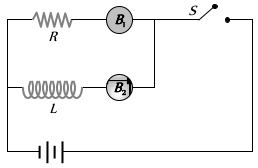
The adjoining figure shows two bulbs $B$ and $B$ resistor $R$ and an inductor $L$. When the switch $\mathrm{S}$ is turned offImage
The ratio of specific charge of an $\alpha$-particle to that of a proton is
To Verify Ohm's law, a student is provided with a test resistor $\mathrm{R}_{\mathrm{T}}$, a high resistance $\mathrm{R}_1$, a small resistance $\mathrm{R}_2$, two identical galvanometers $\mathrm{G}_1$ and $\mathrm{G}_2$, and a variable voltage source $\mathrm{V}$. The correct circuit to carry out the experiment is
A galvanometer of resistance $36 \Omega$ is changed into an ammeter by using a shunt of $4 \Omega$. The fraction $f$ of total current passing through the galvanometer is
A lamp consumes only $50 \%$ of peak power in an a.c. circuit. What is the phase difference between the applied voltage and the circuit current
A body, acted upon by a force of $50 N$ is displaced through a distance 10 meter in a direction making an angle of $60^{\circ}$ with the force. The work done by the force be
A rod of length $I$ and area of cross-section $A$ is heated from $0^{\circ} C$ to $100^{\circ} C$. The rod is so placed that it is not allowed to increase in length, then the force developed is proportional to
If the radius of a planet is four times that of earth and the value of $g$ is same for both, the escape velocity on the planet will be
A point object $O$ is placed on the principal axis of a convex lens of focal length $20 \mathrm{~cm}$ at a distance of $40 \mathrm{~cm}$ to the left of it. The diameter of the lens is $10 \mathrm{~cm}$. If the eye is placed $60 \mathrm{~cm}$ to the right of the lens at a distance $h$ below the principal axis, then the maximum value of $h$ to see the image will be
The pressure exerted by an electromagnetic wave of intensity $l$ (watts $/ m)$ on a nonreflecting surface is [ $c$ is the velocity of light]