MCQ
If we can throw a ball upto a maximum height $H$, the maximum horizontal distance to which we can throw it is
  • $2\,H$
  • B
    $\sqrt 2 \,H$
  • C
    $H$
  • D
    $\frac{H}{2}$

Answer

Correct option: A.
$2\,H$
a
$\begin{array}{l}
H = \frac{{{u^2}}}{{2g}} \Rightarrow {u^2} = 2gH\\
For\,{\rm{maximum}}\,horizontal\,{\rm{distance}}\\
{X_{\max }} = \frac{{{u^2}}}{g} = \frac{{2gH}}{g} = 2H
\end{array}$

Need a full question paper?

Generate a complete, print-ready paper with questions like this in minutes — across 16+ boards, with answer keys.
Start Generating Free

Similar questions

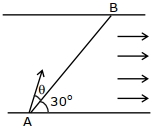
A swimmer wants to cross a river from point $A$ to point $B$. Line $A B$ makes an angle of $30^{\circ}$ with the flow of river. Magnitude of velocity of the swimmer is same as that of the river. The angle $\theta$ with the line ${AB}$ should be $^{\circ}$, so that the swimmer reaches point ${B}$.
A wire of density $9 \times 10^{-3} \,kg\, cm ^{-3}$ is stretched between two clamps $1\, m$ apart. The resulting strain in the wire is $4.9 \times 10^{-4}$. The lowest frequency of the transverse vibrations in the wire is......$HZ$

(Young's modulus of wire $Y =9 \times 10^{10}\, Nm ^{-2}$ ), (to the nearest integer),
A ring and a disc are initially at rest, side by side, at the top of an inclined plane which makes an angle $60^{\circ}$ with the horizontal. They start to roll without slipping at the same instant of time along the shortest path. If the time difference between their reaching the ground is $(2-\sqrt{3}) / \sqrt{10} \mathrm{~s}$, then the height of the top of the inclined plane, in metres, is. . . . . . Take $g=10 \mathrm{~m} \mathrm{~s}^{-2}$.
The correct curve between the height or depression $h$ of liquid in a capillary tube and its radius is
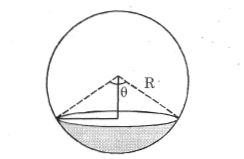
Consider a spherical drop of radius $R$. Surface tension of the liquid is $\sigma$ . Force of surface tension on shaded sub hemisphere due to remaining drop is $0.5\,\pi \sigma R$ . The value of- angle $\theta$ (angle subtended hy the sub hemisphere at centre of drop) is ......$^o$
The acceleration of a body rolling down on an inclined plane does not depend upon
A spacecraft of mass $M$ moves with velocity $V$ in free space at first, then it explodes breaking into two pieces. If after explosion a piece of mass $m$ comes to rest, the other piece of spacecraft will have a velocity
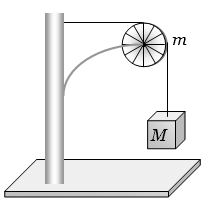
A string of negligible mass going over a clamped pulley of mass m supports a block of mass M as shown in the figure. The force on the pulley by the clamp is given by
The unit vector along $\hat{i}+2 \hat{j}+\hat{k}$ will be :
Four particles each of mass $M$, are located at the vertices of a square with side $L$. The gravitational potential due to this at the centre of the square is