MCQ
The unit vector along $\hat{i}+2 \hat{j}+\hat{k}$ will be :
  • A
    $\hat{i}+2 \hat{j}+\hat{k}$
  • B
    $\frac{\hat{i}+2 \hat{j}+\hat{k}}{3}$
  • $\frac{\hat{i}+2 \hat{j}+\hat{k}}{\sqrt{6}}$
  • D
    $\sqrt{\hat{i}+2 \hat{j}+\hat{k}}$

Answer

Correct option: C.
$\frac{\hat{i}+2 \hat{j}+\hat{k}}{\sqrt{6}}$
(C)
 $\begin{aligned}
\text { Unit vector }= & \frac{\text { Vector }}{\text { Magnitude of vector }} \\
& =\frac{\hat{i}+2 \hat{j}+\hat{k}}{\sqrt{(1)^2+(2)^2+(1)^2}} \\
& =\frac{\hat{i}+2 \hat{j}+\hat{k}}{\sqrt{6}}
\end{aligned}
$
Hence, the correct option is (C).

Need a full question paper?

Generate a complete, print-ready paper with questions like this in minutes — across 16+ boards, with answer keys.
Start Generating Free

Similar questions

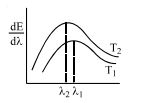
The spectral emissive power $E_\lambda $ for a body at temperature $T_1$ is plotted against the wavelength and area under the curve is found to be $A$. At a different temperature $T_2$ the area is found to be $9A$. Then $\lambda _1/\lambda _2 =$
Determine coefficient of performance of given temperature limit.

$T_{1}=27^{\circ} C$ [outside fridge]

$T_{2}=-23^{\circ} C$ [inside fridge]
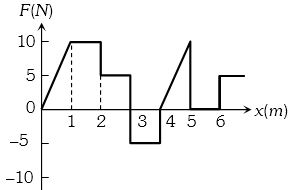
The relationship between the force $F$ and position $x$ of a body is as shown in figure. The work done in displacing the body from $x = 1$ m to $x = 5 $ m will be ........ $J$
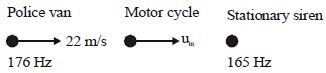
A police van, moving at $22\, m/s$ , chases a motor-cyclist. The police man sounds horn at $176\, Hz$ , while both of them move towards a stationary siren of frequency $165\, Hz$ as shown in the figure. If the motor-cyclist does not observe any beats, his speed must be .... $m/s$ (take the speed of sound $= 330\, m/s$ )
A body of mass $2\,kg$ slides down with an acceleration of $3\,m/s^2$ on a rough inclined plane having a slope of $30^o$ . The external force required to take the same body up the plane with the same acceleration will be  ........ $N$ $(g\, = 10\, m/s^2)$
A solid sphere of radius $R$ and density $\rho$ is attached to one end of a mass-less spring of force constant $k$. The other end of the spring is connected to another solid sphere of radius $R$ and density $3 p$. The complete arrangement is placed in a liquid of density $2 p$ and is allowed to reach equilibrium. The correct statement$(s)$ is (are)

$(A)$ the net elongation of the spring is $\frac{4 \pi R^3 \rho g}{3 k}$

$(B)$ the net elongation of the spring is $\frac{8 \pi R^3 \rho g}{3 k}$

$(C)$ the light sphere is partially submerged.

$(D)$ the light sphere is completely submerged.
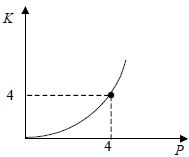
A graph between kinetic energy and momentum of a particle is plotted as shown in the figure. The mass of the moving particle is ........ $kg$.
The volume of an ideal gas $(\gamma=1.5)$ is changed adiabatically from $5$ litres to $4$ litres. The ratio of initial pressure to final pressure is:
The temperature of the body is increased from $-73^o C\, to \,327^o C$, the ratio of energy emitted per second is :
A body is started from rest with acceleration $2\ m/ s^2$ till it attains the maximum velocity then retards to rest with $3\ m/ s^2$. If total time taken is $10$ second then maximum speed attained is: