MCQ
If we can throw a ball upto a maximum height $H$, the maximum horizontal distance to which we can throw it is
  • $2\,H$
  • B
    $\sqrt 2 \,H$
  • C
    $H$
  • D
    $\frac{H}{2}$

Answer

Correct option: A.
$2\,H$
a
$\begin{array}{l}
H = \frac{{{u^2}}}{{2g}} \Rightarrow {u^2} = 2gH\\
For\,{\rm{maximum}}\,horizontal\,{\rm{distance}}\\
{X_{\max }} = \frac{{{u^2}}}{g} = \frac{{2gH}}{g} = 2H
\end{array}$

Need a full question paper?

Generate a complete, print-ready paper with questions like this in minutes — across 16+ boards, with answer keys.
Start Generating Free

Similar questions

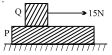
$A$ long plank $P$ of the mass $5\, kg$ is placed on a smooth floor. On $P$ is placed a block $Q$ of mass $2\, kg$. The coefficient of friction between $P$ and $Q$ is $0.5$. If a horizontal force $15N$ is applied to $Q$, as shown, and you may take $g$ as $10N/kg.$
A box when dropped from a certain height reaches the ground with a speed $v$. When it slides from rest from the same height down a rough inclined plane inclined at angle $45^{\circ}$ to the horizontal, it reaches the ground with a speed $v / 3$. The coefficient of sliding friction between the box and the plane is (Take, acceleration due to gravity is $10 \,ms ^{-2}$ )
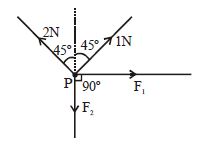
There are four forces acting at a point $P$ produced by strings as shown in figure, point $P$ is at rest. The forces $F_1$ and $F_2$ are respectively
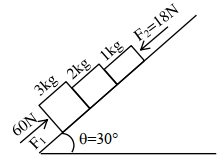
In the diagram shown, the normal reaction force between $2\,kg$ and $1\,kg$ is (Consider the surface, to be smooth)$.........N$ (Given $g =10\,ms ^{-2}$)
$100 \,gm$ of ice at $0°C$ is mixed with $100\, g$ of water at $100°C.$ What will be the final temperature of the mixture .......... $^oC$
Let I1 and I2 be the moments of inertia of two bodies of identical geometrical shape, the first made of aluminium and the second of iron.
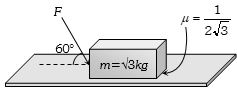
What is the maximum value of the force $F$ such that the block shown in the arrangement, does not move ........ $N$
The length of an iron wire is $L$ and area of cross-section is $A$. The increase in length is $l$ on applying the force $F$ on its two ends. Which of the statement is correct
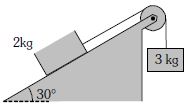
In the arrangement shown, the $2\, kg$ block is held to keep the system at rest. The  string and pulley are ideal. When the $2\, kg$ block is set free, by what amount the  tension in the string changes? $[ g = 10\, m/s^2]$
It is possible to hear beats from the two vibrating sources of frequency