MCQ
If work function of metal is $3$ $eV$ then threshold wavelength will be ............ $\mathop A\limits^o $
  • $4125 $
  • B
    $4000 $
  • C
    $4500 $
  • D
    $5000 $

Answer

Correct option: A.
$4125 $
a
(a) ${\lambda _0} = \frac{{12375}}{{{W_0}(eV)}} = \frac{{12375}}{3} = 4125{Å}$

Need a full question paper?

Generate a complete, print-ready paper with questions like this in minutes — across 16+ boards, with answer keys.

Start Generating Free

Similar questions

The magnetic field at the origin due to a current element $i\,\overrightarrow {dl} $ placed at position $\vec r$ is

$(i)\,\,\left( {\frac{{{\mu _0}i}}{{4\pi }}} \right)\left( {\frac{{d\vec l\, \times \,\vec r}}{{{r^3}}}} \right)$

$(ii)\,\, - \left( {\frac{{{\mu _0}i}}{{4\pi }}} \right)\left( {\frac{{d\vec l\, \times \,\vec r}}{{{r^3}}}} \right)$

$(iii)\,\left( {\frac{{{\mu _0}i}}{{4\pi }}} \right)\left( {\frac{{\,\vec r \times d\vec l}}{{{r^3}}}} \right)$
$(iv)\, - \left( {\frac{{{\mu _0}i}}{{4\pi }}} \right)\left( {\frac{{\,\vec r \times d\vec l}}{{{r^3}}}} \right)$

If $200\, MeV$ energy is released in the fission of a single ${U^{235}}$nucleus, the number of fissions required per second to produce $1\, kilo\,watt$ power shall be (Given  $1\;eV = 1.6 \times {10^{ - 19}}J$)
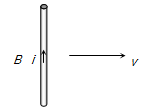
A conducting wire is moving towards right in a magnetic field B. The direction of induced current in the wire is shown in the figure. The direction of magnetic field will be
Two electric dipoles of moment P and 64 P are placed in opposite direction on a line at a distance of 25 cm. The electric field will be zero at point between the dipoles whose distance from the dipole of moment P is
An $X-$ ray machine has an accelerating potential difference of $25,000$ volts. By calculation the shortest wavelength will be obtained as.......$\mathop A\limits^o $ ($h = 6.62 \times {10^{ - 34}}$ J-sec; e = $1.6 \times {10^{ - 19}}$coulomb)
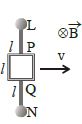
A square frame of metallic wire is moving in a uniform magnetic field $(\vec{B})$ acting perpendicular to the paper inward as shown. $LP$  and  $QN$  are also metallic wires then find the potential difference between $L$ and $N$
A wire in the form of a square of side ‘$a$’ carries a current $i$. Then the magnetic induction at the centre of the square wire is (Magnetic permeability of free space =${\mu _o}$)
A charged particle is moving with velocity v in a magnetic field of induction B. The force on the particle will be maximum when
A point source of light at the surface of a sphere causes a parallel beam of light to emerge from the opposite surface of the sphere. The refractive index of the material of the sphere is
The ozone layer in the atmosphere absorbs: