MCQ
If $x, y, z$ are in arithmetic progression with common difference $d , x \neq 3 d ,$ and the
determinant of the matrix $\left[\begin{array}{ccc}3 & 4 \sqrt{2} & x \\ 4 & 5 \sqrt{2} & y \\ 5 & k & z\end{array}\right]$ is zero, then the value of $k ^{2}$ is ..... .
  • $72$
  • B
    $12$
  • C
    $36$
  • D
    $6$

Answer

Correct option: A.
$72$
a
$\left|\begin{array}{ccc}3 & 4 \sqrt{2} & x \\ 4 & 5 \sqrt{2} & y \\ 5 & k & z\end{array}\right|=0$

$R _{2} \rightarrow R _{1}+ R _{3}-2 R _{2}$

$\Rightarrow\left|\begin{array}{ccc}3 & 4 \sqrt{2} & x \\ 0 & k-6 \sqrt{2} & 0 \\ 5 & k & z\end{array}\right|=0$

$\Rightarrow(k-6 \sqrt{2})(3 z-5 x)=0$

if $3 z-5 x=0 \Rightarrow 3(x+2 d)-5 x=0$

$\Rightarrow x=3 d$ (Not possible)

$\Rightarrow k =6 \sqrt{2} \quad \Rightarrow k ^{2}=72$

Need a full question paper?

Generate a complete, print-ready paper with questions like this in minutes — across 16+ boards, with answer keys.

Start Generating Free

Similar questions

For real numbers $\alpha, \beta, \gamma$ and $\delta,$ if  $\int \frac{\left(x^{2}-1\right)+\tan ^{-1}\left(\frac{x^{2}+1}{x}\right)}{\left(x^{4}+3 x^{2}+1\right) \tan ^{-1}\left(\frac{x^{2}+1}{x}\right)} d x$  $=\alpha \log _{e}\left(\tan ^{-1}\left(\frac{x^{2}+1}{x}\right)\right)$ $+\beta \tan ^{-1}\left(\frac{\gamma\left(x^{2}-1\right)}{x}\right)+\delta \tan ^{-1}\left(\frac{x^{2}+1}{x}\right)+C$  where $C$ is an arbitrary constant, then the value of $10(\alpha+\beta \gamma+\delta)$ is equal to ....... .
${(1 + i)^{10}}$, where ${i^2} = - 1,$ is equal to
Given the following simultaneous equations for vectors $x$  and $ y$; $x + y = a$.....

(i) $x \times y = b$.....

(ii) $x\,.\,a = 1$.....

(iii)Then $x = .........,\,\,\,y = .......$

$\mathop {\lim }\limits_{x \to 0} \frac{{\sqrt {\frac{1}{2}(1 - \cos 2x)} }}{x} = $
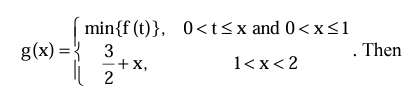
Consider the function $f:(0,2) \rightarrow R$ defined by $f(x)=\frac{x}{2}+\frac{2}{x}$ and the function $g(x)$ defined by
Image
If the number of words, with or without meaning, which can be made using all the letters of the word $MATHEMATICS$ in which $C$ and $S$ do not come together, is $(6 !) k$, then $k$ is equal to $............$.
If ${x^4}$ occurs in the ${r^{th}}$ term in the expansion of ${\left( {{x^4} + \frac{1}{{{x^3}}}} \right)^{15}}$, then $r = $
Let $\alpha$ be a root of the equation $(a-c) x^2+(b-a) x+(c-b)=0$ where $a, b, c$ are distinct real numbers such that the matrix $\left[\begin{array}{ccc}\alpha^2 & \alpha & 1 \\1 & 1 & 1 \\a & b & c\end{array}\right]$ is singular. Then the value of $\frac{(a-c)^2}{(b-a)(c-b)}+\frac{(b-a)^2}{(a-c)(c-b)}+\frac{(c-b)^2}{(a-c)(b-a)}$
Let $z$ be complex number satisfying $|z|^3+2 z^2+4 z-8=0$, where $\bar{z}$ denotes the complex conjugate of $z$. Let the imaginary part of $z$ be nonzero.

Match each entry in List-$I$ to the correct entries in List-$II$.

List-$I$ List-$II$
($P$) $|z|^2$ is equal to ($1$) $12$
($Q$) $|z-\bar{z}|^2$ is equal to ($2$) $4$
($R$) $|z|^2+|z+\bar{z}|^2$ is equal to ($3$) $8$
($S$) $|z+1|^2$ is equal to ($4$) $10$
  ($5$) $7$

The correct option is:

The function $f(x) = x + \sin x$ has