MCQ
If $x = y\sqrt {1 - {y^2},} $ then ${{dy} \over {dx}} = $
  • A
    $0$
  • B
    $x$
  • ${{\sqrt {1 - {y^2}} } \over {1 - 2{y^2}}}$
  • D
    ${{\sqrt {1 - {y^2}} } \over {1 + 2{y^2}}}$

Answer

Correct option: C.
${{\sqrt {1 - {y^2}} } \over {1 - 2{y^2}}}$
c
(c) $x = y\sqrt {1 - {y^2}} $

Differentiate with respect to  $x,$

$1 = \frac{{dy}}{{dx}}\sqrt {1 - {y^2}} + y.\frac{1}{{2\sqrt {1 - {y^2}} }}\,.\,( - 2y)\,.\,\frac{{dy}}{{dx}}$

==> $1 = \frac{{dy}}{{dx}}\sqrt {1 - {y^2}} - \frac{{{y^2}}}{{\sqrt {1 - {y^2}} }}\,.\,\frac{{dy}}{{dx}}$

==> $1 = \frac{{dy}}{{dx}}\left[ {\frac{{1 - {y^2} - {y^2}}}{{\sqrt {1 - {y^2}} }}} \right]$

==> $1 = \frac{{dy}}{{dx}}\left[ {\frac{{1 - 2{y^2}}}{{\sqrt {1 - {y^2}} }}} \right]$

$\frac{{dy}}{{dx}} = \frac{{\sqrt {1 - {y^2}} }}{{1 - 2{y^2}}}$.

Need a full question paper?

Generate a complete, print-ready paper with questions like this in minutes — across 16+ boards, with answer keys.
Start Generating Free

Similar questions

$A=\left[\begin{array}{l}a_{i j}\end{array}\right]_{m\times n}$ is a square matrix, if
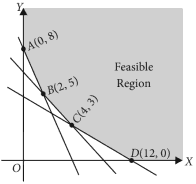
Feasible region for an L.P.P. is shown shaded in the following figure. Minimum of $Z=5 x+3 y$ occurs at the point point
Image
If $P(A)=0.4, P(B)=0.8$ and $P(B \mid A)=0.6$, then $P(A \cup B)$ is equal to
If $y = \sec ({\tan ^{ - 1}}x),$ then ${{dy} \over {dx}}$ is
A family has 2 children and the elder child is a girl. The probability that both children are girls is:
If $z = \sec \,(y - ax) + \tan (y + ax),$ then ${{{\partial ^2}z} \over {\partial {x^2}}} - {a^2}{{{\partial ^2}z} \over {\partial {y^2}}} = $
Consider two events $A$ and $B$ such that $P(A) = \frac{1}{4},\,\,P\left( {\frac{B}{A}} \right) = \frac{1}{2},\,\,P\left( {\frac{A}{B}} \right) = \frac{1}{4}.$ For each of the following statements, which is true

$I.$    $P\,({A^c}/{B^c}) = \frac{3}{4}$

$II.$   The events $A$ and $B$ are mutually exclusive

$III.$  $P(A/B) + P(A/{B^c}) = 1$

For the system of equations:
x + 2y + 3z = 1
2x + y + 3z = 2
5x + 5y + 9z = 4
  1. There is only one solution.
  2. There exists infinitely many solution.
  3. There is no solution.
  4. None of these.
Choose the correct answer from given four options in each of the Exercise:
The number of distinct real roots of $\begin{vmatrix}\sin\text{x}&\cos\text{x}&\cos\text{x}\\\cos\text{x}&\sin\text{x}&\cos\text{x}\\\cos\text{x}&\cos\text{x}&\sin\text{x}\end{vmatrix}=0$ in the interval $-\frac{\pi}{4}\leq\text{x}\leq\frac{\pi}{4}$ is:
  1. 0
  2. 2
  3. 1
  4. 3
Let $R = \{(1, 3), (4, 2), (2, 4), (2, 3), (3, 1)\}$ be a relation on the set $A = \{1, 2, 3, 4\}$. The relation $R$ is