Question
If $\text{x}=3+\sqrt8,$ find the value of $\text{x}^2+\frac{1}{\text{x}^2}.$

Answer

We know that $\text{x}^2+\frac{1}{\text{x}^2}=\Big(\text{x}+\frac{1}{\text{x}^2}\Big)^2-2.$ we have to find the value of $\text{x}^2+\frac{1}{\text{x}^2}.$ As $\text{x}=3+\sqrt8$ therefore,
$\frac{1}{\text{x}}=\frac{1}{3+\sqrt8}$
We know that rationalization factor for $3+\sqrt8$ is $3-\sqrt8.$ We will multiply numerator and denominator of the given expression $\frac{1}{3+\sqrt8}$ by $3-\sqrt8,$ to get.
$\frac{1}{\text{x}}=\frac{1}{3+\sqrt8}\times\frac{3-\sqrt8}{3-\sqrt8}$
$=\frac{3-\sqrt8}{(3)^2-\big(\sqrt8\big)^2}$
$=\frac{3-\sqrt8}{9-8}$
$=3-\sqrt8$
Putting the value of x and $\frac{1}{\text{x}},$ we get
$\text{x}^2+\frac{1}{\text{x}^2}=\big(3+\sqrt8+3-\sqrt8\big)^2-2$
$=(6)^2-2$
$=36-2$
$=34$
Hence the given expression is simplified to 34.

Need a full question paper?

Generate a complete, print-ready paper with questions like this in minutes — across 16+ boards, with answer keys.

Start Generating Free

Similar questions

Two cones have their heights in the ratio 1 : 3 and the radii of their bases in the ratio 3 : 1. Find the ratio of their volumes.
In a $\triangle\text{ABC},$ P and Q are respectively the mid points of AB and BC and R is the midpoint of AP. Prove that:
  1. $\text{ar}(\triangle\text{PBQ})=\text{ar}(\triangle\text{ARC}).$
  2. $\text{ar}(\triangle\text{PRQ})=\frac{1}{2}\text{ar}(\triangle\text{ARC}).$
  3. $\text{ar}(\triangle\text{EQC})=\frac{3}{8}\text{ar}(\triangle\text{ABC}).$
In triangles ABC and CDE, if AC = CE, BC = CD, $\angle\text{A}=60^\circ,\angle\text{C}=30^\circ$ and $\angle\text{D}=90^\circ.$ Are two triangles congruent?
D, E and F are respectively the mid-points of the sides AB, BC and CA of a triangle ABC. Prove that by joining these mid-points D, E and F, the triangles ABC is divided into four congruent triangles.
A die is thrown 100 times. If the probability of getting an even number is $\frac{2}{5}.$ How many times an odd number is obtained?
The following data gives the production of food grains (In thousand tonnes) for some years:
Year
1995
1996
1997
1998
19999
2000
Production (in thousand tonnes)
120
150
140
180
170
190
Represent the above data with the help of a bar graph.
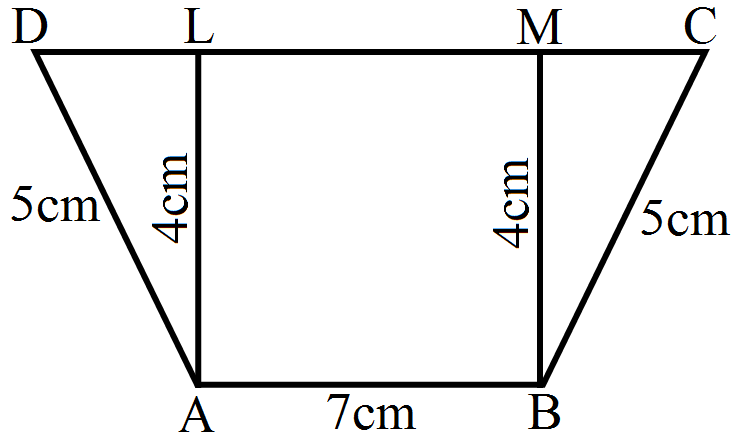
In the adjoining figure, ABCD is a trapezium in which AB || DC; AB = 7cm; AD = BC = 5cm and the distance between AB and DC is 4cm. Find the length of DC and hence, find the area of trap. ABCD.

Express $2.\overline{36}+0.\overline{23}$ as a fraction in simplest form.
Factorise:
a3(b - c)3 + b3(c - a)3 + c3(a - b)3
If ABC and BDE are two equilateral triangles such that D is the mid-point of BC, then find $\text{ar}(\triangle\text{ABC}) : \text{ar}(\triangle\text{BDE}).$