Question
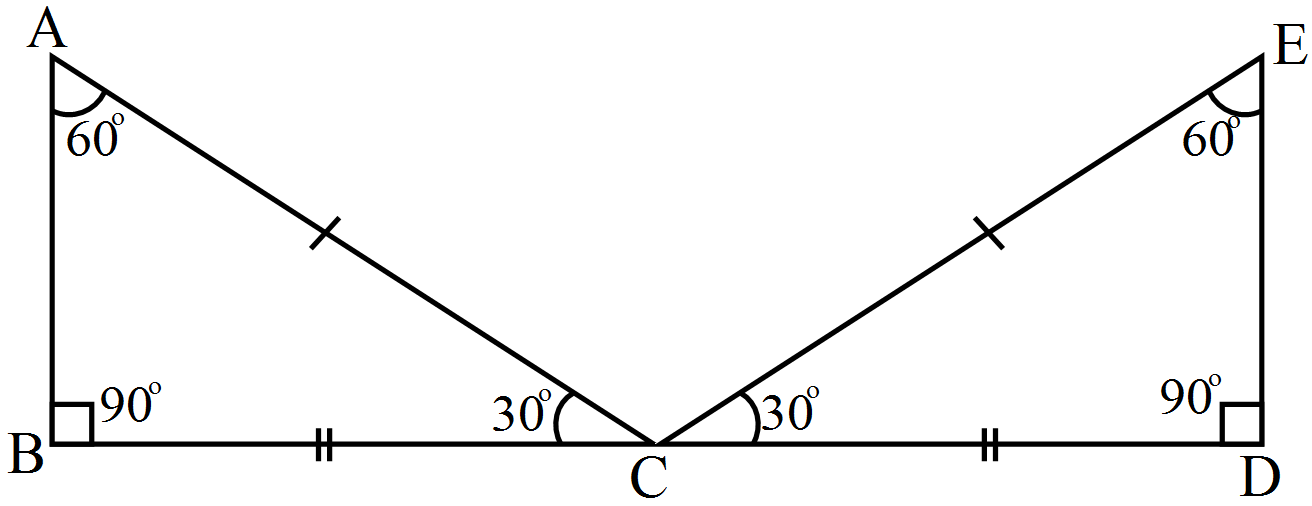
In triangles ABC and CDE, if AC = CE, BC = CD, $\angle\text{A}=60^\circ,\angle\text{C}=30^\circ$ and $\angle\text{D}=90^\circ.$ Are two triangles congruent?
Answer

For the triangles ABC and ECD, we have the following information and corresponding figure:
$\text{AC}=\text{CE}$
$\text{BC}=\text{CD}$
$\angle\text{}A=60^\circ$
$\angle\text{C}=30^\circ$
$\angle\text{D}=90^\circ$

In triangles ABC and ECD, we have
$\text{AC}=\text{EC}$
$\text{BC}=\text{CD}$
and $\angle\text{BAC}=\angle\text{CED}$
The SSA criteria for two triangles to be congruent are being followed. So both the triangles are congruent.

Need a full question paper?

Generate a complete, print-ready paper with questions like this in minutes — across 16+ boards, with answer keys.

Start Generating Free

Similar questions

The mean of the following distribution is 50.
X
f
10
30
50
70
90
17
5a + 3
32
7a - 11
19
Find the value of a and hence the frequencies of 30 and 70.
It costs ₹ 3300 to paint the inner curved surface of a cylindrical vessel 10m deep at the rate of ₹ 30 per m2. Find the:
  1. Inner curved surface area of the vessel.
  2. Inner radius of the base.
  3. Capacity of the vessel.
ABCD is a rectangle in which diagonal BD bisects $\angle\text{B}.$ Show that ABCD is a square.
Prove that the line joining the mid-points of the diagonals of a trapezium is parallel to the parallel sides of the trapezium.
Draw different pairs of circles. How many points does each pair have in common? What is the maximum number of common points?
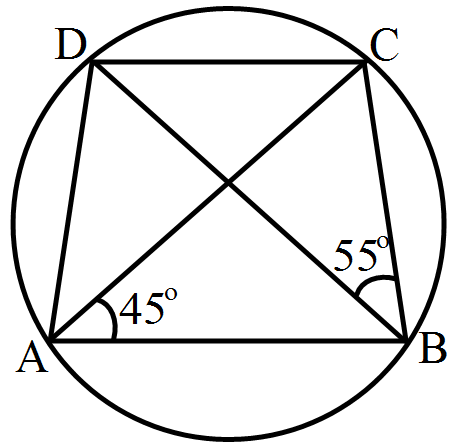
In the given figure, ABCD is a cyclic quadrilateral in which AC and BD are its diagonals. If $\angle\text{DBC}=55^\circ$ and $\angle\text{BAC}=45^\circ,$ find $\angle\text{BCD}.$

Draw the graph of the equations given below. Also, find the coordinates of the points where the graph cuts the coordinate axes:
6x - 3y = 12
Visualize the representation of 3.765 on the number line using successive magnification.
If each of the two lines is perpendicular to the same line, what kind of lines are they to each other?
In a $\triangle\text{ABC},$ P and Q are respectively the mid points of AB and BC and R is the midpoint of AP. Prove that:
  1. $\text{ar}(\triangle\text{PBQ})=\text{ar}(\triangle\text{ARC}).$
  2. $\text{ar}(\triangle\text{PRQ})=\frac{1}{2}\text{ar}(\triangle\text{ARC}).$
  3. $\text{ar}(\triangle\text{EQC})=\frac{3}{8}\text{ar}(\triangle\text{ABC}).$