Question
If y = f(u) is a differentiable function of u and u = g(x) is a differentiable function of x, then y = f(g(x)] is a differentiable function of x and $\frac{\text{dy}}{\text{dx}}=\frac{\text{dy}}{\text{du}}\times\frac{\text{du}}{\text{dx}}.$ This rule is also known as CHAIN RULE.
Based on the above information, find the derivative of functions w.r.t. x in the following questions.
  1. $\cos\sqrt{\text{x}}$
  1. $\frac{-\sin\sqrt{\text{x}}}{2\sqrt{\text{x}}}$
  2. $\frac{\sin\sqrt{\text{x}}}{2\sqrt{\text{x}}}$
  3. $\sin\sqrt{\text{x}}$
  4. $-\sin\sqrt{\text{x}}$
  1. $7^{\text{x}+\frac{1}{\text{x}}}$
  1. $\Big(\frac{\text{x}^2-1}{\text{x}^2}\Big)\cdot7^{\text{x}+\frac{1}{\text{x}}}\cdot\log7$
  2. $\Big(\frac{\text{x}^2+1}{\text{x}^2}\Big)\cdot7^{\text{x}+\frac{1}{\text{x}}}\cdot\log7$
  3. $\Big(\frac{\text{x}^2-1}{\text{x}^2}\Big)\cdot7^{\text{x}-\frac{1}{\text{x}}}\cdot\log7$
  4. $\Big(\frac{\text{x}^2+1}{\text{x}^2}\Big)\cdot7^{\text{x}-\frac{1}{\text{x}}}\cdot\log7$
  1. $\sqrt\frac{{1-\cos\text{x}}}{1+\cos\text{x}}$
  1. $\frac{1}{2}\sec^2\frac{\text{x}}{2}$
  2. $-\frac{1}{2}\sec^2\frac{\text{x}}{2}$
  3. $\sec^2\frac{\text{x}}{2}$
  4. $-\sec^2\frac{\text{x}}{2}$
  1. $\frac{1}{\text{b}}\tan^{-1}\Big(\frac{\text{x}}{\text{b}}\Big)+\frac{1}{\text{a}}\tan^{-1}\Big(\frac{\text{x}}{\text{a}}\Big)$
  1. $\frac{-1}{\text{x}^2+\text{b}^2}+\frac{1}{\text{x}^2+\text{a}^2}$
  2. $\frac{1}{\text{x}^2+\text{b}^2}+\frac{1}{\text{x}^2+\text{a}^2}$
  3. $\frac{1}{\text{x}^2+\text{b}^2}-\frac{1}{\text{x}^2+\text{a}^2}$
  4. None of these.
  1. $\sec^{-1}\text{x}+\text{cosec}^{-1}\frac{\text{x}}{\sqrt{\text{x}^2-1}}$
  1. $\frac{2}{\sqrt{\text{x}^2-1}}$
  2. $\frac{-2}{\sqrt{\text{x}^2-1}}$
  3. $\frac{1}{|\text{x}|\sqrt{\text{x}^2-1}}$
  4. $\frac{2}{|\text{x}|\sqrt{\text{x}^2-1}}$
Answer

  1. (a) $\frac{-\sin\sqrt{\text{x}}}{2\sqrt{\text{x}}}$
Solution:
Let $\text{y}=\cos\sqrt{\text{x}}$
$\therefore\frac{\text{dy}}{\text{dx}}=\frac{\text{d}}{\text{dx}}(\cos\sqrt{\text{x}})=-\sin\sqrt{\text{x}}\cdot\frac{\text{d}}{\text{dx}}(\sqrt{\text{x}})$
$=-\sin\sqrt{\text{x}}\times\frac{1}{2\sqrt{\text{x}}}=\frac{-\sin\sqrt{\text{x}}}{2\sqrt{\text{x}}}$
  1. (a) $\Big(\frac{\text{x}^2-1}{\text{x}^2}\Big)\cdot7^{\text{x}+\frac{1}{\text{x}}}\cdot\log7$
Solution:
Let $\text{y}=7^{\text{x}+\frac{1}{\text{x}}}\therefore\frac{\text{dy}}{\text{dx}}=\frac{\text{d}}{\text{dx}}\Big(7^{\text{x}+\frac{1}{\text{x}}}\Big)$
$=7^{\text{x}+\frac{1}{\text{x}}}\cdot\log7\cdot\frac{\text{d}}{\text{dx}}\Big(\text{x}+\frac{1}{\text{x}}\Big)=7^{\text{x}+\frac{1}{\text{x}}}\cdot\log7\cdot\Big(1-\frac{1}{\text{x}^2}\Big)$
$=\Big(\frac{\text{x}^2-1}{\text{x}^2}\Big)\cdot7^{\text{x}+\frac{1}{\text{x}}}\cdot\log7$
  1. (a) $\frac{1}{2}\sec^2\frac{\text{x}}{2}$
Solution:
Let $\text{y}=\sqrt\frac{{1-\cos\text{x}}}{1+\cos\text{x}}=\sqrt{\frac{1-1+2\sin^2\frac{\text{x}}{2}}{2\cos^2\frac{\text{x}}{2}-1+1}}=\tan\Big(\frac{\text{x}}{2}\Big)$
$\therefore\frac{\text{dy}}{\text{dx}}=\sec^2\frac{\text{x}}{2}\cdot\frac{1}{2}=\frac{1}{2}\sec^2\frac{\text{x}}{2}$
  1. (b) $\frac{1}{\text{x}^2+\text{b}^2}+\frac{1}{\text{x}^2+\text{a}^2}$
Solution:
Let $\text{y}=\frac{1}{\text{b}}\tan^{-1}\Big(\frac{\text{x}}{\text{b}}\Big)+\frac{1}{\text{a}}\tan^{-1}\Big(\frac{\text{x}}{\text{a}}\Big)$
$\therefore\frac{\text{dy}}{\text{dx}}=\frac{1}{\text{b}}\times\frac{1}{1+\frac{\text{x}^2}{\text{b}^2}}\times\frac{1}{\text{b}}+\frac{1}{\text{a}}\times\frac{1}{1+\frac{\text{x}^2}{\text{a}^2}}\times\frac{1}{\text{a}}$
$=\frac{1}{\text{x}^2+\text{b}^2}+\frac{1}{\text{x}^2+\text{a}^2}$
  1. (d) $\frac{2}{|\text{x}|\sqrt{\text{x}^2-1}}$
Solution:
Let $\text{y}=\sec^{-1}\text{x}+\text{cosec}^{-1}\frac{\text{x}}{\sqrt{\text{x}^2-1}}$
Put $\text{x}=\sec\theta\Rightarrow\theta=\sec^{-1}\text{x}$
$\therefore\text{y}=\sec^{-1}(\sec\theta)+\text{cosec}^{-1}\Big(\frac{\sec\theta}{\sqrt{\sec^2\theta-1}}\Big)$
$=\theta+\sin^{-1}\Big[\sqrt{1-\cos^2\theta}\Big]$
$=\theta+\sin^{-1}(\sin\theta)=\theta+\theta=2\theta=2\sec^{-1}\text{x}$
$\therefore\frac{\text{dy}}{\text{dx}}=2\frac{\text{d}}{\text{dx}}(\sec^{-1}\text{x})=2\times\frac{1}{|\text{x}|\sqrt{\text{x}^2-1}}$
$=\frac{2}{|\text{x}|\sqrt{\text{x}^2-1}}$
Need a full question paper?

Generate a complete, print-ready paper with questions like this in minutes — across 16+ boards, with answer keys.

Start Generating Free

Similar questions

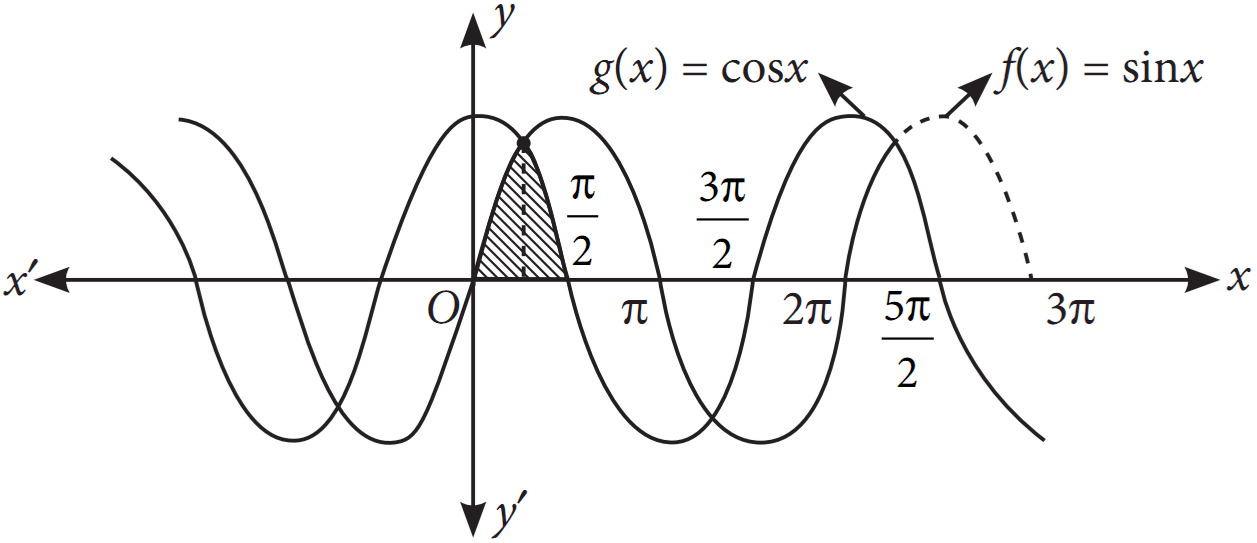
Graphs of two function $\text{f}(\text{x})=\text{sin}\text{ x}$ and $\text{(g)}\text{x}=\text{cos}\text{ x}$ is given below:

Based on the above information, answer the following questions.
  1. In $(0, \pi)$, the curves $\text{f}(\text{x})=\text{sin}\text{ x}$ and $\text{g}\text{ (x)}=\text{cos}\text{ x}$ at $\text{x}=$
    1. $\frac{\pi}{2}$
    2. $\frac{\pi}{3}$
    3. $\frac{\pi}{4}$
    4. ${\pi}$
  2. Value of $\int\limits_{0}^{\frac{\pi}{4}}\text{sin}\text{ x}\text{ dx}$ is.
    1. $1-\frac{1}{\sqrt{2}}$
    2. $1+\frac{1}{\sqrt{2}}$
    3. $2-\frac{1}{\sqrt{2}}$
    4. $2+\frac{1}{\sqrt{2}}$
  1. Value of $\int\limits_\frac{\pi}{4}^{\frac{\pi}{2}}\text{cos}\text{ x}\text{ dx}$ is.
    1. $1+\frac{1}{\sqrt{2}}$
    2. $1-\frac{1}{\sqrt{2}}$
    3. $2-\sqrt{2}$
    4. $2+\sqrt{2}$
  2. Value of $\int\limits_{0}^{\pi}\text{sin}\text{ x}\text{ dx}$ is.
  1. 0
  2. 1
  3. 2
  4. -2
  1. Value of $\int\limits_{0}^\frac{\pi}{2}\text{sin}\text{ x}\text{ dx}$ is.
  1. 0
  2. 1
  3. 3
  4. 4
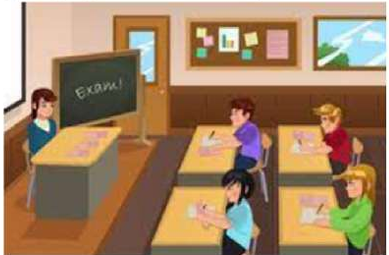
Mr. Ajay is taking up subjects of mathematics, physics, and chemistry in the examination. His probabilities of getting a grade $\mathrm{A}$ in these subjects are $0.2,0.3$, and 0.5 respectively.

Image

(i) Find the probability that Ajay gets Grade A in all subjects.
(ii) Find the probability that he gets Grade A in no subjects.

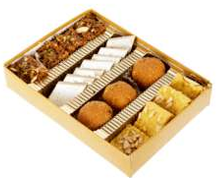
Naina is creative she wants to prepare a sweet box for Diwali at home. She took a square piece of cardboard of side $18 \mathrm{~cm}$ which is to be made into an open box, by cutting a square from each corner and folding up the flaps to form the box. She wants to cover the top of the box with some decorative paper. Naina is interested in maximizing the volume of the box.

Image

(i) Find the volume of the open box formed by folding up the cutting each corner with $\mathrm{x} \mathrm{cm}$.

(ii) Naina is interested in maximizing the volume of the box. So, what should be the side of the square to be cut off so that the volume of the box is maximum?

(iii) Verify that volume of the box is maximum at $x=3 \mathrm{~cm}$ by second derivative test?

OR

Find the maximum volume of the box.

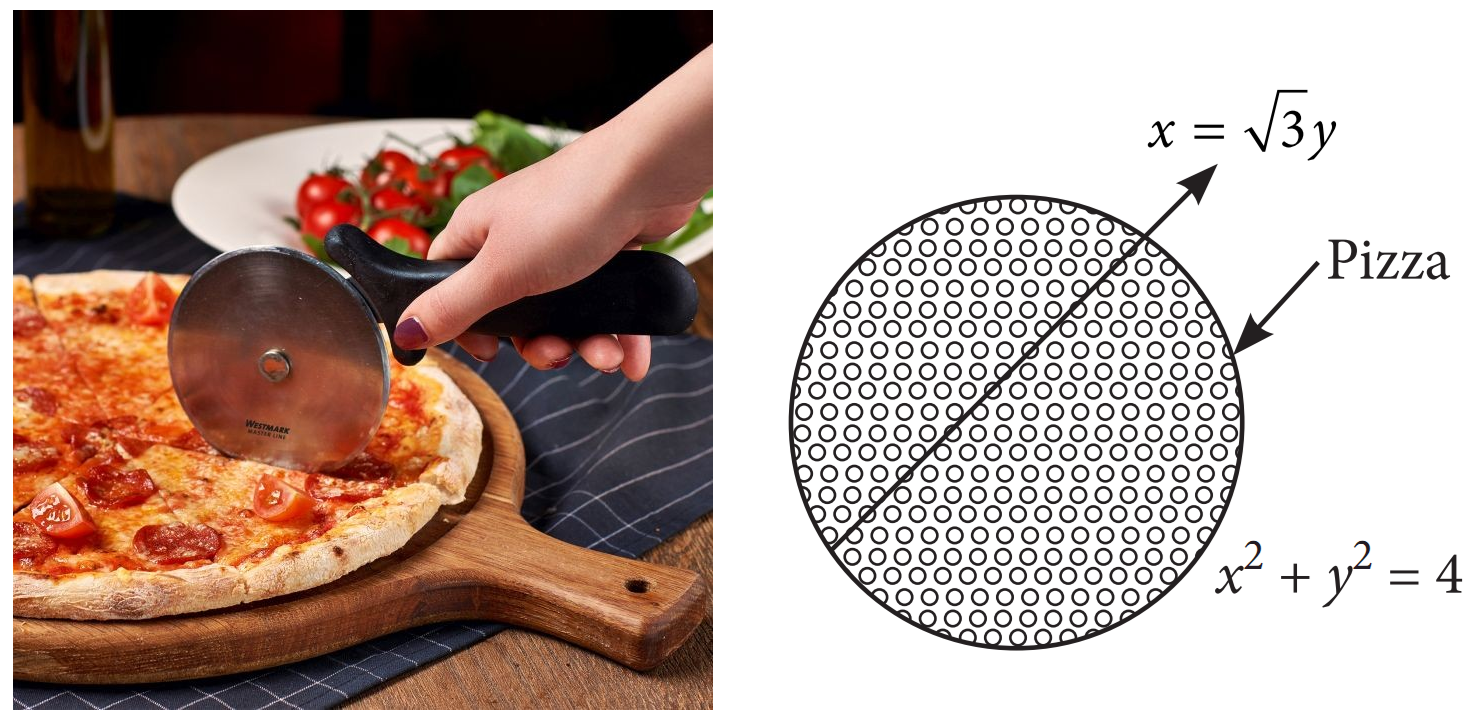
A child cut a pizza with a knife. Pizza is circular in shape which is represented by $x^2+y^2=4$ and sharp edge of knife represents a straight line given by $\text{x}=\sqrt{3\text{y}}$ Based on the above information, answer the following questions.
  1. The point(s) of intersection of the edge of knife (line) and pizza shown in the figure is (are).
  1. $(1, \sqrt{3}),(-1,-\sqrt{3})$
  2. $(\sqrt{3},1),(-\sqrt{3,}-1)$
  3. $(\sqrt{2,}0),(0,\sqrt{3})$
  4. $(-\sqrt{3,}),(1,-\sqrt{3})$
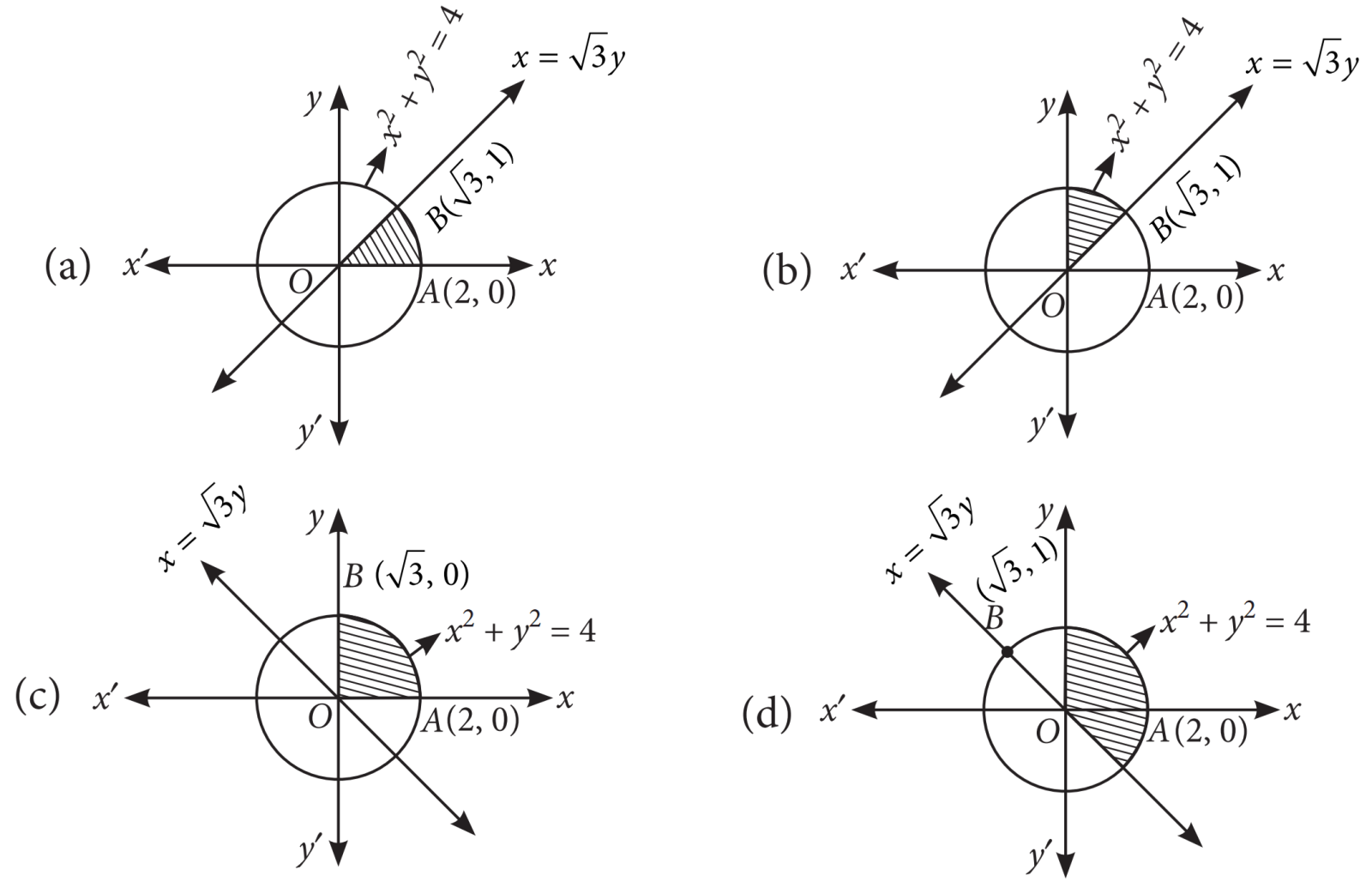
  1. Which of the following shaded portion represent the smaller area bounded by pizza and edge of knife in first quadrant?
  1. Value of area of the region bounded by circular pizza and edge of knife in first quadrant is.
  1. $\frac{\pi}{2}\text{ sq.units}$
  2. $\frac{\pi}{3}\text{ sq.units}$
  3. $\frac{\pi}{5}\text{ sq.units}$
  4. $\pi\text{ sq.units}$
  1. Area of each slice of pizza when child cut the pizza into 4 equal pieces is.
  1. $\pi\text{ sq.units}$
  2. $\frac{\pi}{2}\text{ sq.units}$
  3. $3\pi\text{ sq.units}$
  4. $2\pi\text{ sq.units}$
  1. Area of whole pizza is.
  1. $3\pi\text{ sq.units}$
  2. $2\pi\text{ sq.units}$
  3. $5\pi\text{ sq.units}$
  4. $4\pi\text{ sq.units}$
If the equation is of the form $\frac{\text{dy}}{\text{dx}}=\text{py}=\text{Q},$ where P, Q are functions of x, then the solution of the differential equation is given by $\text{ye}^{\int\text{pdx}}=\int\text{Q e}^{\int\text{pdx}}\text{dx}+\text{c},$ where $\text{e}^{\int\text{pdx}}$ is called the integrating factor (I.F.).
Based on the above information, answer the following questions.
  1. The integrating factor of the differential equation $\sin\text{x}\frac{\text{dy}}{\text{dx}}+2\text{y}\cos\text{x}=1$ is $(\sin\text{x})^\lambda,$ where $\lambda=$
  1. 0
  2. 1
  3. 2
  4. 3
  1. Integrating factor of the differential equation $(1-\text{x}^2)\frac{\text{dy}}{\text{dx}}-\text{xy}=1$ is:
  1. $-\text{x}$
  2. $\frac{\text{x}}{1+\text{x}^2}$
  3. $\sqrt{1-\text{x}^2}$
  4. $\frac{1}{2}\log(1-\text{x}^2)$
  1. The solution of $\frac{\text{dy}}{\text{dx}}+\text{y}=\text{e}^{-\text{x}},\text{ y}(0)=0,$ is:
  1. $\text{y}=\text{e}^\text{x}(\text{x}-1)$
  2. $\text{y}=\text{xe}^{-\text{x}}$
  3. $\text{y}=\text{xe}^{-\text{x}}+1$
  4. $\text{y}=(\text{x}+1)\text{e}^{-\text{x}}$
  1. General solution of $\frac{\text{dy}}{\text{dx}}+\text{y}\tan\text{x}=\sec\text{x}$ is:
  1. $\text{y}\sec\text{y}=\tan\text{x}+\text{c}$
  2. $\text{y}\tan\text{x}=\sec\text{x}+\text{c}$
  3. $\tan\text{x}=\text{y}\tan\text{x}+\text{c}$
  4. $\text{x}\sec\text{x}=\tan\text{y}+\text{c}$
  1. The integrating factor of differential equation $\frac{\text{dy}}{\text{dx}}-3\text{y}=\sin2\text{x}$ is:
  1. $\text{e}^{3\text{x}}$
  2. $\text{e}^{-2\text{x}}$
  3. $\text{e}^{-3\text{x}}$
  4. $\text{xe}^{-3\text{x}}$
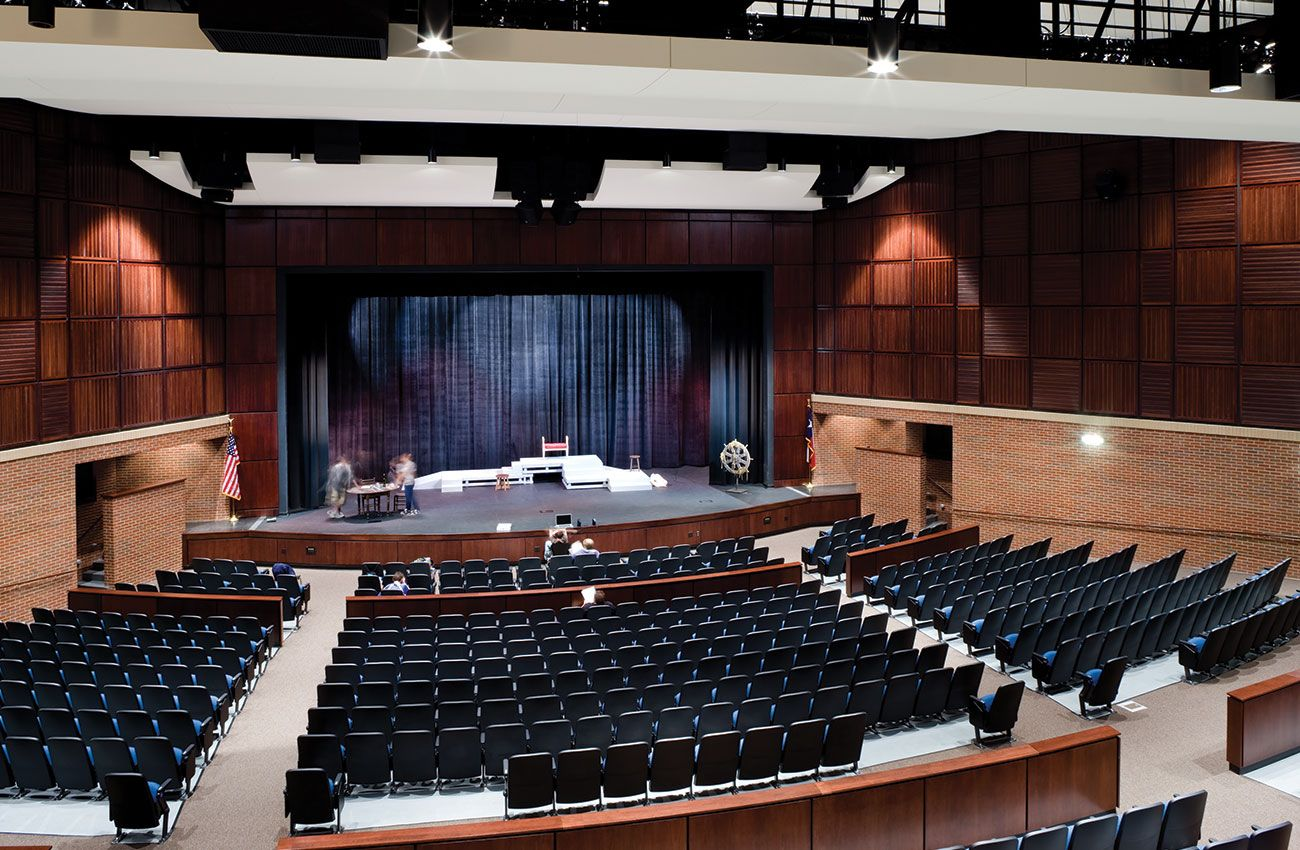
An architecture design a auditorium for a school for its cultural activities. The floor of the auditorium is rectangular in shape and has a fixed perimeter P.

Based on the above information, answer the following questions.
  1. If x and y represents the length and breadth of the rectangular region, then relation between the variable is.
  1. $x + y = P$
  2. $x^2 + y^2 = P^2$
  3. $2(x + y) = P$
  4. $x + 2y = P$
  1. The area (A) of the rectangular region, as a function of x, can be expressed as.
  1. $\text{A}=\text{px}+\frac{\text{x}}{2}$
  2. $\text{A}=\frac{\text{px}+\text{x}^2}{2}$
  3. $\text{A}=\frac{\text{px}-\text{2x}^2}{2}$
  4. $\text{A}=\frac{\text{x}^2}{2}+\text{px}^2$
  1. School's manager is interested in maximising the area of floor 'A' for this to be happen, the value of x should be.
  1. $\text{P}$
  2. $\frac{\text{P}}{2}$
  3. $\frac{\text{P}}{3}$
  4. $\frac{\text{P}}{4}$
  1. The value of y, for which the area of floor is maximum, is.
  1. $\frac{\text{P}}{2}$
  2. $\frac{\text{P}}{3}$
  3. $\frac{\text{P}}{4}$
  4. $\frac{\text{P}}{16}$
  1. Maximum area of floor is.
  1. $\frac{\text{P}^2}{16}$
  2. $\frac{\text{P}^2}{64}$
  3. $\frac{\text{P}^2}{4}$
  4. $\frac{\text{P}^2}{28}$
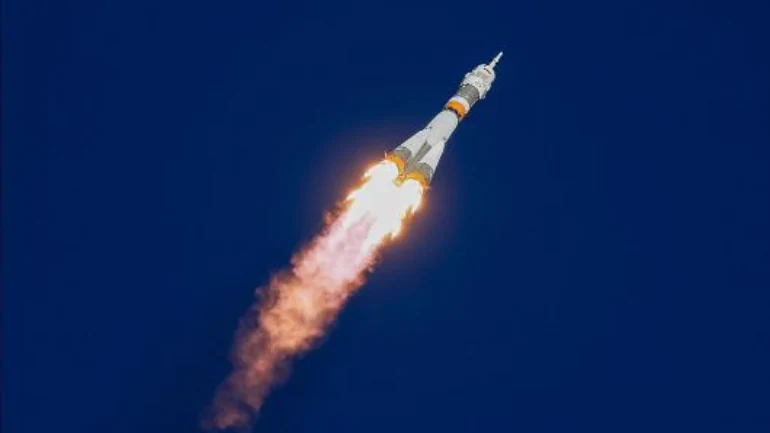
The equation of motion of a rocket are: x = 2t, y = -4t, z = 41, where the time 't' is given in seconds, and the distance measured is in kilometres. Based on the above information, answer the following questions.
  1. What is the path of the rocket?
  1. Straight line.
  2. Circle.
  3. Parabola.
  4. None of these.
  1. Which of the following points lie on the path of the rocket?
  1. (0, 1, 2)
  2. (1, -2, 2)
  3. (2, -2, 2)
  4. None of these
  1. At what distance will the rocket be from the starting point (0, 0, 0) in 10 seconds?
  1. 40km
  2. 60km
  3. 30km
  4. 80km
  1. If the position of rocket at certain instant of time is (3, -6, 6), then what will be the height of the rocket from the ground, which is along the xy-plane?
  1. 3km
  2. 2km
  3. 4km
  4. 6km
  1. At certain instant of time, if the rocket is above sea level, where equation of surface of sea is given by 3x - y + 4z = 2 and position of rocket at that instant of time is (1, -2, 2), then the image of position of rocket in the sea is:
  1. $\Big(\frac{20}{13},\frac{15}{13},\frac{18}{13}\Big)$
  2. $\Big(\frac{-20}{13},\frac{-15}{13},\frac{-18}{13}\Big)$
  3. $\Big(\frac{20}{13},\frac{-15}{13},\frac{18}{13}\Big)$
  4. None of these
Let f(x) be a real valued function, then its
  • Left Hand Derivative (L.H.D.) : $\text{Lf}'(\text{a})=\lim_\limits{\text{h}\rightarrow0}\frac{\text{f}(\text{a}-\text{h})-\text{f}(\text{a})}{-\text{h}}$
  • Right Hand Derivative (R.H.D.) : $\text{Rf}'(\text{a})=\lim_\limits{\text{h}\rightarrow0}\frac{\text{f}(\text{a}+\text{h})-\text{f}(\text{a})}{\text{h}}$
Also, a function f(x) is said to be differentiable at x = a if its L.H.D. and R.H.D. at x = a exist and are equal.
For the function $\text{f}(\text{x})=\begin{cases}|\text{x}-3|,\text{x}\geq1\\\\\frac{\text{x}^2}{4}-\frac{3\text{x}}{2}+\frac{13}{4},\text{x}<1\end{cases},$ answer the following questions.
  1. R.H.D. of f(x) at x = 1 is:
  1. 1
  2. -1
  3. 0
  4. 2
  1. L.H.D. of f(x) at x = 1 is:
  1. 1
  2. -1
  3. 0
  4. 2
  1. f(x) is non-differentiable at:
  1. x = 1
  2. x = 2
  3. x = 3
  4. x = 4
  1. Find the value of f'(2).
  1. 1
  2. 2
  3. 3
  4. -1
  1. The value of f'(-1) is:
  1. 2
  2. 1
  3. -2
  4. -1
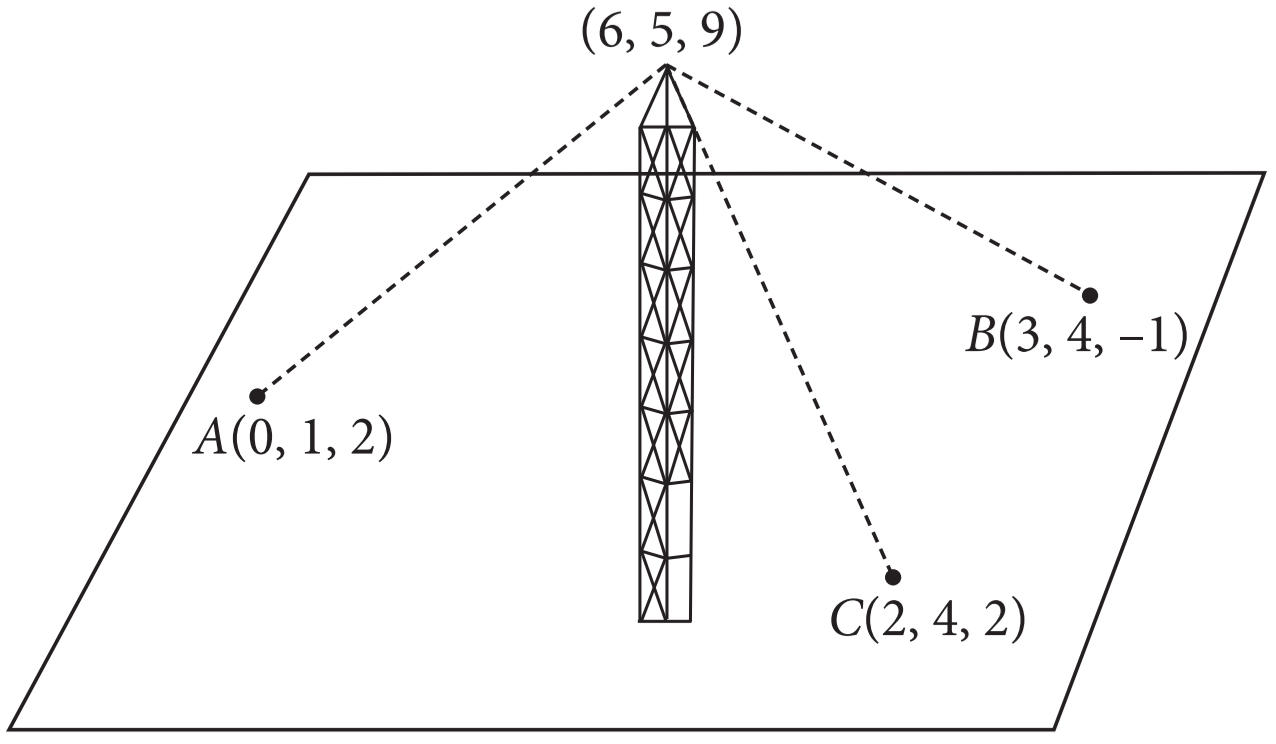
A mobile tower stands at the top of a hill. Consider the surface on which tower stand as a plane having points A(0, 1, 2), B(3, 4, -1), and C(2, 4, 2) on it. The mobile tower is tied with 3 cables from the point A, Band C such that it stand vertically on the ground. The peak of the tower is at the point ( 6, 5, 9), as shown in the figure. Based on the above information, answer the following questions.
  1. The equation of plane passing through the points A, Band C is:
  1. 3x - 4y + z = 0
  2. 3x - 2y + z = 0
  3. 3x - 2y + z = 0
  4. 4x - 3y + 3z = 0
  1. The height of the tower from the ground is:
  1. 6 units
  2. 5 units
  3. $\frac{17}{\sqrt{14}}\text{units}$
  4. $\frac{5}{\sqrt{14}}\text{units}$
  1. The equation of line of perpendicular drawn from the peak of tower to the ground is:
  1. $\frac{\text{x}-6}{3}=\frac{\text{y}-4}{-2}=\frac{\text{z}-9}{1}$
  2. $\frac{\text{x}-6}{3}=\frac{\text{y}-5}{-2}=\frac{\text{z}-9}{1}$
  3. $\frac{\text{x}-6}{3}=\frac{\text{y}-4}{2}=\frac{\text{z}-9}{1}$
  4. $\frac{\text{x}-6}{3}=\frac{\text{y}-5}{2}=\frac{\text{z}-9}{1}$
  1. The coordinates of foot of perpendicular drawn from the peak of tower to the ground are:
  1. $\Big(\frac{33}{14},\frac{104}{14},\frac{109}{14}\Big)$
  2. $\Big(\frac{33}{14},\frac{109}{14},\frac{104}{14}\Big)$
  3. $\Big(\frac{33}{14},\frac{105}{14},\frac{109}{14}\Big)$
  4. None of these
  1. The area of $\triangle\text{ABC}$ is:
  1. $\frac{1}{2}\sqrt{14}\text{sq}.\text{units}$
  2. $\frac{3}{2}\sqrt{14}\text{sq}.\text{units}$
  3. $\sqrt{14}\text{sq}.\text{units}$
  4. $2\sqrt{14}\text{sq}.\text{units}$
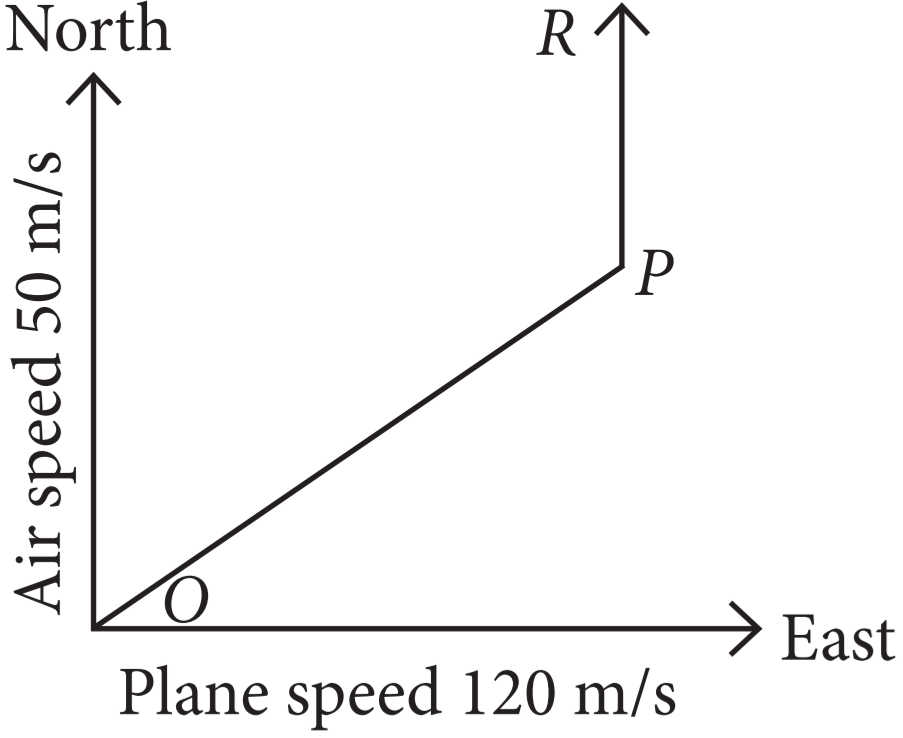
A plane started from airport situated at O with a velocity of 120m/s towards east. Air is blowing at a velocity of 50m/ s towards the north as shown in the figure.
The plane travelled 1hr in OP direction with the resultant velocity. From P to R the plane travelled 1hr keeping velocity of 120m/s and finally landed at R.

Based on the above information, answer the following questions.
  1. What is the resultant velocity from O to P?
  1. 100m/ s
  2. 130m/ s
  3. 126m/ s
  4. 180m/ s
  1. What is the direction of travel of plane from O to P with East?
  1. $\tan^{-1}\Big(\frac{5}{12}\Big)$
  2. $\tan^{-1}\Big(\frac{12}{3}\Big)$
  3. 50
  4. 80
  1. What is the displacement from O to P?
  1. 600km
  2. 468km
  3. 532km
  4. 500km
  1. What is the resultant velocity from P to R?
  1. 120m/ s
  2. 70m/ s
  3. 170m/ s
  4. 200m/ s
  1. What is the displacement from P to R?
  1. 450km
  2. 532km
  3. 610km
  4. 612km