Question
Let f(x) be a real valued function, then its
  • Left Hand Derivative (L.H.D.) : $\text{Lf}'(\text{a})=\lim_\limits{\text{h}\rightarrow0}\frac{\text{f}(\text{a}-\text{h})-\text{f}(\text{a})}{-\text{h}}$
  • Right Hand Derivative (R.H.D.) : $\text{Rf}'(\text{a})=\lim_\limits{\text{h}\rightarrow0}\frac{\text{f}(\text{a}+\text{h})-\text{f}(\text{a})}{\text{h}}$
Also, a function f(x) is said to be differentiable at x = a if its L.H.D. and R.H.D. at x = a exist and are equal.
For the function $\text{f}(\text{x})=\begin{cases}|\text{x}-3|,\text{x}\geq1\\\\\frac{\text{x}^2}{4}-\frac{3\text{x}}{2}+\frac{13}{4},\text{x}<1\end{cases},$ answer the following questions.
  1. R.H.D. of f(x) at x = 1 is:
  1. 1
  2. -1
  3. 0
  4. 2
  1. L.H.D. of f(x) at x = 1 is:
  1. 1
  2. -1
  3. 0
  4. 2
  1. f(x) is non-differentiable at:
  1. x = 1
  2. x = 2
  3. x = 3
  4. x = 4
  1. Find the value of f'(2).
  1. 1
  2. 2
  3. 3
  4. -1
  1. The value of f'(-1) is:
  1. 2
  2. 1
  3. -2
  4. -1

Answer

We have, $\text{f}(\text{x})=\begin{cases}\text{x}-3&,\text{x}\geq3\\3-\text{x}&,1\leq\text{x}<3\\\\\frac{\text{x}^2}{4}-\frac{3\text{x}}{2}+\frac{13}{4}&,\text{x}<1\end{cases}$
  1. (b) -1
Solution:

$\text{Rf}'(1)=\lim\limits_{\text{h}\rightarrow0}\frac{\text{f}(1+\text{h})-\text{f}(1)}{\text{h}}$

$\lim\limits_{\text{h}\rightarrow0}\frac{3-(1+\text{h})-2}{\text{h}}=\lim\limits_{\text{h}\rightarrow0}-\frac{\text{h}}{\text{h}}=-1$
  1. (b) -1
Solution:

$\text{Lf}'(1)=\lim\limits_{\text{h}\rightarrow0}\frac{\text{f}(1-\text{h})-\text{f}(1)}{-\text{h}}$

$=\lim\limits_{\text{h}\rightarrow0}\frac{-1}{\text{h}}\Big[\frac{(1-\text{h})^2}{4}-\frac{3(1-\text{h})}{2}+\frac{13}{4}-2\Big]$

$=\lim\limits_{\text{h}\rightarrow0}\frac{-1}{\text{h}}\Big(\frac{1+\text{h}^2-2\text{h}-6+6\text{h}+13-8}{-4\text{h}}\Big)$

$=\lim\limits_{\text{h}\rightarrow0}\Big(\frac{\text{h}^2+4\text{h}}{-4\text{h}}\Big)=-1$
  1. (c) x = 3
Solution:

Since, R.H.D. at x = 3 is 1

and L.H.D. at x = 3 is - 1

$\therefore$ f(x) is non-differentiable at x = 3.
  1. (d) -1
  1. (c) -2
Solution:

From above, we have

$\text{f}'(\text{x})=\frac{\text{x}}{2}-\frac{3}{2},\text{x}<1$

$\therefore\text{f}'(-1)=\frac{-1}{2}-\frac{3}{2}=-2$

Need a full question paper?

Generate a complete, print-ready paper with questions like this in minutes — across 16+ boards, with answer keys.

Start Generating Free

Similar questions

In pre-board examination of class XII, commerce stream with Economics and Mathematics of a particular school, 50% of the students failed in Economics, 35% failed in Mathematics and 25% failed in both Economics and Mathematics. A student is selected at random from the class. Based on the above information, answer the following questions.
  1. The probability that the selected student has failed in Economics, if it is known that he has failed in Mathematics, is:
  1. $\frac{3}{10}$
  2. $\frac{12}{25}$
  3. $\frac{1}{4}$
  4. $\frac{5}{7}$
  1. The probability that the selected student has failed in Mathematics, if it is known that he has failed in Economics, is:
  1. $\frac{22}{25}$
  2. $\frac{12}{25}$
  3. $\frac{1}{2}$
  4. $\frac{3}{25}$
  1. The probability that the selected student has passed in at least one of the two subjects, is:
  1. $\frac{1}{4}$
  2. $\frac{1}{2}$
  3. $\frac{3}{4}$
  4. None of these.
  1. The probability that the selected student has failed in at least one of the two subjects, is:
  1. $\frac{3}{5}$
  2. $\frac{22}{25}$
  3. $\frac{2}{5}$
  4. $\frac{43}{100}$
  1. The probability that the selected student has passed in Mathematics, if it is known that he has failed in Economics, is:
  1. $\frac{2}{5}$
  2. $\frac{3}{4}$
  3. $\frac{1}{3}$
  4. $\frac{1}{2}$
Area of a triangle whose vertices are $(x_1, y_1), (x_2, y_2)$ and $(x_3, y_3)$ is given by the determinant:
$\Delta=\frac{1}{2}\begin{vmatrix}\text{x}_1&\text{y}_1&1\\\text{x}_2&\text{y}_2&1\\\text{x}_3&\text{y}_3&1\end{vmatrix}$
Since, area is a positive quantity, so we always take the absolute value of the determinant $\Delta.$ Also, the area of the triangle formed by three collinear points is zero.
Based on the above information, answer the following questions.
  1. Find the area of the triangle whose vertices are $(-2, 6), (3, -6) $ and $(1, 5).$
  1. $30$ sq. units
  2. $35 $ sq. units
  3. $40$ sq. units
  4. $15.5$ sq. units
  1. If the points $(2, -3), (k, -1)$ and $(0, 4)$ are collinear, then find the value of $4k.$
  1. $4$
  2. $\frac{7}{140}$
  3. $47$
  4. $\frac{40}{7}$
  1. If the area of a triangle $ABC,$ with vertices $A(1, 3), B(0, 0)$ and $C(k, 0)$ is 3 sq. units, then a value of $k$ is:
  1. $2$
  2. $3$
  3. $4$
  4. $5$
  1. Using determinants, find the equation of the tine joining the points $A(1, 2)$ and $B(3, 6).$
  1. $y = 2x$
  2. $x = 3y$
  3. $y = x$
  4. $4x - y = 5$
  1. If $\text{A}\equiv(11,7),\text{B}\equiv(5,5)$ and $\text{C}\equiv(-1,3),$ then:
  1. $\Delta\text{ABC}$ is scalene triangle.
  2. $\Delta\text{ABC}$ is equilateral triangle.
  3. $A, B$ and $C$ are collinear.
  4. None of these.
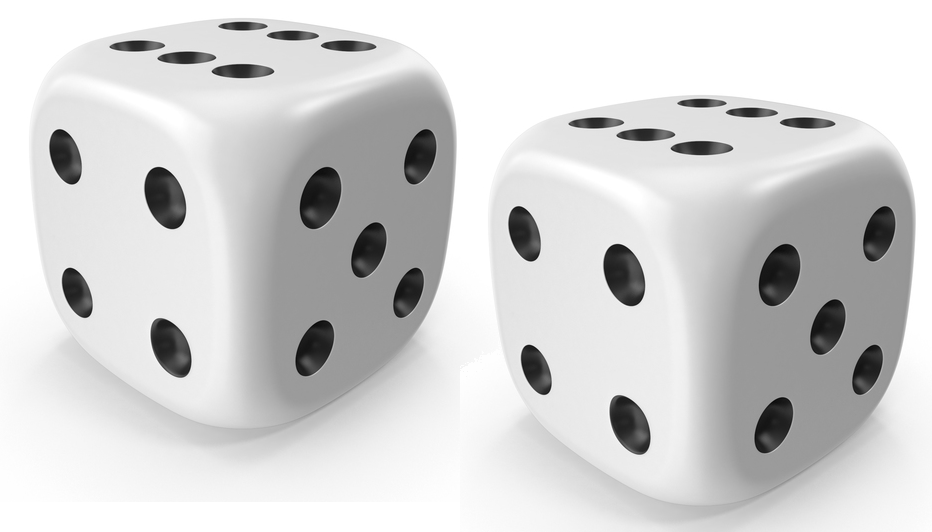
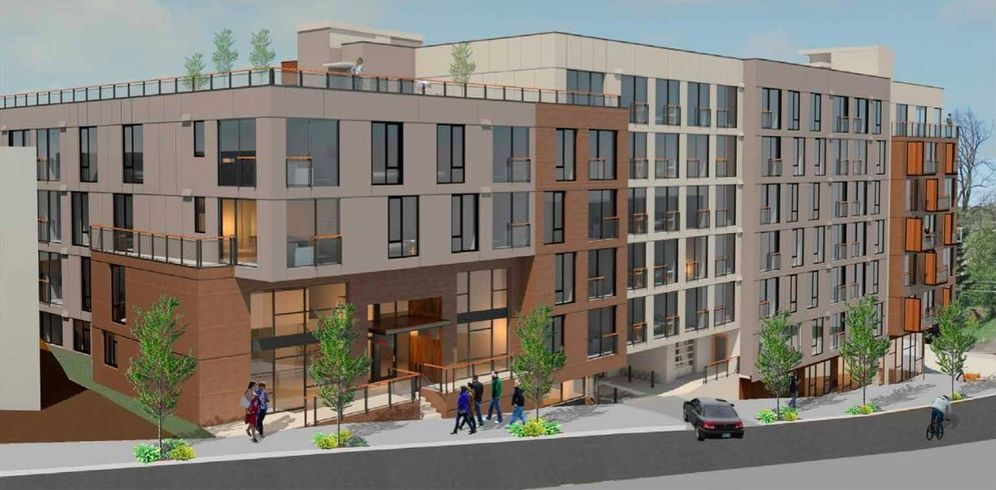
Three friends A, Band Care playing a dice game. The numbers rolled up by them in their first three chances were noted and given by A= {1, 5}, B = {2, 4, 5} and C = {1, 2, 5} as A reaches the cell 'SKIP YOUR NEXT TURN' in second throw. Based on the above information, answer the following questions.
  1. P(A | B) =
  1. $\frac{1}{6}$
  2. $\frac{1}{3}$
  3. $\frac{1}{2}$
  4. $\frac{2}{3}$
  1. P(B | C) =
  1. $\frac{2}{3}$
  2. $\frac{1}{12}$
  3. $\frac{1}{9}$
  4. $0$
  1. $\text{P}(\text{A}\cap\text{B}|\text{C})=$
  1. $\frac{1}{6}$
  2. $\frac{1}{2}$
  3. $\frac{1}{12}$
  4. $\frac{1}{3}$
  1. P(A | C)
  1. $\frac{1}{4}$
  2. $1$
  3. $\frac{2}{3}$
  4. None of these.
  1. $\text{P}(\text{A}\cup\text{B}|\text{C})=$
  1. 0
  2. $\frac{1}{2}$
  3. $\frac{2}{3}$
  4. 1
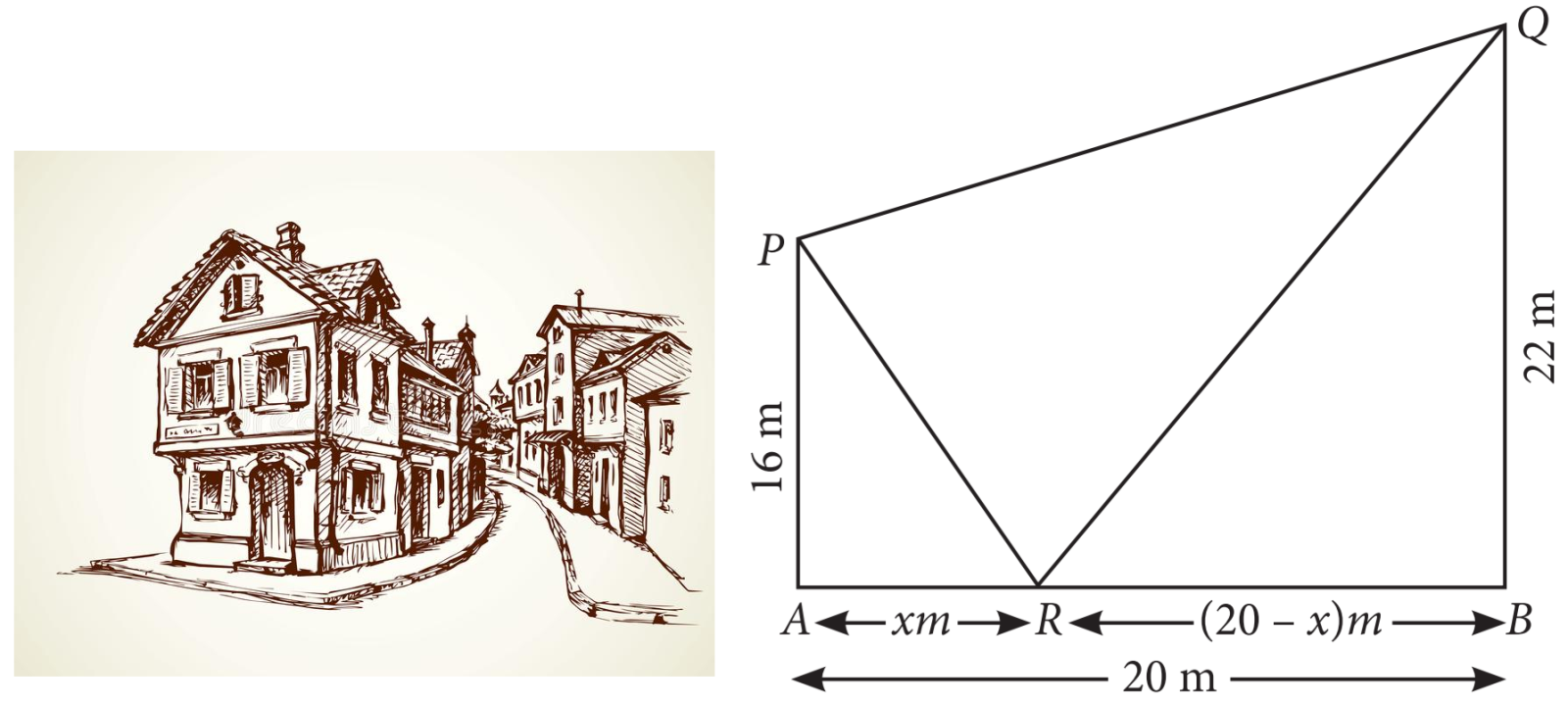
Two multi-storey buildings $($represented by $AP$ and $BQ)$ are on opposite side of a $20m$ wide road at point $A$ and $B$ respectively. There is a point $R$ on road as shown in figure.

Based on the above information, answer the following questions.
  1. Area of trapezium $ABQP$ is.
  1. $380$ sq. m
  2. $280$ sq. m
  3. $320$ sq. m
  4. $430$ sq. m
  1. The length $PQ$ is.
  1. $20.5m$
  2. $19.80m$
  3. $20.88m$
  4. $21m$
  1. Let there be a quantity $S$ such that $S = RP^2 + RQ^2,$ then $S$ is given by.
  1. $2x^2 - 40x - 1140$
  2. $2x^2 + 40x + 1140$
  3. $2x^2 - 40x + 1140$
  4. $2x^2 + 40x - 1140$
  1. Find the value of $x$ for which value of $S$ is minimum.
  1. $10$
  2. $0$
  3. $4$
  4. $-10$
  1. For minimum value of S, find the value of $PR$ and $RQ.$
  1. $18.50\ m,  19.36\ m$
  2. $18.86\ m, 24.17\ m$
  3. $17.56\ m, 23.29\ m$
  4. None of these
A real estate company is going to build a new residential complex. The land they have purchased can hold at most $4500$ apartments. Also, if they make x apartments, then the monthly maintenance cost for the whole complex would be as follows: Fixed cost $= ₹ 50,00,000$. Variable cost $= (160x - 0.04x^2)$

Based on the above information, answer the following questions.
  1. The maintenance cost as a function of $x$ will be.
  1. $160x - 0.04x^2$ 
  2. $5000000$
  3. $5000000 + 160x - 0.04x^2$ 
  4. None of these
  1. If $C(x)$ denote the maintenance cost function, then maximum value of $C(x)$ occur at $x =$
  1. $0$
  2. $2000$
  3. $4500$
  4. $5000$
  1. The maximum value of $C(x)$ would be.
  1. $₹\ 5225000$
  2. $₹\ 5160000$
  3. $₹\ 5000000$
  4. $₹\ 4000000$
  1. The number of apartments, that the complex should have in order to minimize the maintenance cost, is.
  1. $4500$
  2. $5000$
  3. $1750$
  4. $3500$
  1. If the minimum maintenance cost is attain, then the maintenance cost for each apartment would be.
  1. $₹\ 1091.11$
  2. $₹\ 1200$
  3. $₹\ 1000$
  4. $₹\ 2000$
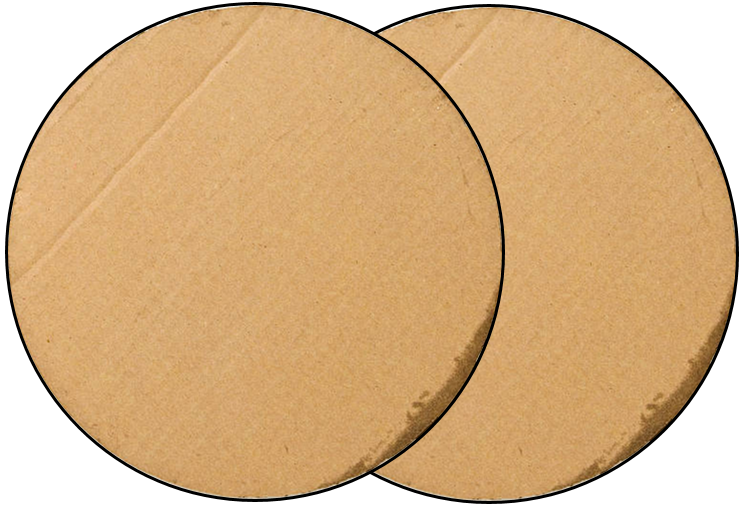
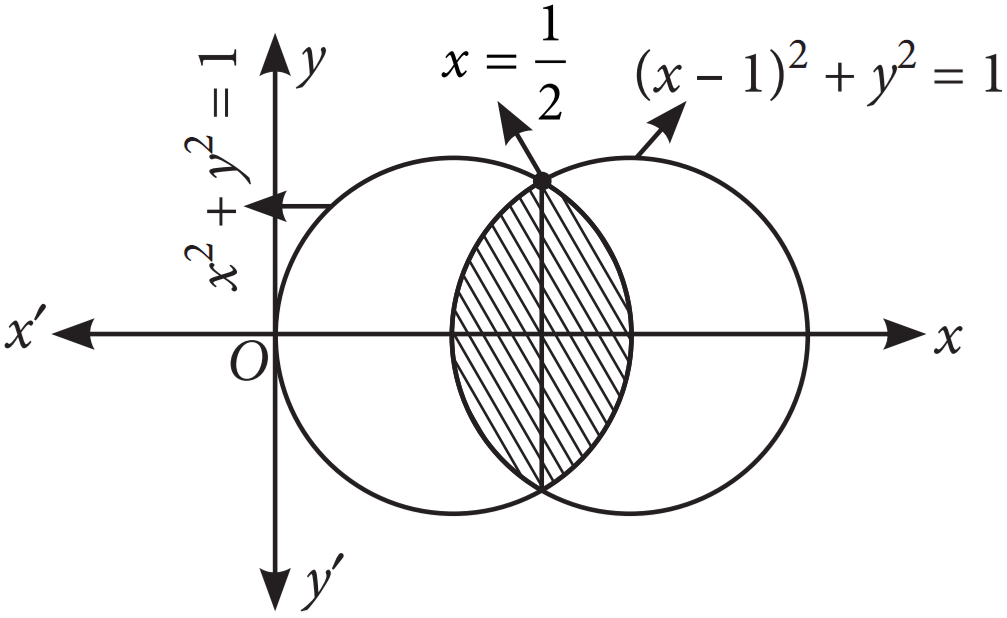
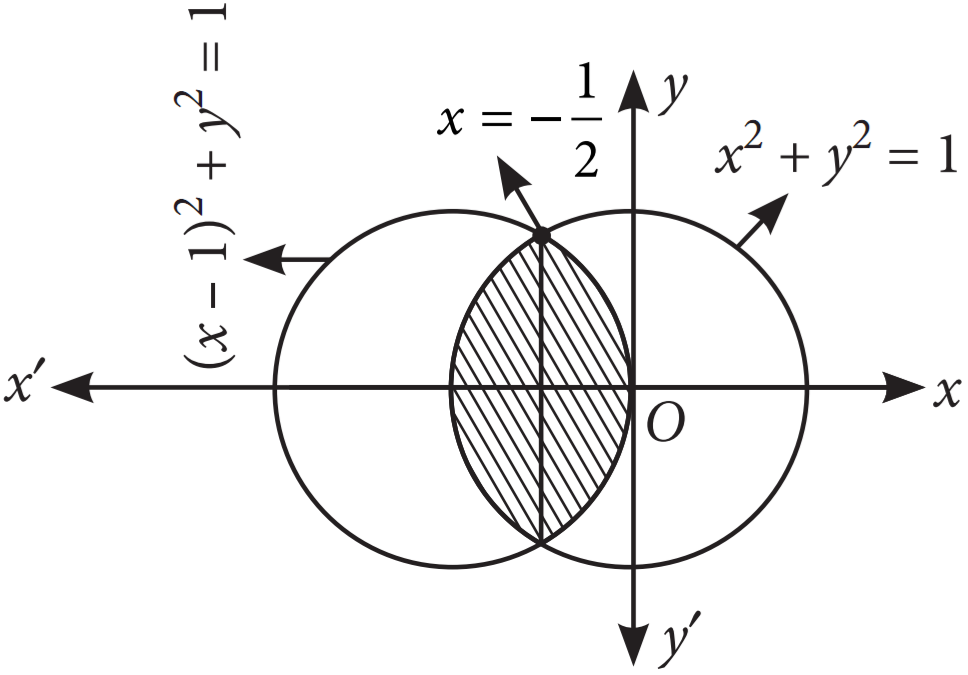
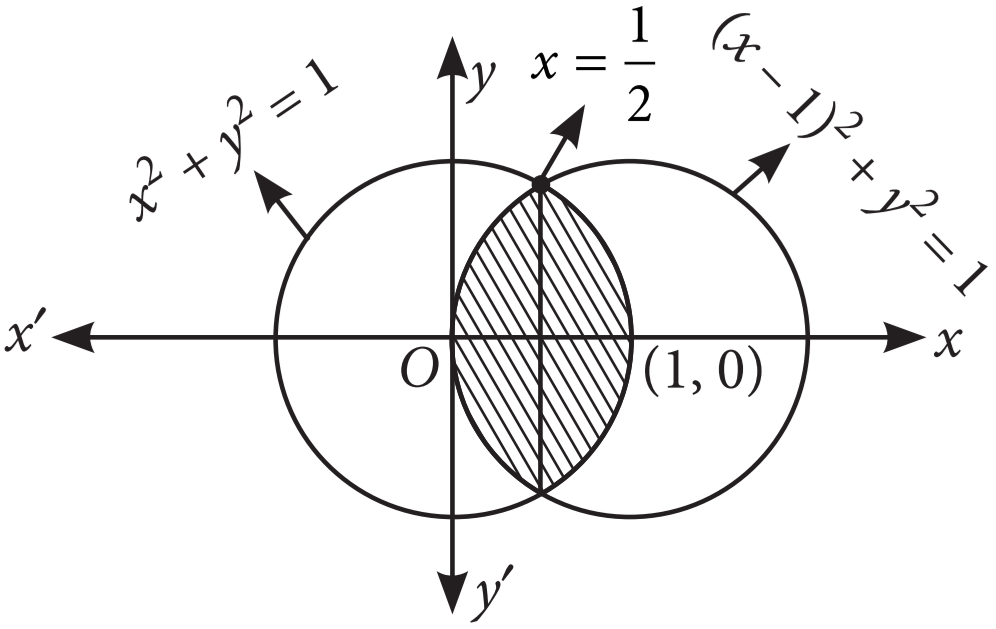
Ajay cut two circular pieces of cardboard and placed one upon other as shown in figure. One of the circle represents the equation $(x - 1)^2 + y^2 = 1$, while other circle represents the equation $x^2 + y^2 = 1$.

Based on the above information, answer the following questions.
  1. Both the circular pieces of cardboard meet each other at
  1. $\text{x}=1$
  2. $\text{x}=\frac{1}{2}$
  3. $\text{x}=\frac{1}{3}$
  4. $\text{x}=\frac{1}{4}$
  1. Graph of given two curves can be drawn as.
  1. None of these
  1. Value of $\int\limits_{0}^{\frac{1}{2}}\sqrt{1-(\text{x}-1)^2}\text{dx}$ is.
  1. $\frac{\pi}{6}-\frac{\sqrt{3}}{8}$
  2. $\frac{\pi}{6}+\frac{\sqrt{3}}{8}$
  3. $\frac{\pi}{2}+\frac{\sqrt{3}}{4}$
  4. $\frac{\pi}{2}-\frac{\sqrt{3}}{4}$
  1. Value of $\int\limits_{\frac{1}{2}}^{1}\sqrt{1-\text{x}^2}\text{dx}$ is.
  1. $\frac{\pi}{6}+\frac{\sqrt{3}}{4}$
  2. $\frac{\pi}{6}+\frac{\sqrt{3}}{8}$
  3. $\frac{\pi}{6}-\frac{\sqrt{3}}{8}$
  4. $\frac{\pi}{2}-\frac{\sqrt{3}}{4}$
  1. Area of hidden portion of lower circle is.
  1. $\bigg(\frac{2\pi}{3}+\frac{\sqrt{3}}{2}\bigg)\text{ sq.units}$
  2. $\bigg(\frac{\pi}{3}-\frac{\sqrt{3}}{8}\bigg)\text{ sq.units}$
  3. $\bigg(\frac{\pi}{3}+\frac{\sqrt{3}}{8}\bigg)\text{ sq.units}$
  4. $\bigg(\frac{2\pi}{3}-\frac{\sqrt{3}}{2}\bigg)\text{ sq.units}$
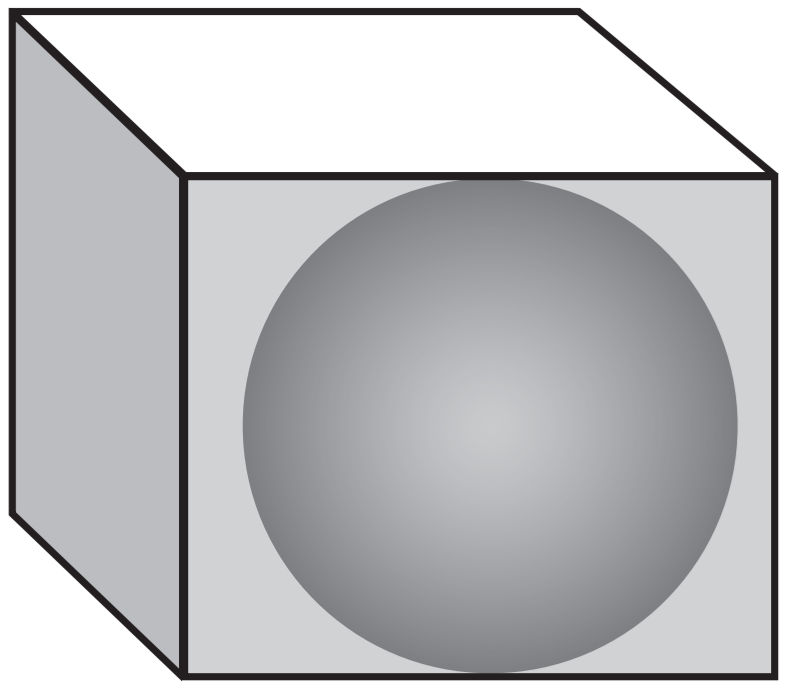
Shreya got a rectangular parallelepiped shaped box and spherical ball inside it as return gift. Sides of the box are x, 2x, and $\frac{\text{x}}{3},$ while radius of the ball is r.

Based on the above information, answer the following questions.
  1. If S represents the sum of volume of parallelepiped and sphere, then Scan be written as.
  1. $\frac{4\text{x}^3}{3}+\frac{2}{2}\pi\text{r}^2$
  2. $\frac{2\text{x}^2}{3}+\frac{4}{3}\pi\text{r}^2$
  3. $\frac{2\text{x}^3}{3}+\frac{4}{3}\pi\text{r}^3$
  4. $\frac{2}{3}\text{x}+\frac{4}{3}\pi\text{r}$
  1. If sum of the surface areas of box and ball are given to be constant $k^2$ then x is equal to.
  1. $\sqrt{\frac{\text{k}^2-4\pi\text{r}^2}{6}}$
  2. $\sqrt{\frac{\text{k}^2-4\pi\text{r}}{6}}$
  3. $\sqrt{\frac{\text{k}^2-4\pi}{6}}$
  4. $\text{None of these}$
  1. The radius of the ball, when Sis minimum, is.
  1. $\sqrt{\frac{\text{k}^2}{54+\pi}}$
  2. $\sqrt{\frac{\text{k}^2}{54+4}}$
  3. $\sqrt{\frac{\text{k}^2}{64+3\pi}}$
  4. $\sqrt{\frac{\text{k}^2}{4\pi+3}}$
  1. Relation between length of the box and radius of the ball can be represented as.
  1. $\text{x} = \frac{2}{\text{r}}$
  2. $\text{x}=\frac{\text{r}}{2}$
  3. $\text{x}=\frac{2}{\text{r}}$
  4. $\text{x}=3\text{r}$
  1. Minimum value of S is.
  1. $\frac{\text{k}^2}{2(3\pi+54)^\frac{2}{3}}$
  2. $\frac{\text{k}}{2(3\pi+54)^\frac{3}{2}}$
  3. $\frac{\text{k}^3}{2(4\pi+54)^\frac{1}{2}}$
  4. $\text{None of these}$
Minor of an element $a_{ij}$ of a determinant is the determinant obtained by deleting its $i^{th}$ row and $j^{th}$ column in which element $a_{ij}$ lies and is denoted by $M_{ij}.$
Cofactor of an element $a_{ij}$, denoted by $A_{ij}$, is defined by $A_{ij} = (-1)^{i+j} M_{ij},$ where $M_{ij}$ is minor of $a_{ij}$.
Also, the determinant of a square matrix A is the sum of the products of the elements of any row (or column) with their corresponding cofactors. For example, if $\text{A}=[\text{a}_\text{ij}]_{3\times3},$ then $|A| = a_{11}A_{11} + a_{12}A_{12} + a_{13}A_{13}.$
  1. Find the sum of the cofactors of all the elements of $\begin{vmatrix}1&-2\\4&3\end{vmatrix}.$
  1. $2$
  2. $-2$
  3. $4$
  4. $1$
  1. Find the minor of $a_{21}$ of $\begin{vmatrix}5&6&-3\\-4&3&2\\-4&-7&3\end{vmatrix}.$
  1. $3$
  2. $-3$
  3. $39$
  4. $-39$
  1. In the determinant $\begin{vmatrix}2&-3&5\\6&0&4\\1&5&-7\end{vmatrix},$ find the value of $a_{32}.A_{32}.$
  1. $27$
  2. $-110$
  3. $110$
  4. $-27$
  1. If $\Delta=\begin{vmatrix}5&3&8\\2&0&1\\1&2&3\end{vmatrix},$ then write the minor of $a_{23}.$
  1. $-10$
  2. $-7$
  3. $10$
  4. $7$
  1. If $\Delta=\begin{vmatrix}2&-3&5\\6&0&4\\1&5&-7\end{vmatrix},$ then find the value of $|\Delta|.$
  1. $26$
  2. $28$
  3. $72$
  4. $46$
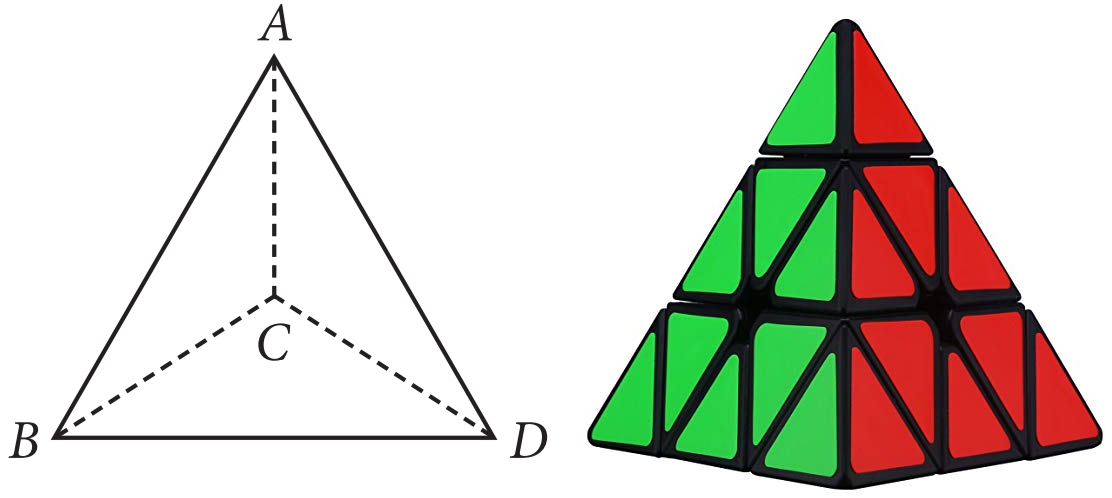
A building is to be constructed in the form of a triangular pyramid, ABCD as shown in the figure.

Let its angular points are A(0, 1, 2), B(3, 0, 1), C(4, 3, 6), and D(2, 3, 2), and G be the point of intersection of the medians of $\triangle\text{BCD}.$
Based on the above information, answer the following questions.
  1. The coordinates of point Gare:
  1. (2, 3, 3)
  2. (3, 3, 2)
  3. (3, 2, 3)
  4. (0, 2, 3)
  1. The length of vector $\overline{\text{AG}}$ is:
  1. $\sqrt{17}\text{ units}$
  2. $\sqrt{11}\text{ units}$
  3. $\sqrt{13}\text{ units}$
  4. $\sqrt{19}\text{ units}$
  1. Area of $\triangle\text{ABC}$ (in sq. units) is:
  1. $\sqrt{10}$
  2. $2\sqrt{10}$
  3. $3\sqrt{10}$
  4. $5\sqrt{10}$
  1. The sum of lengths of $\overline{\text{AB}}$ and $\overline{\text{AC}}$ is:
  1. 5 units
  2. 9.32 units
  3. 10 units
  4. 11 units
  1. The length of the perpendicular from the vertex D on the opposite face is:
  1. $\frac{6}{\sqrt{10}}\text{ units}$
  2. $\frac{2}{\sqrt{10}}\text{ units}$
  3. $\frac{3}{\sqrt{10}}\text{ units}$
  4. $8\sqrt{10}\text{ units}$