Question
If y = f(u) is a differentiable function of u and u = g(x) is a differentiable function of x, then y = f(g(x)] is a differentiable function of x and $\frac{\text{dy}}{\text{dx}}=\frac{\text{dy}}{\text{du}}\times\frac{\text{du}}{\text{dx}}.$ This rule is also known as CHAIN RULE.
Based on the above information, find the derivative of functions w.r.t. x in the following questions.
  1. $\cos\sqrt{\text{x}}$
  1. $\frac{-\sin\sqrt{\text{x}}}{2\sqrt{\text{x}}}$
  2. $\frac{\sin\sqrt{\text{x}}}{2\sqrt{\text{x}}}$
  3. $\sin\sqrt{\text{x}}$
  4. $-\sin\sqrt{\text{x}}$
  1. $7^{\text{x}+\frac{1}{\text{x}}}$
  1. $\Big(\frac{\text{x}^2-1}{\text{x}^2}\Big)\cdot7^{\text{x}+\frac{1}{\text{x}}}\cdot\log7$
  2. $\Big(\frac{\text{x}^2+1}{\text{x}^2}\Big)\cdot7^{\text{x}+\frac{1}{\text{x}}}\cdot\log7$
  3. $\Big(\frac{\text{x}^2-1}{\text{x}^2}\Big)\cdot7^{\text{x}-\frac{1}{\text{x}}}\cdot\log7$
  4. $\Big(\frac{\text{x}^2+1}{\text{x}^2}\Big)\cdot7^{\text{x}-\frac{1}{\text{x}}}\cdot\log7$
  1. $\sqrt\frac{{1-\cos\text{x}}}{1+\cos\text{x}}$
  1. $\frac{1}{2}\sec^2\frac{\text{x}}{2}$
  2. $-\frac{1}{2}\sec^2\frac{\text{x}}{2}$
  3. $\sec^2\frac{\text{x}}{2}$
  4. $-\sec^2\frac{\text{x}}{2}$
  1. $\frac{1}{\text{b}}\tan^{-1}\Big(\frac{\text{x}}{\text{b}}\Big)+\frac{1}{\text{a}}\tan^{-1}\Big(\frac{\text{x}}{\text{a}}\Big)$
  1. $\frac{-1}{\text{x}^2+\text{b}^2}+\frac{1}{\text{x}^2+\text{a}^2}$
  2. $\frac{1}{\text{x}^2+\text{b}^2}+\frac{1}{\text{x}^2+\text{a}^2}$
  3. $\frac{1}{\text{x}^2+\text{b}^2}-\frac{1}{\text{x}^2+\text{a}^2}$
  4. None of these.
  1. $\sec^{-1}\text{x}+\text{cosec}^{-1}\frac{\text{x}}{\sqrt{\text{x}^2-1}}$
  1. $\frac{2}{\sqrt{\text{x}^2-1}}$
  2. $\frac{-2}{\sqrt{\text{x}^2-1}}$
  3. $\frac{1}{|\text{x}|\sqrt{\text{x}^2-1}}$
  4. $\frac{2}{|\text{x}|\sqrt{\text{x}^2-1}}$
Answer

  1. (a) $\frac{-\sin\sqrt{\text{x}}}{2\sqrt{\text{x}}}$
Solution:
Let $\text{y}=\cos\sqrt{\text{x}}$
$\therefore\frac{\text{dy}}{\text{dx}}=\frac{\text{d}}{\text{dx}}(\cos\sqrt{\text{x}})=-\sin\sqrt{\text{x}}\cdot\frac{\text{d}}{\text{dx}}(\sqrt{\text{x}})$
$=-\sin\sqrt{\text{x}}\times\frac{1}{2\sqrt{\text{x}}}=\frac{-\sin\sqrt{\text{x}}}{2\sqrt{\text{x}}}$
  1. (a) $\Big(\frac{\text{x}^2-1}{\text{x}^2}\Big)\cdot7^{\text{x}+\frac{1}{\text{x}}}\cdot\log7$
Solution:
Let $\text{y}=7^{\text{x}+\frac{1}{\text{x}}}\therefore\frac{\text{dy}}{\text{dx}}=\frac{\text{d}}{\text{dx}}\Big(7^{\text{x}+\frac{1}{\text{x}}}\Big)$
$=7^{\text{x}+\frac{1}{\text{x}}}\cdot\log7\cdot\frac{\text{d}}{\text{dx}}\Big(\text{x}+\frac{1}{\text{x}}\Big)=7^{\text{x}+\frac{1}{\text{x}}}\cdot\log7\cdot\Big(1-\frac{1}{\text{x}^2}\Big)$
$=\Big(\frac{\text{x}^2-1}{\text{x}^2}\Big)\cdot7^{\text{x}+\frac{1}{\text{x}}}\cdot\log7$
  1. (a) $\frac{1}{2}\sec^2\frac{\text{x}}{2}$
Solution:
Let $\text{y}=\sqrt\frac{{1-\cos\text{x}}}{1+\cos\text{x}}=\sqrt{\frac{1-1+2\sin^2\frac{\text{x}}{2}}{2\cos^2\frac{\text{x}}{2}-1+1}}=\tan\Big(\frac{\text{x}}{2}\Big)$
$\therefore\frac{\text{dy}}{\text{dx}}=\sec^2\frac{\text{x}}{2}\cdot\frac{1}{2}=\frac{1}{2}\sec^2\frac{\text{x}}{2}$
  1. (b) $\frac{1}{\text{x}^2+\text{b}^2}+\frac{1}{\text{x}^2+\text{a}^2}$
Solution:
Let $\text{y}=\frac{1}{\text{b}}\tan^{-1}\Big(\frac{\text{x}}{\text{b}}\Big)+\frac{1}{\text{a}}\tan^{-1}\Big(\frac{\text{x}}{\text{a}}\Big)$
$\therefore\frac{\text{dy}}{\text{dx}}=\frac{1}{\text{b}}\times\frac{1}{1+\frac{\text{x}^2}{\text{b}^2}}\times\frac{1}{\text{b}}+\frac{1}{\text{a}}\times\frac{1}{1+\frac{\text{x}^2}{\text{a}^2}}\times\frac{1}{\text{a}}$
$=\frac{1}{\text{x}^2+\text{b}^2}+\frac{1}{\text{x}^2+\text{a}^2}$
  1. (d) $\frac{2}{|\text{x}|\sqrt{\text{x}^2-1}}$

Solution:
Let $\text{y}=\sec^{-1}\text{x}+\text{cosec}^{-1}\frac{\text{x}}{\sqrt{\text{x}^2-1}}$
Put $\text{x}=\sec\theta\Rightarrow\theta=\sec^{-1}\text{x}$
$\therefore\text{y}=\sec^{-1}(\sec\theta)+\text{cosec}^{-1}\Big(\frac{\sec\theta}{\sqrt{\sec^2\theta-1}}\Big)$
$=\theta+\sin^{-1}\Big[\sqrt{1-\cos^2\theta}\Big]$
$=\theta+\sin^{-1}(\sin\theta)=\theta+\theta=2\theta=2\sec^{-1}\text{x}$
$\therefore\frac{\text{dy}}{\text{dx}}=2\frac{\text{d}}{\text{dx}}(\sec^{-1}\text{x})=2\times\frac{1}{|\text{x}|\sqrt{\text{x}^2-1}}$
$=\frac{2}{|\text{x}|\sqrt{\text{x}^2-1}}$

Need a full question paper?

Generate a complete, print-ready paper with questions like this in minutes — across 16+ boards, with answer keys.

Start Generating Free

Similar questions

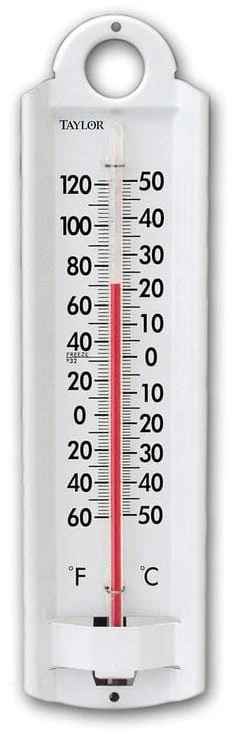
A thermometer reading 80°F is taken outside. Five minutes later the thermometer reads 60°F. After another 5 minutes the thermometer reads 50°F. At any time t the thermometer reading be T°F and the outside temperature be S°F.

Based on the above information, answer the following questions.

  1. If $\lambda$ is posinve constant of propornonality, then $\frac{\text{dn}}{\text{dt}}$ is:
  1. $\lambda(\text{T - S})$
  2. $\lambda(\text{T + S})$
  3. $\lambda\text{T S}$
  4. $-\lambda(\text{T - S})$
  1. The value of T(S) is:
  1. 30°F
  2. 40°F
  3. 5D°F
  4. 60°F
  1. The value of T(10) is:
  1. 50°F
  2. 60°F
  3. 80°F
  4. 90°F
  1. Find the general solution of differential equation fanned in given situation.
  1. $\log\text{T}=\text{St + c}$
  2. $\log(\text{T}-\text{S})=\lambda{\text{t + c}}$
  3. $\log\text{T}=\text{tT + c}$
  4. $\log(\text{T + S})=\lambda{\text{t + c}}$
  1. Find the value of constant of integration c in the solution of differential equation formed in given situation.
  1. $\log(60\ -\ \text{S})$
  2. $\log(80\ +\ \text{S})$
  3. $\log(80\ -\ \text{S})$
  4. $\log(60\ +\ \text{S})$
In a family there are four children. All of them have to work in their family business to earn their livelihood at the age of 18. Based on the above information, answer the following questions.
  1. Probability that all children are girls, if it is given that elder child is a boy, is:
  1. $\frac{3}{8}$
  2. $\frac{1}{8}$
  3. $\frac{5}{8}$
  4. None of these.
  1. Probability that all children are boys, if two elder children are boys, is:
  1. $\frac{1}{4}$
  2. $\frac{3}{4}$
  3. $\frac{1}{2}$
  4. None of these.
  1. Find the probability that two middle children are boys, if it is given that eldest child is a girl.
  1. $0$
  2. $\frac{3}{4}$
  3. $\frac{1}{4}$
  4. None of these.
  1. Find the probability that all children are boys, if it is given that at most one of the children is a girl.
  1. $0$
  2. $\frac{1}{5}$
  3. $\frac{2}{5}$
  4. $\frac{4}{5}$
  1. Find the probability that all children are boys, if it is given that at least three of the children are boys.
  1. $\frac{1}{5}$
  2. $\frac{2}{5}$
  3. $\frac{3}{5}$
  4. $\frac{4}{5}$
To promote the making of toilets for women, an organisation tried to generate awareness through (i) house call (ii) emails and (iii) announcements. The cost for each mode per attempt is given below:
  1. ₹ 50
  2. ₹ 20
  3. ₹ 40
The number of attempts made in the villages X, Y and Z are given below:
  (i) (ii) (iii)
X 400 300 100
Y 300 250 75
Z 500 400 150
Also, the chance of making of toilets corresponding to one attempt of given modes is:
  1. 2%
  2. 4%
  3. 20%
Based on the above information, answer the following questions.
  1. The cost incurred by the organisation on village X is:
  1. ₹ 10000
  2. ₹ 15000
  3. ₹ 30000
  4. ₹ 20000
  1. The cost incurred by the organisation on village Y is:
  1. ₹ 25000
  2. ₹ 18000
  3. ₹ 23000
  4. ₹ 28000
  1. The cost incurred by the organisation on village Z is:
  1. ₹ 19000
  2. ₹ 39000
  3. ₹ 45000
  4. ₹ 50000
  1. The total number of toilets that can be expected after the promotion in village X, is:
  1. 20
  2. 30
  3. 40
  4. 50
  1. The total number of toilets that can be expected after the promotion in village Z, is
  1. 56
  2. 26
  3. 36
  4. 46
Read the following text carefully and answer the questions that follow:
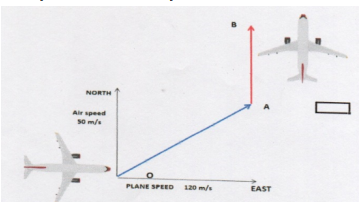
A plane started from airport $O$ with a velocity of $120 \ m/s$ towards east. Air is blowing at a velocity of $50 \ m/s$ towards the north As shown in the figure.
The plane travelled $1 \ hr$ in $OA$ direction with the resultant velocity. From $A$ and $B$ travelled $1 \ hr$ with keeping velocity of $120 \ m/s$ and finally landed at $B.$
Image
$i.$ What is the resultant velocity from $O$ to $A$?
$ii.$ What is the direction of travel of plane $O$ to $A$ with east?
$iii.$ What is the total displacement from $O$ to $A$?
$OR$
What is the resultant velocity from $A$ to $B$?
In a college hostel accommodating 1000 students, one of the hostellers came in carrying Corona virus, and the hostel was isolated. The rate at which the virus spreads is assumed to be proportional to the product of the number of infected students and remaining students. There are 50 infected students after 4 days.

Based on the above information, answer the following questions.
  1. If n(I) denote the number of students infected by Corona virus at any time I, then maximum value of n(I) is:
  1. 50
  2. 100
  3. 500
  4. 1000
  1. $\frac{\text{dn}}{\text{dt}}$ is proporuona to:
  1. n(1000 - n)
  2. n(100 + n)
  3. n(100 - n)
  4. n(100 + n)
  1. The value of n(4) is:
  1. 1
  2. 50
  3. 100
  4. 1000
  1. The most general solution of differential equation formed in given situation is:
  1. $\frac{1}{1000}\log\Big(\frac{1000-\text{n}}{\text{n}}\Big)=\lambda\text{t}+\text{c}$
  2. $\log\Big(\frac{\text{n}}{100-\text{n}}\Big)=\lambda\text{t}+\text{c}$
  3. $\frac{1}{1000}\log\Big(\frac{\text{n}}{1000-\text{n}}\Big)=\lambda\text{t}+\text{c}$
  4. None of these.
  1. The value of n at any time is given by:
  1. $\text{n(t)}=\frac{1000}{1+999\text{e}^{-0.9906\text{t}}}$
  2. $\text{n(t)}=\frac{1000}{1-999\text{e}^{-0.9906\text{t}}}$
  3. $\text{n(t)}=\frac{100}{1-999\text{e}^{-0.9906\text{t}}}$
  4. $\text{n(t)}=\frac{100}{1+999\text{e}^{-0.9906\text{t}}}$
Read the following passage and answer the questions given below.

Image

In an elliptical sport field the authority wants to design a rectangular soccer field with the maximum possible area. The sport field is given by the graph of $\frac{x^2}{a^2}+\frac{y^2}{b^2}=1$

(i) If the length and the breadth of the rectangular field be $2 x$ and $2 y$ respectively, then find the area function in terms of $x$.

(ii) Find the critical point of the function.

(iii) Use First derivative Test to find the length $2 x$ and width $2 y$ of the soccer field (in terms of $a$ and b) that maximize its area.

OR

(iii) Use Second Derivative Test to find the length $2 x$ and width $2 y$ of the soccer field (in terms of $a$ and $b$ ) that maximize its area.

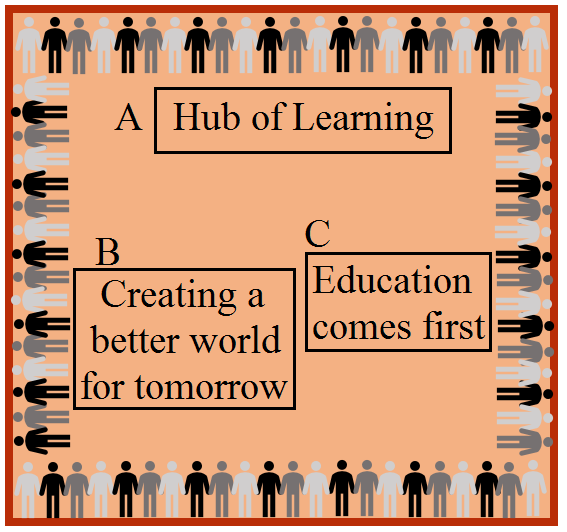
Three slogans on chart papers are to be placed on a school bulletin board at the points A, Band C displaying A (Hub of Learning), B (Creating a better world for tomorrow) and C (Education comes first). The coordinates of these points are (1, 4, 2), (3, -3, -2) and (-2, 2, 6) respectively.

Based on the above information, answer the following questions.
  1. Let $\vec{\text{a}},\vec{\text{b}}$ and $\vec{\text{c}}$ be the position vectors of points A, B and C respectively, then $\vec{\text{a}}+\vec{\text{b}}+\vec{\text{c}}$ is equal to:
  1. $2\hat{\text{i}}+3\hat{\text{j}}+6\hat{\text{k}}$
  2. $2\hat{\text{i}}-3\hat{\text{j}}-6\hat{\text{k}}$
  3. $2\hat{\text{i}}+8\hat{\text{j}}+3\hat{\text{k}}$
  4. $2(7\hat{\text{i}}+8\hat{\text{j}}+3\hat{\text{k}})$
  1. Which of the following is not true?
  1. $\overline{\text{AB}}+\overline{\text{BC}}+\overline{\text{CA}}=\vec{0}$
  2. $\overline{\text{AB}}+\overline{\text{BC}}-\overline{\text{AC}}=\vec{0}$
  3. $\overline{\text{AB}}+\overline{\text{BC}}-\overline{\text{CA}}=\vec{0}$
  4. $\overline{\text{AB}}-\overline{\text{CB}}+\overline{\text{CA}}=\vec{0}$
  1. Area of $\triangle\text{ABC}$ is:
  1. 19 sq. units
  2. $\sqrt{1937}\text{sq}.\text{units}$
  3. $\frac{1}{2}\sqrt{1937}\text{sq}.\text{units}$
  4. $\sqrt{1837}\text{sq}.\text{units}$
  1. Suppose, if the given slogans are to be placed on a straight line, then the value of $|\vec{\text{a}}\times\vec{\text{b}}+\vec{\text{b}}\times\vec{\text{c}}+\vec{\text{c}}\times\vec{\text{a}}|$ will be equal to:
  1. -1
  2. -2
  3. 2
  4. 0
  1. If $\vec{\text{a}}=2\hat{\text{i}}+3\hat{\text{j}}+6\hat{\text{k}},$ then unit vector in the direction of vector $\vec{\text{a}}$ is:
  1. $\frac{2}{7}\hat{\text{i}}-\frac{3}{7}\hat{\text{j}}-\frac{6}{7}\hat{\text{k}}$
  2. $\frac{2}{7}\hat{\text{i}}+\frac{3}{7}\hat{\text{j}}+\frac{6}{7}\hat{\text{k}}$
  3. $\frac{3}{7}\hat{\text{i}}+\frac{2}{7}\hat{\text{j}}+\frac{6}{7}\hat{\text{k}}$
  4. None of these
Minor of an element $a_{ij}$ of a determinant is the determinant obtained by deleting its $i^{th}$ row and $j^{th}$ column in which element $a_{ij}$ lies and is denoted by $M_{ij}.$
Cofactor of an element $a_{ij}$, denoted by $A_{ij}$, is defined by $A_{ij} = (-1)^{i+j} M_{ij},$ where $M_{ij}$ is minor of $a_{ij}$.
Also, the determinant of a square matrix A is the sum of the products of the elements of any row (or column) with their corresponding cofactors. For example, if $\text{A}=[\text{a}_\text{ij}]_{3\times3},$ then $|A| = a_{11}A_{11} + a_{12}A_{12} + a_{13}A_{13}.$
  1. Find the sum of the cofactors of all the elements of $\begin{vmatrix}1&-2\\4&3\end{vmatrix}.$
  1. $2$
  2. $-2$
  3. $4$
  4. $1$
  1. Find the minor of $a_{21}$ of $\begin{vmatrix}5&6&-3\\-4&3&2\\-4&-7&3\end{vmatrix}.$
  1. $3$
  2. $-3$
  3. $39$
  4. $-39$
  1. In the determinant $\begin{vmatrix}2&-3&5\\6&0&4\\1&5&-7\end{vmatrix},$ find the value of $a_{32}.A_{32}.$
  1. $27$
  2. $-110$
  3. $110$
  4. $-27$
  1. If $\Delta=\begin{vmatrix}5&3&8\\2&0&1\\1&2&3\end{vmatrix},$ then write the minor of $a_{23}.$
  1. $-10$
  2. $-7$
  3. $10$
  4. $7$
  1. If $\Delta=\begin{vmatrix}2&-3&5\\6&0&4\\1&5&-7\end{vmatrix},$ then find the value of $|\Delta|.$
  1. $26$
  2. $28$
  3. $72$
  4. $46$
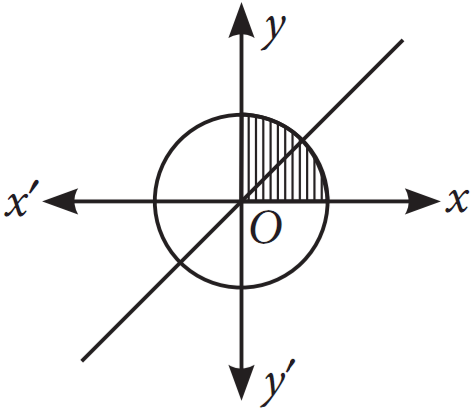
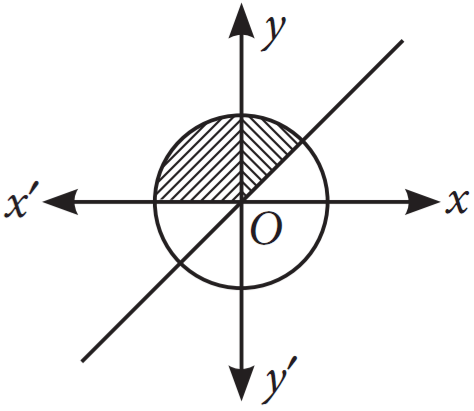
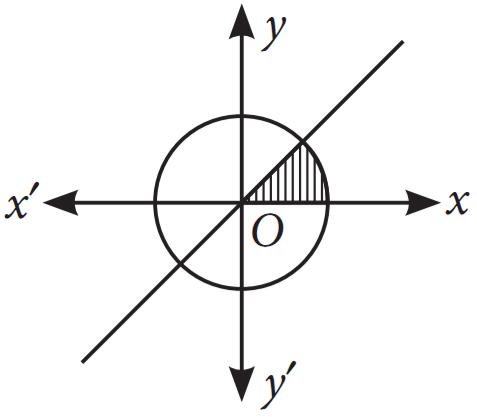
Consider the curve $x^2+y^2=16$ and line $y = x$ in the first quadrant. Based on the above information, answer the following questions.
  1. Point of intersection of both the given curves is.
  1. $(0, 4)$
  2. $(0, 2\sqrt{2})$
  3. $(2\sqrt{ 2},2\sqrt{2})$
  4. $(2,\sqrt{2},4)$
  1. Which of the following shaded portion represent the area bounded by given two curves?
  1. None of these
  1. The value of the integral $\int\limits_{0}^{2\sqrt{2}}\text{x}\text{dx}$ is.
  1. $0$
  2. $1$
  3. $2$
  4. $4$
  1. The value of the integral $\int\limits_{2\sqrt{2}}^{0}\sqrt{16-\text{x}^2}\text{ dx}$ is.
  1. $2(\pi-2)$
  2. $2(\pi-8)$
  3. $4(\pi-2)$
  4. $4(\pi+2)$
  1. Area bounded by the two given curves is.
  1. $3\pi\text{ sq.units}$
  2. $\frac{\pi}{2}\text{ sq.units}$
  3. $\pi\text{ sq.units}$
  4. $2\pi\text{ sq.units}$
Read the following passage and answer the questions given below: In an Office three employees James, Sophia and Oliver process incoming copies of a certain form. James processes $50\%$ of the forms, Sophia processes $20\%$ and Oliver the remaining $30\%$ of the forms. James has an error rate of $0.06,$ Sophia has an error rate of $0.04$ and Oliver has an error rate of $0.03.$ Based on the above
Image
information, answer the following questions.
(i) Find the probability that Sophia processed the form and committed an error.
(ii) Find the total probability of committing an error in processing the form.
(iii) The manager of the Company wants to do a quality check. During inspection, he selects a form at random from the days output of processed form. If the form selected at random has an error, find the probability that the form is not processed by James.
OR
(iii) Let E be the event of committing an error in processing the form and let 12 ,EEand 3 Ebe the events that James, Sophia and Oliver processed the form. Find the value of$\sum_{i=1}^3 P\left(E_i \mid E\right)$