Question
If Young's double slit experiment is performed in water:
  1. The fringe width will decrease.
  2. The fringe width will increase.
  3. The fringe width will remain unchanged.
  4. There will be no fringe.

Answer

  1. The fringe width will decrease.

Explanation:

As fringe width is proportional to the wavelength and wavelength of light is inversely proportional to the refractive index of the medium,

Here,

$\lambda_\text{M}=\frac{\lambda}{\eta}$

$\lambda_\text{M}$ = wavelength in medium

$\lambda$ = wavelength in vacuum

$\eta$ = refractive index of medium

Hence, fringe width decreases when Young's double slit experiment is performed under water.

Need a full question paper?

Generate a complete, print-ready paper with questions like this in minutes — across 16+ boards, with answer keys.

Start Generating Free

Similar questions

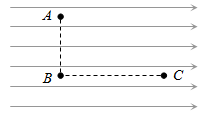
Figure shows three points A, B and C in a region of uniform electric field .  The line AB is perpendicular and BC is parallel to the field lines. Then which of the following holds good. Where  and  represent the electric potential at points  A, B and C respectively

(a)  

(b)  

(c)  

(d)  

At Curie temperature the ferromagnetic materials get converted into.

A piece of cloud having area 25   and electric potential of  volts. If the height of cloud is 0.75 km, then energy of electric field between earth and cloud will be

(a) 250 J  

(b) 750 J

(c) 1225 J

(d) 1475 J

The net resistance of a voltmeter should be large to ensure that

(a) It does not get overheated

(b) It does not draw excessive current

(c) It can measure large potential difference

(d)  It does not appreciably change the potential difference to be measured

Which of the following relation is significant for metals when the temperature increases?
Quantity that is not affected by magnetic field is:

The focal length of a normal eye-lens is about:

Photoelectric effect was successfully explained first by:

Two radioactive materials  and  have decay constants 10λ  and λ respectively. If initially they have the same number of nuclei, then the ratio of the number of nuclei of   to that of   will be 1/e  after a time

(a) 1/(10 λ)

(b) 1/(11 λ)

(c) 11(10 λ)

(d) 1(9 λ)

In which of the following remote sensing technique is not used

(a) Forest density

(b) Pollution

(c) Wetland mapping

(d) Medical treatment