Question
Illustrate by taking examples of transition elements and non-transition elements that oxidation states of elements are largely based on electronic configuration.
Answer

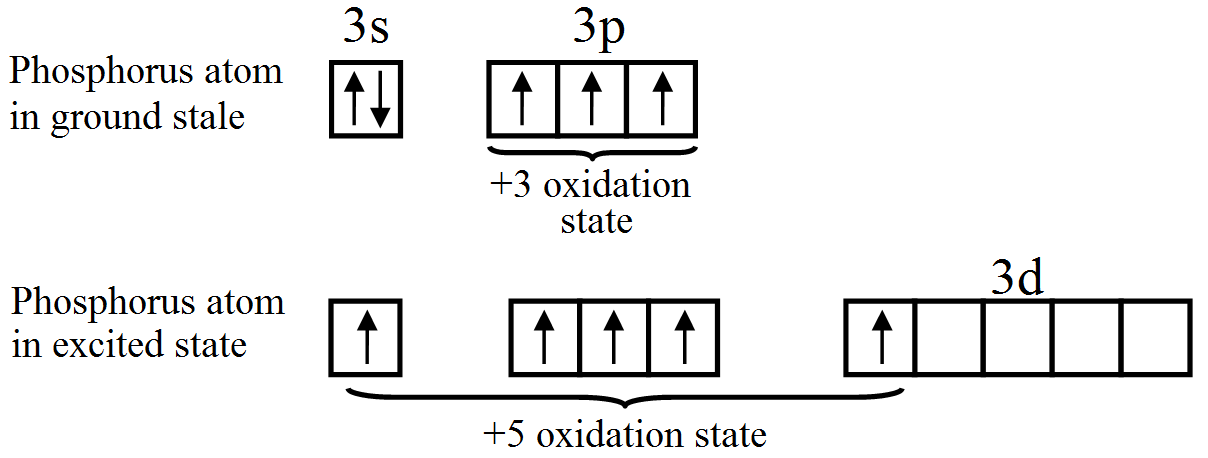
The transition elements show a large number of oxidation states. The various oxidation states are related to the electronic configuration of their atoms. The various oxidation states of a transition metal is due to the involvement of ( $\mathrm{n}-1) \mathrm{d}$ and outer ns electrons in bonding. The lower oxidation state is generally shown when ns electrons participate and higher oxidation states are exhibited when $n s$ and $(n-1) d$ electrons take part in bonding. For example, manganese, electronic configuration $(n-1) d^5 n s^2$, can show $+2,+3,+4,+6$ and +7 oxidation states. In the first five elements of the first transition series, i.e., up to manganese, the maximum oxidation state is equal to the sum of 4 s and 3 d electrons. For remaining five elements, the maximum state is not related to their electronic configurations. The non-transition elements mainly the p-block elements can show a number of oxidation states from +n to $(\mathrm{n}-8$ ) where n is the number of electrons present in the outermost shell. For example, phosphorus can show $-3,+3$ and +5 oxidation states while sulphur can show $-2,+2,+4$ and +6 oxidation states. lodine can show $-1,+1,+3,+5$ and +7 oxidation states. Lower oxidation states are ionic as the atom accepts the electron or electrons to achieve stable configuration while higher oxidation states are achieved by unpairing the paired orbitals and shifting the electrons to vacant d-orbitals.

Need a full question paper?

Generate a complete, print-ready paper with questions like this in minutes — across 16+ boards, with answer keys.

Start Generating Free

Similar questions

How would you explain the fact that the first ionization enthalpy of sodium is lower than that of magnesium but its second ionization enthalpy is higher than that of magnesium?
At $0°C$, the density of a certain oxide of a gas at $2$ bar is same as that of dinitrogen at $5$ bar. What is the molecular mass of the oxide?
Write short note on ionisation constant and ionic product of water.
  1. Hydrolysis of sucrose give
$\text{Sucrose}+\text{H}_2\text{O}\rightleftharpoons\text{Glucose}+\text{Fructose}$

Equilibrium constant $K_c$ for the reaction is $2 \times 10^{13}$ at $300K$. Calculate $\Delta\text{G}^\circ\text{ at }300\text{K.}(\log 2=0.3010)$
  1. The concentration of hydrogen in two sample of soft drinks A and B $4.0 \times 10^{-7}$ and $3.2 \times 10^{-6}$ respectively. Which of these two soft drinks has higher pH?
If the photon of the wavelength $150pm$ strikes an atom and one of tis inner bound electrons is ejected out with a velocity of $1.5 \times 107ms ^{–1}$, calculate the energy with which it is bound to the nucleus.
Match the species in Column I with the type of hybrid orbitals in Column II.
 
Column I
 
Column II
i.
NO
a.
1.5
ii.
CO
b.
2.0
iii.
$\text{O}^{-}_{2}$
c.
2.5
iv.
$\text{O}_{2}$
d.
3.0
Among $\mathrm{NH}_3, \mathrm{H}_2 \mathrm{O}$ and HF , which would you expect to have highest magnitude of hydrogen bonding and why?
The ionization constant of $HF , HCOOH$ and HCN at 298 K are $6.8 \times 10^{-4}, 1.8 \times 10-4$ and $4.8 \times 10^{-9}$ respectively. Calculate the ionization constants of the corresponding conjugate base.
Explain tropospheric pollution in 100 words.
Give three points of differences between inductive effect and resonance effect.