Question
Illustrate by taking examples of transition elements and non-transition elements that oxidation states of elements are largely based on electronic configuration.
Answer

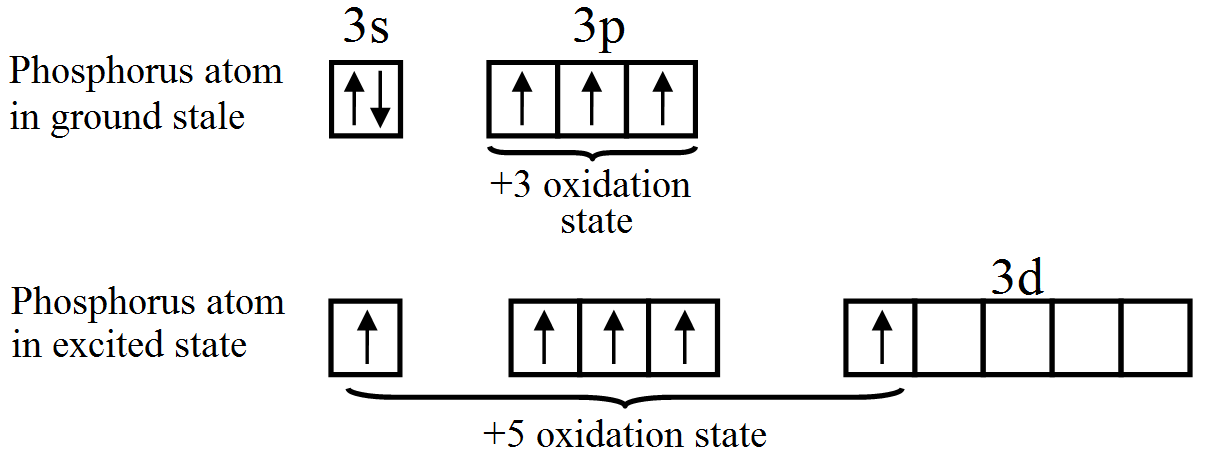
The transition elements show a large number of oxidation states. The various oxidation states are related to the electronic configuration of their atoms. The various oxidation states of a transition metal is due to the involvement of (n-1)d and outer ns electrons in bonding. The lower oxidation state is generally shown when ns electrons participate and higher oxidation states are exhibited when ns and (n - 1)d electrons take part in bonding. For example, manganese, electronic configuration (n - 1) d5 ns2, can show +2, +3, +4, +6 and +7 oxidation states. In the first five elements of the first transition series, i.e., up to manganese, the maximum oxidation state is equal to the sum of 4s and 3d electrons. For remaining five elements, the maximum state is not related to their electronic configurations. The non-transition elements mainly the p-block elements can show a number of oxidation states from +n to (n - 8) where n is the number of electrons present in the outermost shell. For example, phosphorus can show -3, +3 and +5 oxidation states while sulphur can show -2, +2, +4 and +6 oxidation states. Iodine can show -1, +1, +3, +5 and +7 oxidation states. Lower oxidation states are ionic as the atom accepts the electron or electrons to achieve stable configuration while higher oxidation states are achieved by unpairing the paired orbitals and shifting the electrons to vacant d-orbitals.

Need a full question paper?

Generate a complete, print-ready paper with questions like this in minutes — across 16+ boards, with answer keys.

Start Generating Free

Similar questions

What is meant by the term average bond enthalpy? Why there is difference in bond enthalpy of O–H bond in ethanol (C2H5OH) and water?
1. Write all structural isomers of molecular formula $C _3 H _6 O$
2. Write resonance structures of $CH _3 COO ^{-}$and show the movement of electrons by curved arrows.
What is Gibbs energy? How does this explain spontaneity?
Compare the relative stability of the following species and indicate their magnetic properties;

$\text{O}_2,\text{O}_2^+,\text{O}^-_2$ (superoxide), $\text{O}^{2-}_2$ (peroxide)

Each first element of a group differs in properties with other members of group. Explain the statement with reason.
or
In second period there is a difference between properties of elements. Why?
The ionization constant of dimethylamine is 5.4 × 10⁻⁴. Calculate its degree of ionization in its 0.02M solution. What percentage of dimethylamine is ionized if the solution is also 0.1M in NaOH?
Match Column I with Column II.
 
Column I
 
Column II
(i)
Dumas method.
(a)
AgNO3
(ii)
Kjeldahl’s method.
(b)
Silica gel.
(iii)
Carius method.
(c)
Nitrogen gas.
(iv)
Chromatography
(d)
Free radicals.
(v)
Homolysis
(e)
Ammonium sulphate.
What is the minimum volume of water required to dissolve 1g of calcium sulphate at 298K? (For calcium sulphate, Ksp is 9.1 × 10⁻⁶).
The ionization constant of acetic acid is 1.74 × 10⁻⁵. Calculate the degree of dissociation of acetic acid in its 0.05M solution. Calculate the concentration of acetate ion in the solution and its pH.
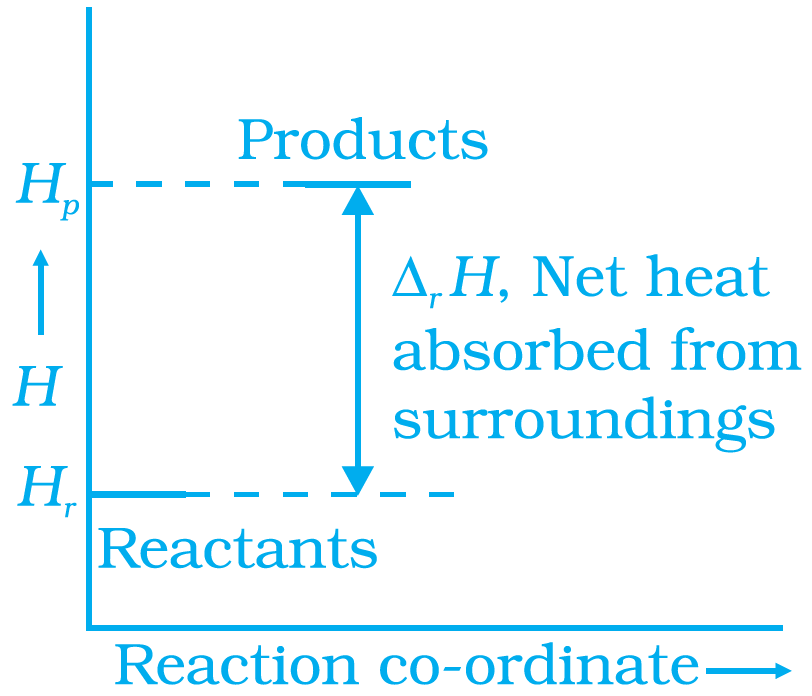
Enthalpy diagram for a particular reaction is given in Fig. Is it possible to decide spontaneity of a reaction from given diagram. Explain.