Question
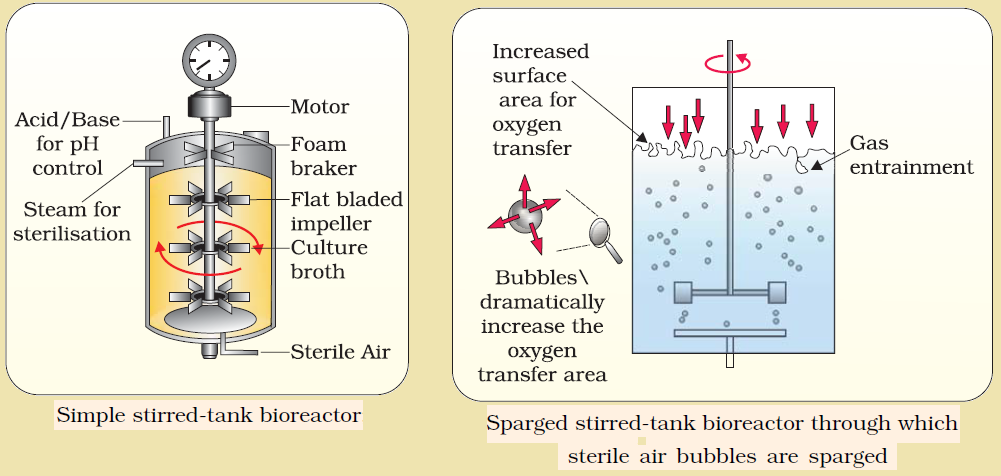
Illustrate the design of a bioreactor. Highlight the difference between a flask in your laboratory and a bioreactor which allows cells to grow in a continuous culture system.
Answer

Small volume cultures cannot yield appreciable quantities of products. To produce in large quantities, the development of bioreactors, where large volumes (100-1000 litres) of culture can be processed, was required. Thus, bioreactors can be thought of as vessels in which raw materials are biologically converted into specific products, individual enzymes, etc., using microbial plant, animal or human cells. A bioreactor provides the optimal conditions for achieving the desired product by providing optimum growth conditions (temperature, pH, substrate, salts, vitamins, oxygen).

Structure of Bioreactor:

  • It is a cylindrical structure with a curved base.
  • A stirrer is present for even mixing and oxygen availability throughout the reactor.
  • There is an agitator system, an oxygen delivery system, a foam control system, a temperature control system, etc.
  • There is a sampling port through which small volumes of culture can be taken out periodically.

A flask in a laboratory cannot be used for producing recombinant DNA on large scale. Unlike a bioreactor; a flask cannot be used to grow culture continuously.

Difference:

 
Flask
 
Bioreactor
i.
Flask is used to small laboratory scale testing of a culture.
i.
Bioreactor is used for commercial scale production.
ii.
The cells harbouring cloned genes of interest may be grown on a small scale in the laboratory.
ii.
The cells can also be multiplied in a continuous culture system wherein the used medium is drained out from one side while fresh medium is added from the other to maintain the cells in their physiologically most active log/ exponential phase. This type of culturing method produces a larger biomass leading to higher yields of desired protein.
iii.
Small volume cultures cannot yield appreciable quantities of products.
iii.
To produce in large quantities, the development of bioreactors, where large volumes (100–1000 litres) of culture can be processed, was required.


Need a full question paper?

Generate a complete, print-ready paper with questions like this in minutes — across 16+ boards, with answer keys.
Start Generating Free

Similar questions

Explain the post pollination events up to double fertilisation, that occur in an angiosperm.
Why should biological control of pests and pathogens be preferred to the conventional use of chemical pesticides? Explain how the following microbes act as biocontrol agents:
  1. Bacillus thuringiensis.
  2. Nucleopoly hedrovirus.
Ramesh visited a National Park on a school trip where he saw tiger eating a deer. He got disturbed and asked his teacher why is he doing so. His teacher replied that it is natural population controlling phenomenon.
  1. Which type of interspecific interaction is found between tiger and deer?
  2. State the role of predators.
  3. What other type of population interactions are seen in nature?
  4. State the values of Ramesh towards animals.
Answer the following questions:

Given below is the T.S. of human ovary. Identify the following in the diagram:

  1. Corpus luteum.
  2. Secondary oocyte.
  3. Antrum.
  4. Primary follicle.
  5. Blood vessels.
Answer the following questions with respect to recombinant DNA technology:
i. Why is plasmid considered to be an important tool in rDNA technology? From where can plasmids be isolated? (Any two sources)
ii. Explain the role of ori and selectable marker in a cloning vector.
iii. r-DNA technology cannot proceed without restriction endonuclease. Justify.
  1. Give reasons for:
  1. Both strands of DNA are not copied during transcription.
  2. Transcription and translation in bacteria can be coupled.
  1. Differentiate between the process of transcription in prokaryotes and eukaryotes.
What evidence for biological evolution is obtained from, comparative anatomy? Describe in detail
Answer the following questions:
Draw a Graafian follicle and label antrum and secondary oocyte.
Make a list of any three outbreeding devices that flowering plants have developed and explain how they help to encourage cross-pollination.
The relation between species richness and area for a wide variety of taxa turns out to be a rectangular hyperbola. Give a brief explanation.