Question
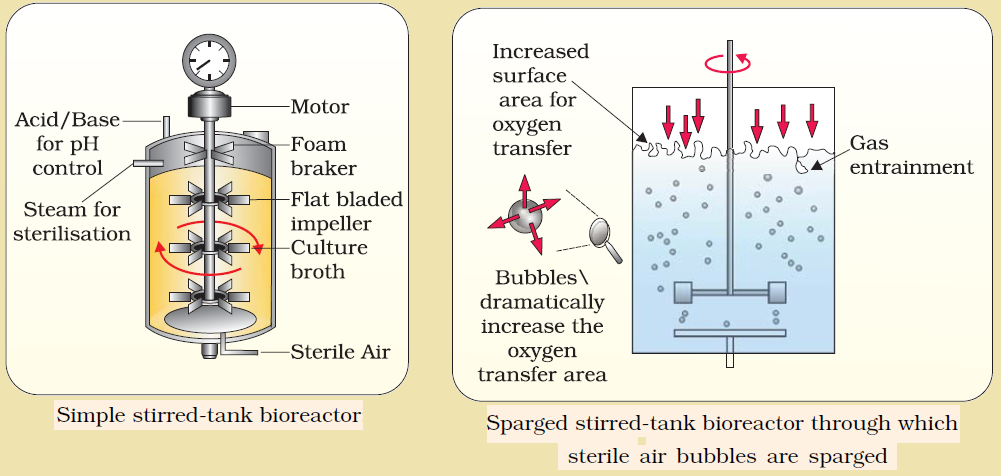
Illustrate the design of a bioreactor. Highlight the difference between a flask in your laboratory and a bioreactor which allows cells to grow in a continuous culture system.
Answer

Small volume cultures cannot yield appreciable quantities of products. To produce in large quantities, the development of bioreactors, where large volumes (100-1000 litres) of culture can be processed, was required. Thus, bioreactors can be thought of as vessels in which raw materials are biologically converted into specific products, individual enzymes, etc., using microbial plant, animal or human cells. A bioreactor provides the optimal conditions for achieving the desired product by providing optimum growth conditions (temperature, pH, substrate, salts, vitamins, oxygen).
Structure of Bioreactor:
  • It is a cylindrical structure with a curved base.
  • A stirrer is present for even mixing and oxygen availability throughout the reactor.
  • There is an agitator system, an oxygen delivery system, a foam control system, a temperature control system, etc.
  • There is a sampling port through which small volumes of culture can be taken out periodically.
A flask in a laboratory cannot be used for producing recombinant DNA on large scale. Unlike a bioreactor; a flask cannot be used to grow culture continuously.
Difference:
 
Flask
 
Bioreactor
i.
Flask is used to small laboratory scale testing of a culture.
i.
Bioreactor is used for commercial scale production.
ii.
The cells harbouring cloned genes of interest may be grown on a small scale in the laboratory.
ii.
The cells can also be multiplied in a continuous culture system wherein the used medium is drained out from one side while fresh medium is added from the other to maintain the cells in their physiologically most active log/ exponential phase. This type of culturing method produces a larger biomass leading to higher yields of desired protein.
iii.
Small volume cultures cannot yield appreciable quantities of products.
iii.
To produce in large quantities, the development of bioreactors, where large volumes (100–1000 litres) of culture can be processed, was required.

Need a full question paper?

Generate a complete, print-ready paper with questions like this in minutes — across 16+ boards, with answer keys.
Start Generating Free