Question
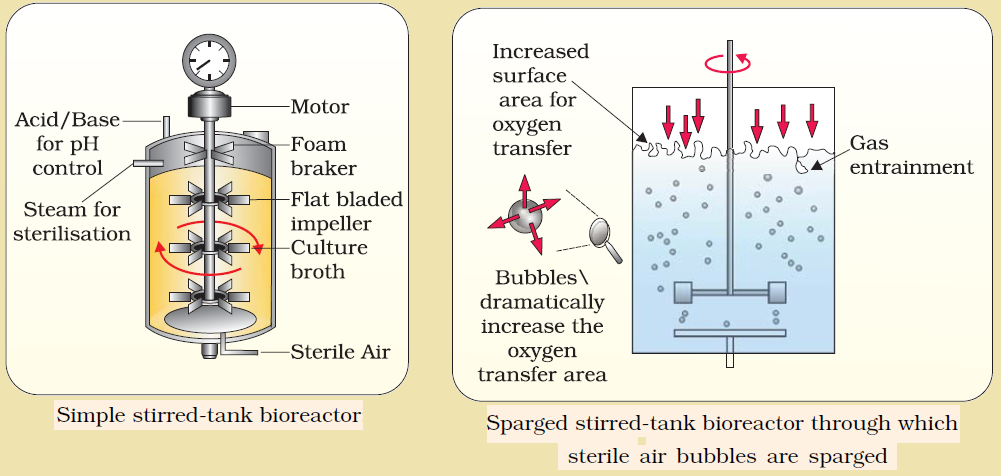
Illustrate the design of a bioreactor. Highlight the difference between a flask in your laboratory and a bioreactor which allows cells to grow in a continuous culture system.
Answer

Small volume cultures cannot yield appreciable quantities of products. To produce in large quantities, the development of bioreactors, where large volumes (100-1000 litres) of culture can be processed, was required. Thus, bioreactors can be thought of as vessels in which raw materials are biologically converted into specific products, individual enzymes, etc., using microbial plant, animal or human cells. A bioreactor provides the optimal conditions for achieving the desired product by providing optimum growth conditions (temperature, pH, substrate, salts, vitamins, oxygen).
Structure of Bioreactor:
  • It is a cylindrical structure with a curved base.
  • A stirrer is present for even mixing and oxygen availability throughout the reactor.
  • There is an agitator system, an oxygen delivery system, a foam control system, a temperature control system, etc.
  • There is a sampling port through which small volumes of culture can be taken out periodically.
A flask in a laboratory cannot be used for producing recombinant DNA on large scale. Unlike a bioreactor; a flask cannot be used to grow culture continuously.
Difference:
 
Flask
 
Bioreactor
i.
Flask is used to small laboratory scale testing of a culture.
i.
Bioreactor is used for commercial scale production.
ii.
The cells harbouring cloned genes of interest may be grown on a small scale in the laboratory.
ii.
The cells can also be multiplied in a continuous culture system wherein the used medium is drained out from one side while fresh medium is added from the other to maintain the cells in their physiologically most active log/ exponential phase. This type of culturing method produces a larger biomass leading to higher yields of desired protein.
iii.
Small volume cultures cannot yield appreciable quantities of products.
iii.
To produce in large quantities, the development of bioreactors, where large volumes (100–1000 litres) of culture can be processed, was required.

Need a full question paper?

Generate a complete, print-ready paper with questions like this in minutes — across 16+ boards, with answer keys.

Start Generating Free

Similar questions

Describe about the physiological effects and applications of cytokinin.
Describe, in brief, an account of disorders of adrenal gland.
How were simple organic molecules formed on the earth?
A flower of tomato plant following the process of sexual reproduction produce 240 viable seeds.
Answer the following questions giving reasons:
How many male gametes were involved in this case?
Long Answer Questions: Pleiotropy.
Read the following and answer any four questions from (i) to (v) given below:
Crown gall is a neoplastic disease of most dicotyledonous plants and is caused by the soil bacterium Agrobacterium tumefaciens. A large extra chromosomal plasmid in these bacteria was found to be responsible for this disease. The plasmid is known as Ti plasmid. Bacteria free crown gall cells can be cultured in the absence of phytohormones. Ti plasmid is widely used in genetic engineering to deliver the desirable genes. The part of Ti plasmid transferred into plant cell DNA is called T-DNA. T-DNA with desired DNA segment is inserted into the chromosome of the host plant where it produces copies of itself.
  1. Which of the following is the full full of T-DNA?
  1. Transfer DNA.
  2. Tumour inducing DNA.
  3. Transgenic DNA.
  4. None of these.
  1. Ti plasmid cannot infect and develop crown gall in,
  1. Tomato.
  2. Maize.
  3. Soybean.
  4. sunflower.
  1. While making transgenic plant, T-DNA is inserted into the host cell, it is then:
  1. Integrated into the target host genome.
  2. Lie independent of the host genome.
  3. Rupture the host cell wall.
  4. Produce oncogenic factors in the host.
  1. Agrobacterium mediated gene transfer in plants:
  1. Allows relatively large segment of DNA.
  2. Transfer of DNA with defined ends and minimal rearrangement.
  3. High quality and fertility in transgenic plants.
  4. All of these.
  1. Assertion: In Agrobacterium mediated gene transfer in plants, transgenic plants do not develop tumors.
Reason: In T-DNA tumor producing genes are deleted during the process of gene transfer.
  1. Both assertion and reason are true and reason is the correct explanation of assertion.
  2. Both assertion and reason are true but reason is not the correct explanation of assertion.
  3. Assertion is true but reason is false.
  4. Both assertion and reason are false.
Parasympathetic nervous system.
Answer the following questions:
Give a schematic representation of oogenesis in human female indicating the chromosomal number at each step. Mention at what stage of female life does each phase occur.
Distinguish between : Active absorption and Passive absorption.
Give the term/ reason:
Mechanism responsible for parturition.