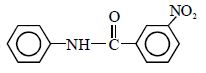
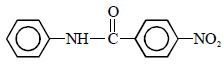
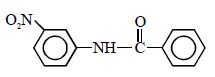
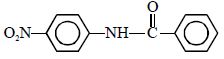
MCQ
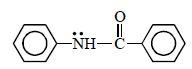
(image) $\xrightarrow{{NO_2^ \oplus }}$ Product is
  • A

  • B

  • C


Answer

Correct option: D.

d

Need a full question paper?

Generate a complete, print-ready paper with questions like this in minutes — across 16+ boards, with answer keys.
Start Generating Free

Similar questions

Colour in transition metal compounds is attributed to:
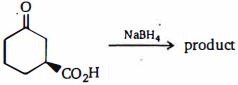
What the major product of the following reaction ?
Potassium chlorate is prepared by electrolysis of $\mathrm{KCl}$ in basic solution as shown by following equation.

$6 \mathrm{OH}^{-}+\mathrm{Cl}^{-} \rightarrow \mathrm{ClO}_{3}^{-}+3 \mathrm{H}_{2} \mathrm{O}+6 \mathrm{e}^{-}$

A current of $x A$ has to be passed for $10 h$ to produce $10.0 \mathrm{~g}$ of potassium chlorate. The value of $\mathrm{x}$ is $.......$ (Nearest integer)

(Molar mass of $\left.\mathrm{KClO}_{3}=122.6 \mathrm{~g} \mathrm{~mol}^{-1}, \mathrm{~F}=96500 \mathrm{C}\right)$

$A$ and $B$ decompose via first order kinetics with half-lives $54.0\, min$ and $18.0\, min$ respectively. Starting from an equimolar non reactive mixture of $A$ and $B$, the time taken for the concentration of $A$ to become $16$ times that of $B$ is ...... $min.$ (Round off to the Nearest Integer).
What must be the concentration of $Ag^+$ in an aqueous solution containing $Cu^{2+} = 1.0\ M$ so that both the metal can be deposited on the cathode simultaneously. Given that $E_{cu/c{u^{2 + }}}^0 =  - 0.34\,V\,$ and $E_{A{g^ + }/Ag}^0 = 0.812\,V,$, $T = 298\,K$
Which of the following is arranged in order of increasing melting point?
In the following reaction $A \longrightarrow B + C$, rate constant is $0.001\, Ms^{-1}$. If we start with $1\, M$ of $A$ then concentration of $A$ and $B$ after $10\, minutes$ are respectively
Conc. $H_2SO_4$ cannot be used to prepare $HBr$ from $NaBr$ because it :
Consider the following sequence of reaction.$Na+N{{H}_{3}}\left( g \right)\to \left[ X \right]\xrightarrow{{{N}_{2}}O}\left[ Y \right]\xrightarrow{Heat}\underset{Gas\,Pure}{\mathop{\left[ Z \right]}}\,$ Identify $[Z]$ gas
When propionamide reacts with $Br_2$ in the presence of alkali the product is :