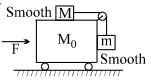
Imagine $a$ situation in which the horizontal surface of block $M_0$ is smooth and its vertical surface is rough with $a$ coefficient of friction $\mu$ Consider a special situation in which both the faces of the block $M_0$ are smooth, as shown in adjoining figure. Mark out the correct statement $(s)$
Difficult
Download our app for free and get started

Download our appand get started for free
Experience the future of education. Simply download our apps or reach out to us for more information. Let's shape the future of learning together!No signup needed.*
Similar Questions
- 1View SolutionThe limiting value of static friction between two contact surfaces is ...........
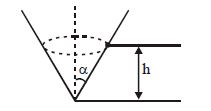
- 2A particle is describing circular motion in a horizontal plane in contact with the smooth inside surface of a fixed right circular cone with its axis vertical and vertex down. The height of the plane of motion above the vertex is $h$ and the semivertical angle of the cone is $\alpha $ . The period of revolution of the particleView Solution
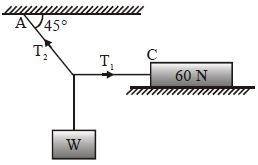
- 3In the figure, a block of weight $60\, N$ is placed on a rough surface. The coefficient of friction between the block and the surfaces is $0.5$. ........ $N$ should be the maximum weight $W$ such that the block does not slip on the surface .View Solution
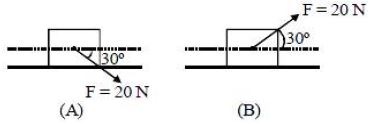
- 4A block of mass $5\, kg$ is $(i)$ pushed in case $(A)$ and $(ii)$ pulled in case $(B)$, by a force $F = 20\, N$, making an angle of $30^o$ with the horizontal, as shown in the figures. The coefficient of friction between the block and floor is $\mu = 0.2$. The difference between the accelerations of the block, in case $(B)$ and case $(A)$ will be ........ $ms^{-2}$ .$(g = 10\, ms^{-2})$View Solution
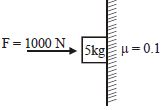
- 5For the given figure, if block remains in equilibrium position then find frictional force between block and wall ........ $N$View Solution
- 6A mass of $2 \,kg$ is whirled in a horizontal circle by means of a string at an initial speed of $5$ revolutions per minute. Keeping the radius constant the tension in the string is doubled. The new speed is nearly ....... $rpm$View Solution
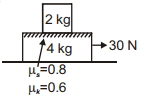
- 7Figure shows two block system, $4 \,kg$ block rests on a smooth horizontal surface, upper surface of $4 \,kg$ is rough. A block of mass $2 \,kg$ is placed on its upper surface. The acceleration of upper block with respect to earth when $4 \,kg$ mass is pulled by a force of $30 \,N$, is ......... $m / s ^2$View Solution
- 8A boy on a cycle pedals around a circle of $20\, metres$ radius at a speed of $20\,metres/\sec .$ The combined mass of the boy and the cycle is $90\, kg$. The angle that the cycle makes with the vertical so that it may not fall is ......... $^o$ $(g = 9.8\,m/{\sec ^2})$View Solution
- 9An isolated rail car originally moving with speed $v_0$ on a straight, frictionles, level track contains a large amount of sand. $A$ release valve on the bottom of the car malfunctions, and sand begins to pour out straight down relative to the rail car. What happens to the speed of the rail car as the sand pours out?View Solution
- 10A stone of mass $0.25\; kg$ tied to the end of a string is whirled round in a circle of radius $1.5 \;m$ with a speed of $40\; rev./min$ in a hortzontal plane. What is the tenston in the string? What is the maximum speed in $m/s $ with which the stone can be whirled around if the string can withstand a maximum tension of $200\; N ?$View Solution